
Knife Knowledge · Materials & Corrosion
Why Stainless Steel Knives Can Still Show Spots, Discoloration, or Corrosion
Visible marks on stainless steel may be drying residue, deposits, heat tint, contamination, or actual metal loss. Buyers should classify the condition, reinspect the surface, and confirm evidence before naming a cause.
Quick answer
“Stainless” describes useful corrosion resistance, not immunity. A stain, water mark, deposit, heat tint, pit, and crevice-related attack are different conditions; photographs alone rarely establish which one is present.
Stainless steel is widely used for kitchen knives because it can offer useful corrosion resistance in food-preparation environments. But “stainless” does not mean that the surface can never develop spots, discoloration, deposits, or localized corrosion.
For importers, distributors, private-label brands, product managers, and quality teams, the more important question is not simply whether a blade “looks rusty.” It is whether the visible condition is a removable surface deposit, a change in the oxide surface, or actual metal loss.
These conditions can look similar in photographs, but they have different causes, different inspection requirements, and different implications for supplier evaluation.
Stainless Steel Corrosion Resistance Depends on Surface Condition and Environment
The corrosion resistance of stainless steel is closely associated with its passive surface condition.
On a clean stainless-steel surface, a thin chromium-rich oxide layer can form naturally when the environment provides suitable conditions for passivation. If the surface is damaged but remains clean and sufficiently exposed to oxygen, the passive condition may also recover.
However, this behavior should not be interpreted as a permanent protective guarantee.
Local conditions can change significantly when the surface is contaminated, covered by deposits, exposed to chlorides, kept wet for extended periods, or located inside a narrow crevice where liquid circulation and oxygen transport are restricted.
Chemical passivation treatment is also different from the natural passive state of stainless steel. ASTM A967/A967M covers chemical passivation treatments for stainless-steel parts, but the standard does not mean that a treated component becomes immune to corrosion in every later environment. Its acceptance tests are tied to specified processing and inspection conditions.
For buyers, this distinction matters. A passivation record can document a specific treatment or acceptance activity, but it should not be treated as proof of unlimited resistance to salt, acids, cleaners, food residues, or storage moisture.
Start With the Visible Condition, Not the Assumed Cause
A spot on a knife blade should first be treated as an observed surface condition rather than a confirmed diagnosis.
Several different phenomena can produce visible marks.
Surface Stains
“Surface stain” is a broad appearance term. It may describe removable contamination, food residue, cleaning residue, deposited particles, heat-related discoloration, or corrosion products.
The term does not identify a corrosion mechanism by itself.
For QC reporting, wording such as “brown surface mark,” “localized discoloration,” or “visible deposit” is usually more precise than immediately labeling the condition as corrosion.
Water Spots and Drying Marks
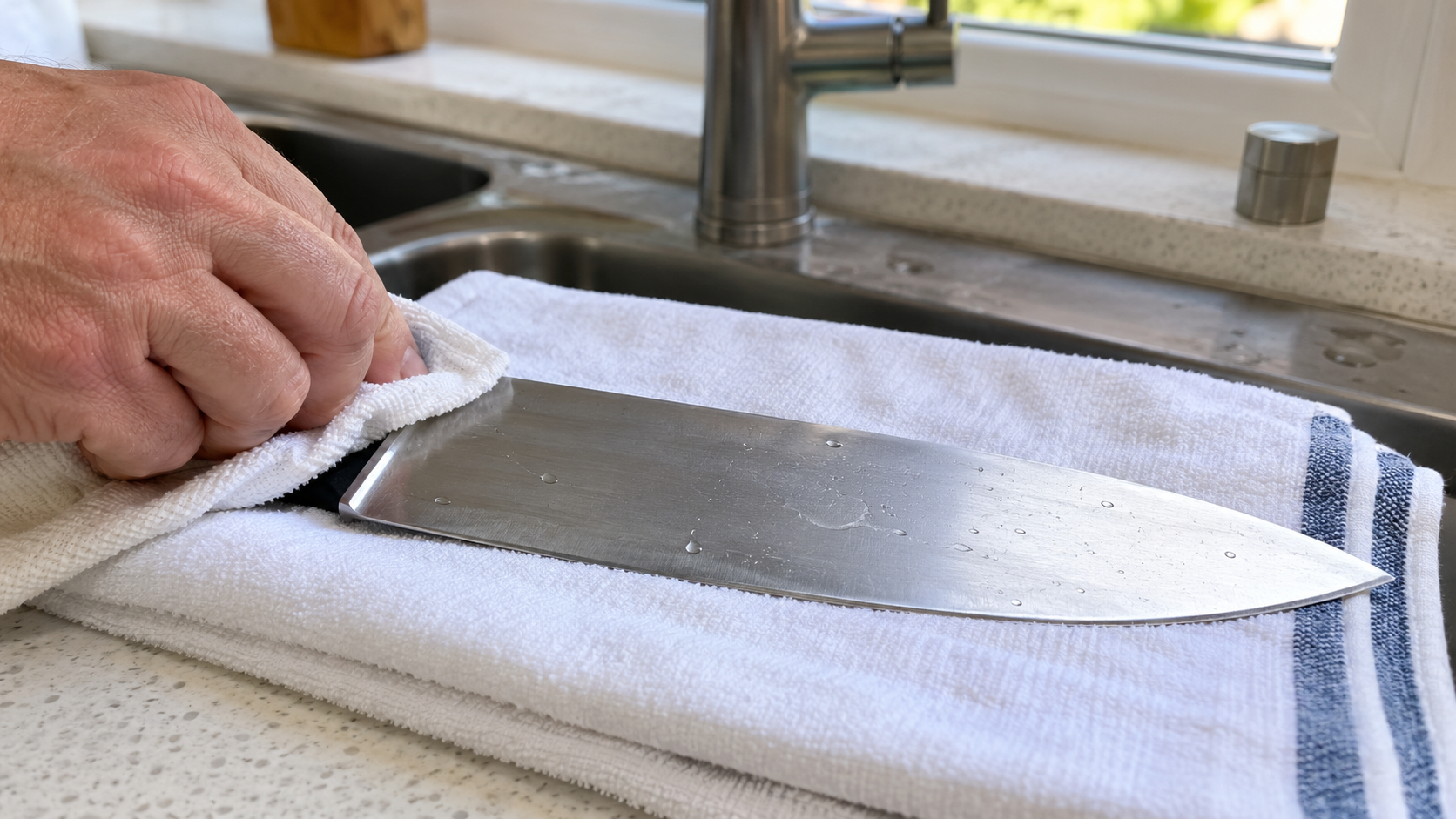
Water can leave visible marks when dissolved material remains on the surface after evaporation.
Hard water, for example, may contain calcium and magnesium compounds. Water used for washing can also carry salts, cleaning chemicals, or other dissolved substances. If droplets dry on the blade, these materials may remain as white, gray, cloudy, or ring-shaped deposits.
This does not automatically mean the stainless steel has lost metal.
At the same time, a removable surface deposit does not prove that the surface underneath is undamaged. If a deposit retains moisture or concentrates dissolved substances beneath it, additional examination may be necessary.
Food-Derived Residues
Pigments, proteins, oils, salts, acids, and other food-derived materials may remain on a blade after use.
However, color alone is usually insufficient to identify a particular food residue. A reddish, yellow, brown, or dark mark cannot reliably be assigned to a specific food or chemical substance from a photograph alone.
Exposure history and controlled cleaning provide more useful evidence than color matching.
Heat Tint
Heating stainless steel in air can change the thickness and optical appearance of its surface oxide layer, producing yellow, brown, purple, blue, or other visible colors.
This phenomenon is commonly described as heat tint or thermal discoloration.
The important limitation is that color does not provide a universal temperature record. The appearance can vary with alloy composition, heating time, atmosphere, original surface finish, and other conditions.
A blue or brown region may therefore be consistent with thermal oxidation, but the color alone cannot establish a unique temperature, processing step, or heat-treatment history.
Surface Deposits and Corrosion Are Not the Same Thing
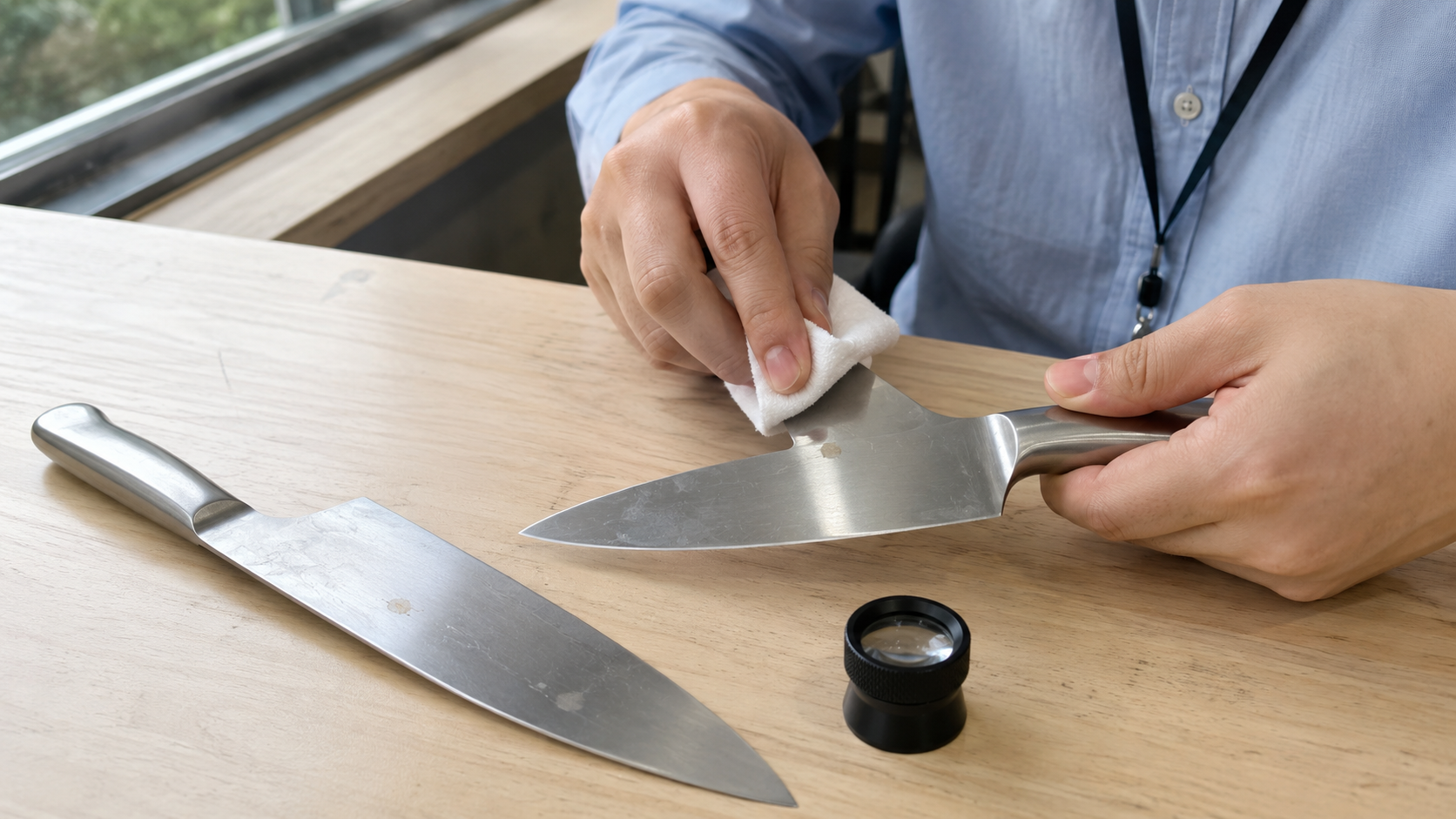
A deposit is foreign material present on the metal surface.
It may consist of minerals, salts, cleaning residues, food-derived material, carbon-steel particles, dust, or other contaminants.
Corrosion, in contrast, involves deterioration of the metal through chemical or electrochemical interaction with the environment.
These can occur separately or together.
A deposit may simply be removable contamination. But under some conditions, a deposit can create a shielded local environment that stays wet longer than the surrounding open surface. This may affect oxygen transport and local chemistry.
For this reason, buyers should distinguish:
- a deposit on the surface;
- corrosion products produced by metal deterioration;
- corrosion occurring underneath or adjacent to a deposit.
The presence of one does not automatically prove the others.
Uniform Corrosion, Pitting, and Crevice Corrosion Should Not Be Grouped Together
The word “rust” is often used loosely in commercial discussions, but several different corrosion forms may need to be considered.
Uniform Corrosion
Uniform or general corrosion involves relatively broad metal loss over a larger surface area.
General dulling, haze, staining, or color change is not sufficient by itself to confirm uniform corrosion. A corrosion-rate evaluation requires a defined method, specimen condition, environment, and exposure period.
ISO 18069, for example, addresses uniform corrosion-rate testing of stainless steels and nickel-based alloys under specified liquid conditions. It is not a general kitchen-knife qualification method and specifically separates uniform corrosion testing from environments that readily cause localized attack.
Pitting Corrosion
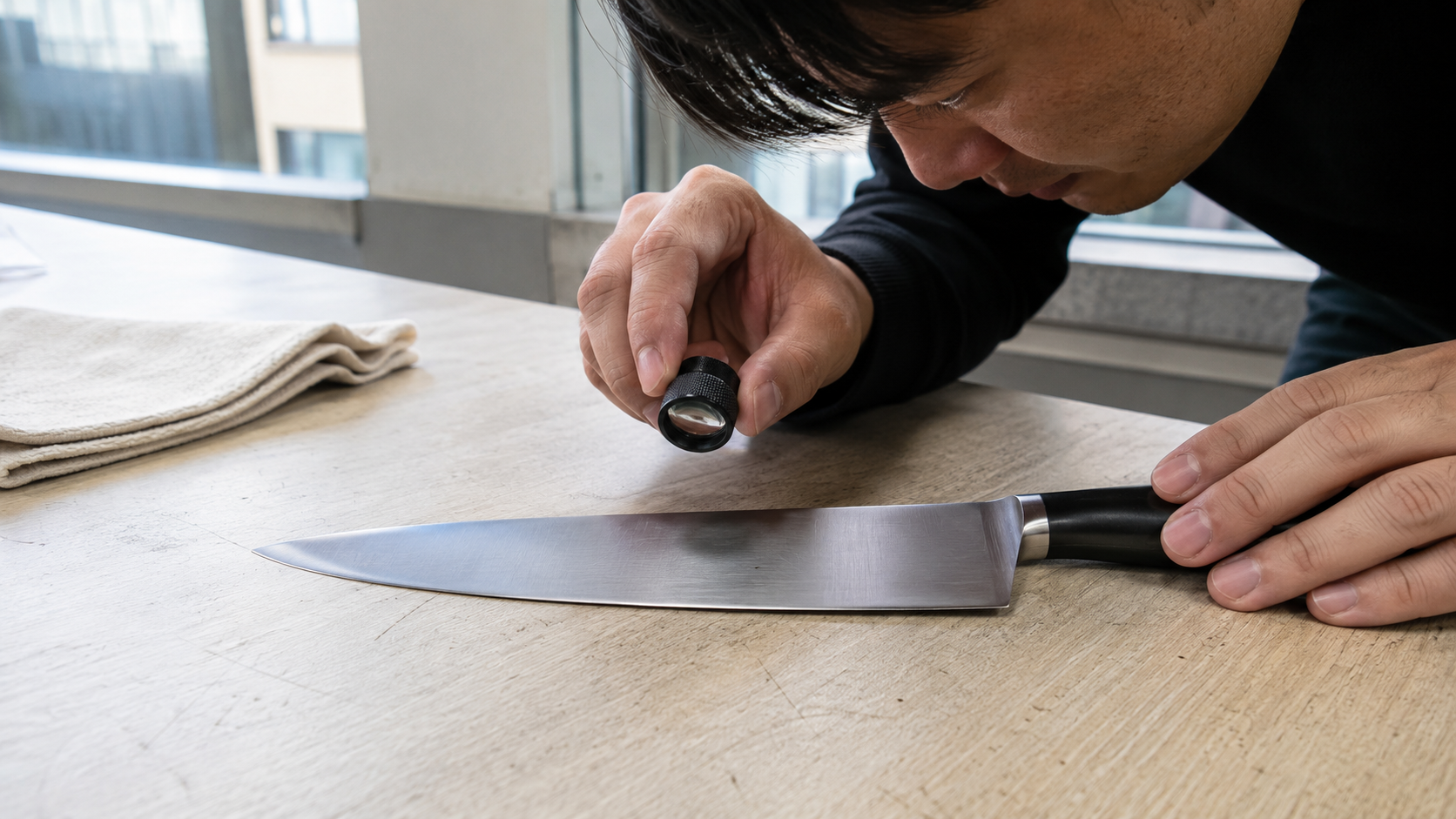
Pitting is localized corrosion that forms cavities extending into the metal.
A dark or orange dot on a blade is not automatically a pit.
It may instead be a particle, deposit, stain, or corrosion product sitting on the surface. Proper evaluation may require controlled cleaning followed by magnified inspection, surface profiling, or other examination.
ASTM G46 and ISO 11463 both emphasize that the identification and evaluation of pitting depend on the purpose of the investigation and the inspection method used.
Crevice Corrosion
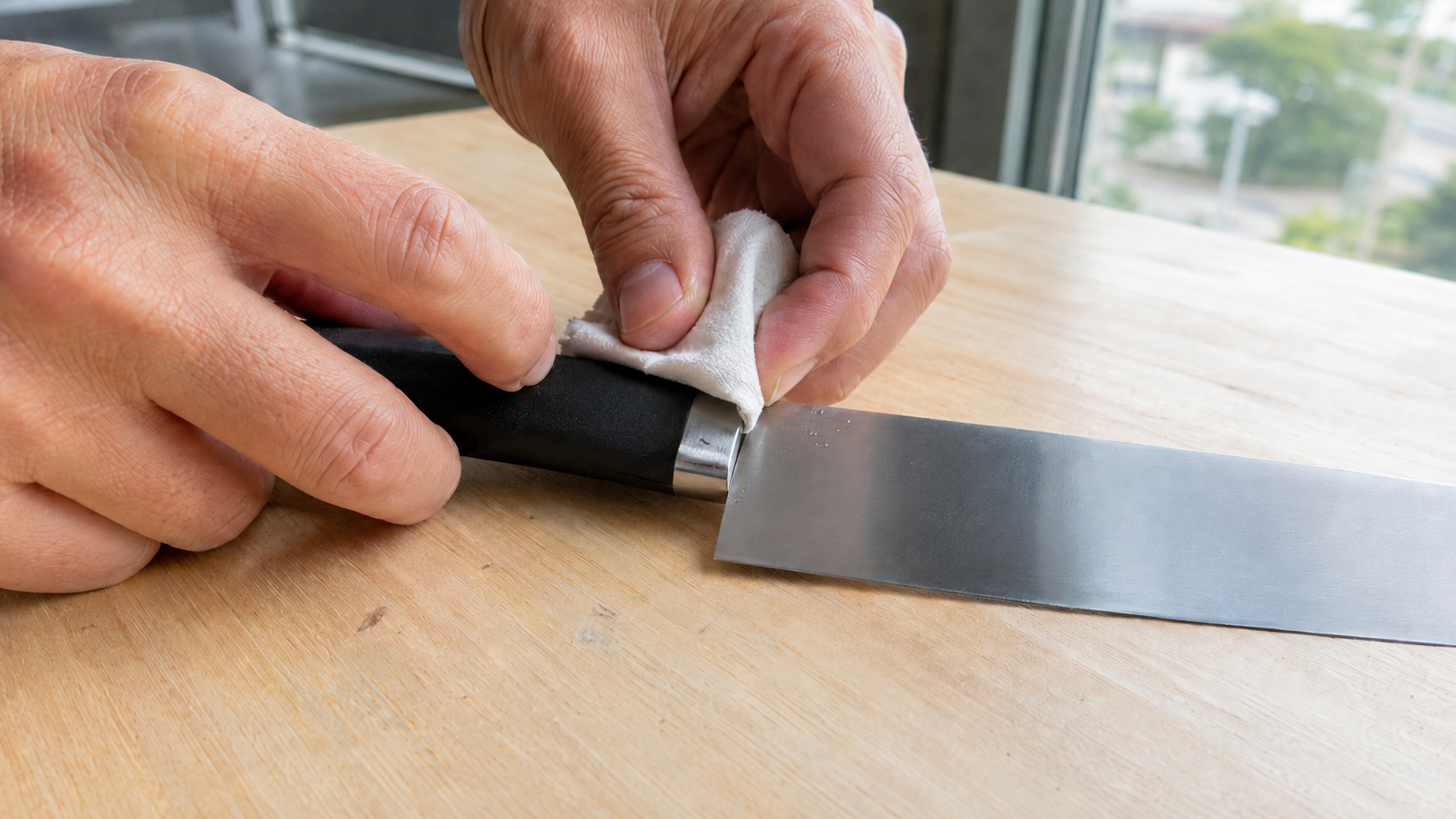
Crevice corrosion can develop in narrow or shielded regions where liquid becomes trapped and mass transfer is restricted.
In a kitchen knife, locations that may justify inspection include joints, overlaps, tight interfaces, covered areas, or regions where residues can remain.
But the existence of a visible joint does not prove that crevice corrosion is occurring.
The local environment must support the process. Relevant factors can include retained moisture, oxygen restriction, chloride accumulation, acidity, temperature, and exposure time.
Chlorides and Salt Can Matter, but There Is No Universal Threshold
Chlorides are widely recognized as important contributors to localized corrosion of stainless steels under certain aqueous conditions.
Possible sources in kitchen and handling environments include:
- salt-containing food residues;
- saline water;
- some cleaning or sanitizing chemicals;
- coastal or transport environments;
- concentrated residues left after evaporation.
But chloride exposure should not be treated as a complete diagnosis.
The response depends on factors such as stainless-steel grade, surface condition, temperature, pH, chloride concentration, exposure time, geometry, deposits, and whether the surface repeatedly dries and rewets.
This is why a universal “safe chloride concentration” for all kitchen knives would be misleading.
ASTM G48 uses controlled ferric-chloride test environments to compare resistance to localized corrosion initiation. Results from that method apply to the specified test conditions and specimens. They should not be converted directly into real-world service life, performance in chloride-free environments, or a universal ranking of finished knives.
Acidic Residues Also Require Context
Low-pH conditions can influence corrosion behavior, but “acidic” is too broad a description to establish cause.
Different acids behave differently. Concentration, temperature, exposure time, chloride content, oxygen conditions, steel composition, and surface state may all change the result.
For the same reason, statements such as “acidic foods corrode stainless steel knives” are too general for a technical B2B article.
A more accurate approach is to record the actual exposure:
- what substance contacted the blade;
- approximate concentration if known;
- how long it remained;
- whether the surface was rinsed;
- whether it stayed wet afterward;
- what material and surface condition were involved.
Water and Long-Term Moisture Are Exposure Conditions, Not Complete Root Causes
Water is often part of a corrosion environment because it can act as an electrolyte and transport dissolved substances.
However, the presence of water alone does not establish why a particular mark formed.
The important conditions may include what the water contained, whether evaporation concentrated salts, how long the surface remained wet, whether a narrow joint retained liquid, and whether deposits were present.
For packaging and storage investigations, prolonged moisture or condensation can therefore be relevant, but it should be documented as an exposure condition rather than reported as a confirmed corrosion mechanism without further evidence.
Cleaning Agents Must Be Evaluated by Their Actual Chemistry and Use Conditions
“Cleaner,” “detergent,” “sanitizer,” and “dishwasher chemical” are not single material categories.
Their effects can vary considerably depending on:
- formulation;
- concentration;
- temperature;
- contact time;
- rinse procedure;
- repeated exposure;
- compatibility with the specific stainless steel and finished knife construction.
Some chloride-containing or strongly acidic cleaning environments may create unfavorable conditions for stainless steel, but this should not be expanded into a claim that all detergents or all dishwasher cycles cause pitting.
When a cleaning chemical is suspected in a complaint investigation, the correct evidence is the exact product identity, supplier instructions or safety documentation, dilution conditions, temperature, contact time, and rinse history.
Dissimilar Metals Require Two Different Questions
When different metals are involved, two mechanisms are often confused.
Galvanic Corrosion
Galvanic corrosion requires dissimilar metals to be electrically connected while an electrolyte provides an ionic path.
Simply finding two different metals near each other does not prove a galvanic mechanism.
The actual metal pair, area relationship, electrical contact, environment, moisture exposure, and location of deterioration all matter.
Iron Contamination
A separate issue is contamination from carbon steel or free iron.
Steel tools, wire brushes, grinding particles, or other ferrous contamination can leave small particles on stainless steel. In a damp environment, those particles may rust and create orange-brown marks.
This means a rust-colored spot on stainless steel does not automatically prove that the stainless-steel substrate itself is the original source of the corrosion product.
Controlled cleaning and further inspection may be required.
Surface Scratches and Finish Should Not Be Oversimplified
Surface condition can influence corrosion testing and localized corrosion behavior, but this relationship is not adequately described by saying that “rough surfaces rust” or that “polished surfaces do not.”
Grinding direction, roughness, embedded particles, inclusions, scratches, passive-film condition, alloy composition, and test environment may interact.
Research on specific stainless-steel grades has shown that surface preparation can influence pitting initiation under controlled laboratory conditions. Those findings remain specific to the alloy, specimen preparation, inclusions, electrolyte, and test method used.
They should not be converted into a universal claim that every scratch on a kitchen knife causes corrosion.
What a Photograph Can Tell a Buyer
Photographs are useful evidence, particularly when they are taken before cleaning.
A good inspection record can document:
- color and general appearance;
- number and distribution of marks;
- whether marks are isolated or widespread;
- exact location on the blade or handle assembly;
- whether the issue appears near a joint, marking, grind line, or packaging contact point;
- whether multiple samples show similar patterns;
- how the condition changes after controlled cleaning.
Consistent lighting, scale references, sample identification, and before-and-after images can make these records more useful.
What a Photograph Usually Cannot Confirm
A photograph normally cannot establish:
- the chemical composition of a residue;
- whether an orange particle originated from carbon steel or the blade substrate;
- pit depth;
- subsurface pit geometry;
- exact alloy identity;
- passive-film chemistry;
- exact chloride concentration;
- pH during exposure;
- precise heat-treatment or overheating temperature;
- galvanic current or mechanism;
- corrosion rate;
- remaining product life;
- regulatory compliance.
ISO 23721 uses reference photographs for qualitative rating of rust and staining on stainless steel exposed to atmospheric corrosion conditions. That demonstrates that visual comparison can be useful for standardized appearance assessment, but it should not be interpreted as a root-cause method for kitchen knives.
A Practical Buyer-Supplier Investigation Sequence
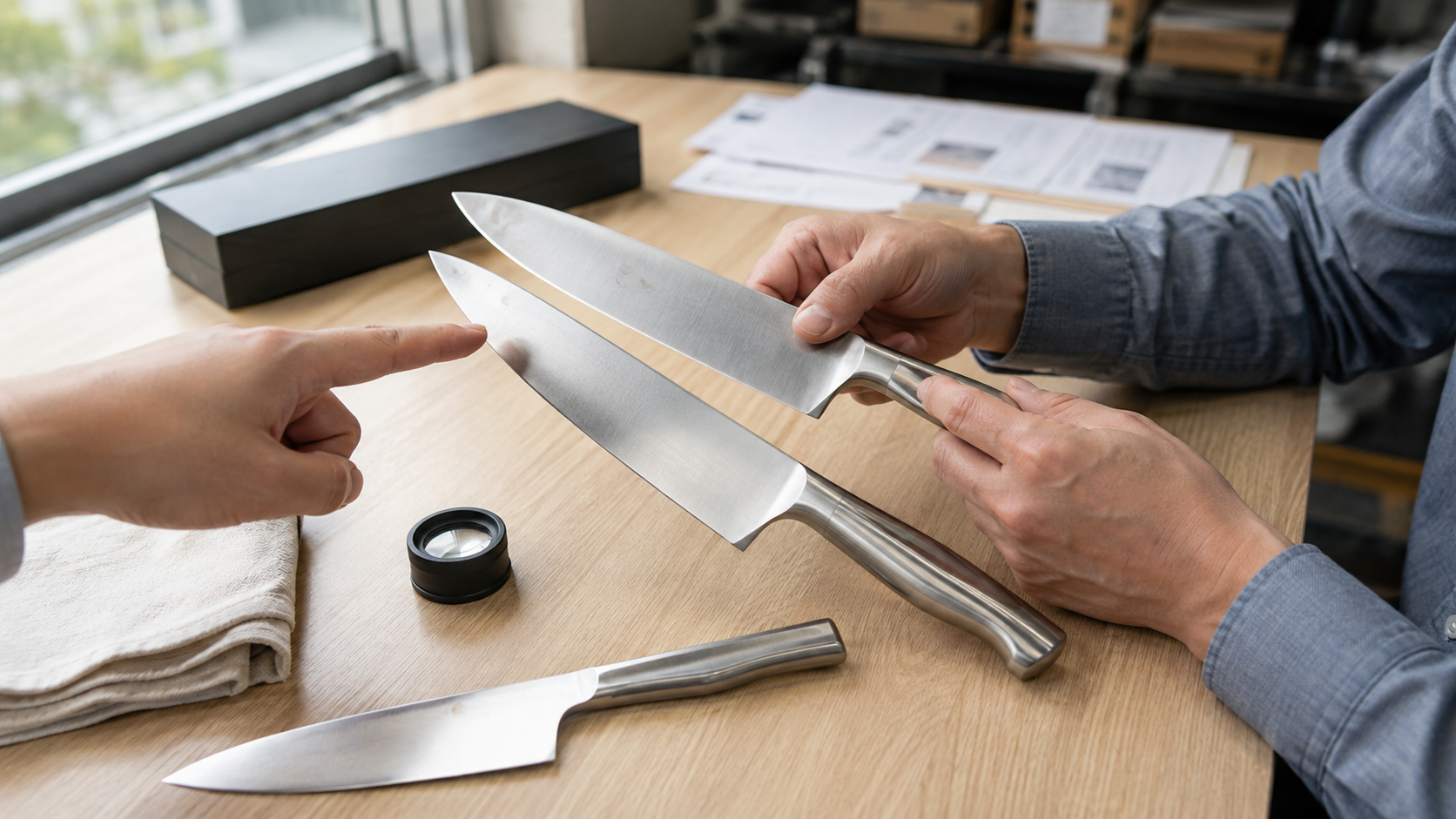
When an importer or QC team encounters unexplained blade spots, a structured investigation is more useful than immediately assigning a cause.
1. Preserve the Initial Condition
Do not clean every affected sample before documentation.
Record:
- batch and sample identity;
- carton and packaging condition;
- storage history;
- transport moisture or condensation if known;
- food exposure;
- cleaning and sanitizing history;
- water exposure;
- salt or chemical exposure;
- approximate wet time.
2. Photograph Before Cleaning
Take overall and macro photographs under consistent lighting.
Record the exact location of each condition.
3. Use a Controlled Cleaning Step
Use a cleaning method appropriate for the specific product and material.
Avoid undocumented acids, aggressive abrasives, or improvised chemical treatments because they may alter the evidence.
Record whether the mark:
- transfers to a cloth;
- dissolves;
- remains raised;
- changes color;
- disappears;
- reveals a surface cavity underneath.
4. Reinspect the Surface
If the mark remains or a cavity is visible, magnified inspection may help determine whether the issue is a surface residue or possible localized metal loss.
5. Review Material and Process Evidence
Where the commercial significance justifies escalation, buyers may need to review:
- material grade and batch documentation;
- surface-finishing records;
- final cleaning records;
- passivation records where applicable;
- packaging conditions;
- supplier inspection data.
6. Escalate to Laboratory Analysis When Necessary
If the root cause matters for a supplier dispute, recurring batch issue, corrective action, or product specification, laboratory examination may be required.
Possible questions include:
- What is the residue made of?
- Is a cavity present?
- How deep is it?
- Is the material loss associated with an inclusion, deposit, joint, or external contamination?
- Are multiple samples affected in the same way?
The appropriate method should be selected according to the question being investigated.
Report the Evidence Before Reporting the Cause
For B2B quality communication, the strongest reports separate four levels of information:
- Observed condition — what is visibly present.
- Confirmed evidence — what cleaning, inspection, records, or analysis established.
- Possible mechanism — what is technically consistent with the evidence.
- Confirmed root cause — what the full investigation can support.
This distinction helps prevent a visual observation from becoming an unsupported material, process, or supplier conclusion.
A brown spot may be removable contamination. It may be an external iron particle. It may cover a corrosion pit. It may also involve more than one mechanism.
The investigation should determine which interpretation is supported.
Conclusion
Stainless steel can develop spots, discoloration, deposits, or corrosion when material condition, surface state, chemistry, geometry, moisture, and exposure time interact.
For kitchen-knife buyers, the key is not to assume that every visible mark is corrosion—or that every removable stain is harmless.
A useful evaluation follows three steps:
classify the visible condition, determine whether metal loss is present, and then investigate the material, environment, and process evidence needed to explain the result.
That approach produces more reliable supplier discussions, inspection records, and product specifications than diagnosing a blade from color or photographs alone.
References
- ASTM International. ASTM A380/A380M — Cleaning, descaling and passivation of stainless steel.
- ASTM International. ASTM G150-18(2024) — Critical pitting temperature testing of stainless steels.
Scope note: These sources support the general principles discussed here; they do not prove the material, performance, compliance, or production history of any specific Tastiva product. Links last checked August 24, 2026.
Continue exploring practical knife specifications and buyer guidance.View all News →