
Knife Knowledge · Geometry & Manufacturing
Forged vs. Stamped Kitchen Knives: Manufacturing Routes, Structural Clues, and Buyer Misconceptions
Forged and stamped describe manufacturing routes, not universal quality grades. Buyers should verify how the blank was formed, what downstream processes followed, and what product-specific evidence supports performance claims.
Quick answer
Forging and stamping describe how the blank begins, not the final quality grade. Finished performance depends on steel identity, heat treatment, grinding, geometry, tang and handle construction, surface finish, and process control; buyers should verify those attributes directly.
For kitchen-knife buyers, “forged” and “stamped” are often treated as shorthand for product quality. A forged knife may be assumed to be heavier, stronger, or more durable, while a stamped knife may be associated with lighter construction or a lower market position.
That distinction is too simple for specification work.
From a manufacturing perspective, forging, stamping, blanking, laser cutting, grinding, machining, and heat treatment describe different operations. A finished kitchen knife can pass through several of them, and the method used to create the initial blade blank does not by itself determine the final blade geometry, tang construction, bolster design, weight, hardness, or cutting performance.
For importers, brands, product managers, and quality teams, a more useful question is not simply:
“Is this knife forged or stamped?”
It is:
“How was the blank formed, what happened afterward, and what documentation supports the stated construction?”
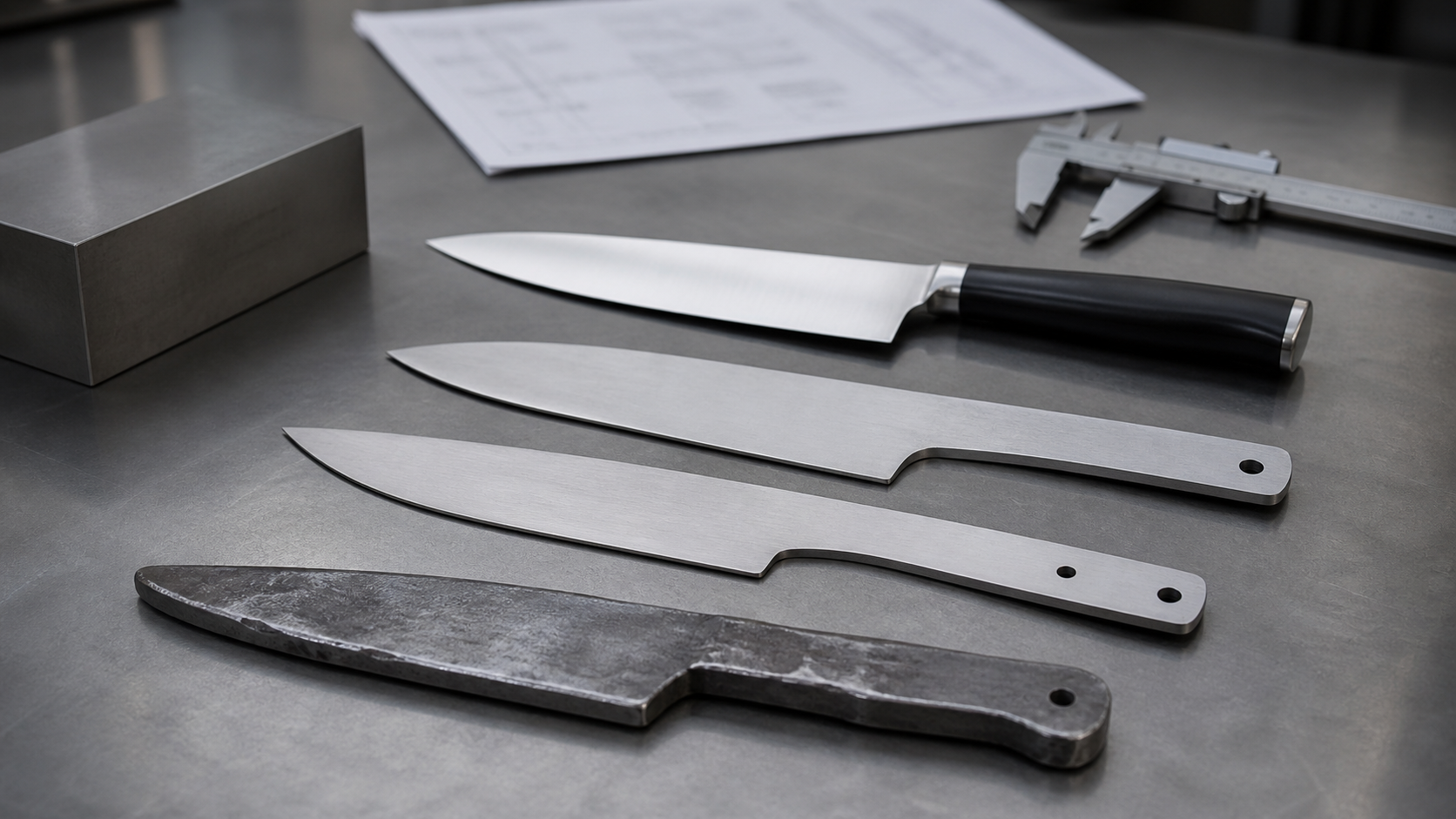
What “Forging” Means
In general metalworking terminology, forging involves shaping metal through compressive deformation. Depending on the process, this may involve hot forging, cold forging, hammer forging, press forging, die forging, or localized upset forging.
This matters because the commercial term “forged knife” does not necessarily describe one identical production route.
In one process, a substantial portion of the blade blank may be heated and formed in dies. In another, deformation may be concentrated around a particular region, such as the bolster area. Subsequent trimming, machining, grinding, heat treatment, and finishing may still be required.
This is an important distinction for procurement teams. A statement such as “forged construction” should ideally be accompanied by clarification of:
- which part of the blank was forged;
- whether forging was local or extended across a larger portion of the blank;
- what starting material form was used;
- which later machining and grinding operations followed.
Forging should therefore be treated as a manufacturing-process description, not as a complete product specification.
Stamping and Blanking Are Not Exactly the Same Term
“Stamping” is another term that is frequently simplified in knife marketing.
In general manufacturing terminology, sheet-metal stamping is a broad family of press-and-die operations. It may include blanking, punching, bending, coining, embossing, and other forming operations.
Blanking is more specific. In a blanking operation, a punch and die shear a shaped piece from sheet or strip material, and the separated piece becomes the workpiece.
For a kitchen-knife buyer, this distinction can be useful because the phrase “stamped knife” may not tell you exactly how the blade profile was produced.
A supplier could be referring to a die-blanked blade. In some commercial knife literature, however, the same general category may also include blades whose outlines are laser-cut from flat stock.
That is why a purchase specification should avoid relying on “stamped” as the only process description.
A more precise question is:
- Was the blank die-blanked?
- Was it laser-cut?
- Was it waterjet-cut?
- Was another cutting method used?
- Was any subsequent coining, forming, or localized forging performed?
These questions describe the actual route more clearly than a single market label.
Why “Laser-Cut” and “Stamped” Can Appear Together
Commercial terminology does not always follow strict manufacturing taxonomy.
Some established knife manufacturers describe products as “stamped” while also identifying their manufacturing method as laser cutting. Others use terms such as “laser-cut,” “non-forged,” and “stamped” within the same product family.
This does not mean that laser cutting and die blanking are technically the same operation.
It demonstrates that “stamped knife” is sometimes used commercially as a broader category for a blade made from flat stock rather than one formed through forging.
For buyers comparing quotations from different suppliers, this creates a terminology risk. Two suppliers may both offer a “stamped chef knife” while using different blank-forming equipment and different downstream processes.
A specification should therefore record the actual operation rather than assume that the market term has a universal definition.
What Is Stock Removal?
“Stock removal” is another common expression in knife manufacturing, but it should also be used carefully.
In practical knife-making language, stock removal generally describes a route in which material is progressively removed from existing sheet, plate, bar, or a previously produced blank until the required blade form and geometry are achieved.
The route may involve operations such as:
- laser cutting;
- sawing;
- milling;
- surface grinding;
- belt grinding;
- edge grinding;
- other machining or abrasive processes.
The term does not identify one standardized machine or one fixed manufacturing sequence.
For procurement purposes, “stock removal” is therefore better treated as a route description than as a complete technical specification.
If the route matters commercially or technically, the individual operations should be listed.
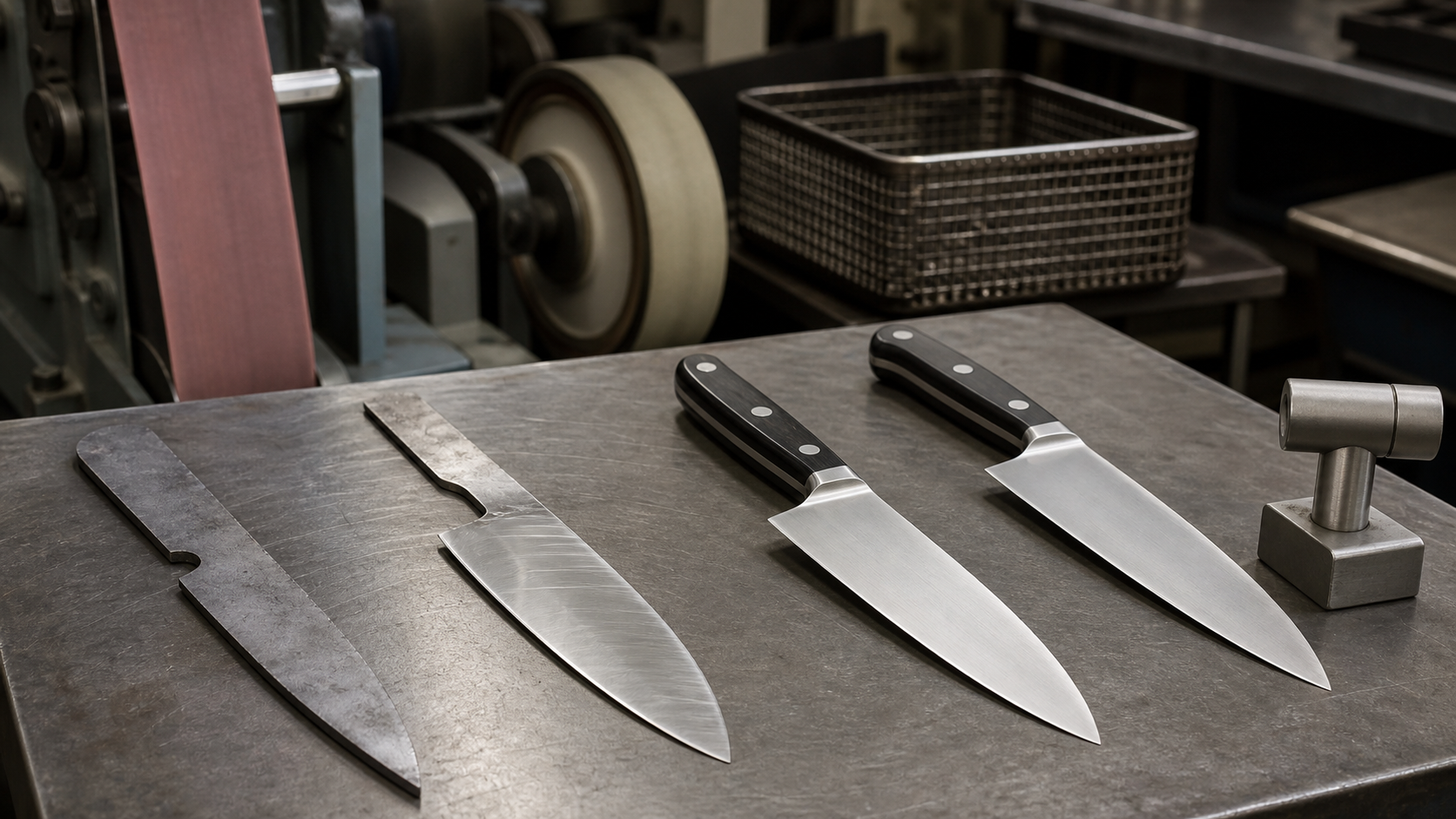
Forming the Blank Is Only the Beginning
One of the most common misconceptions in forged-versus-stamped comparisons is that the blank-forming method determines the finished blade.
In practice, many important characteristics are created or modified later.
A blade blank may still require:
- heat treatment;
- straightening;
- surface grinding;
- thickness reduction;
- taper development;
- bevel grinding;
- polishing or other surface finishing;
- sharpening;
- bolster installation;
- handle assembly.
Published knife-manufacturing examples show that laser-cut blanks can undergo heat treatment and extensive grinding afterward. Some manufacturing routes also attach a bolster to a previously cut blade by welding.
Likewise, forged blanks may contain machining or finishing allowance that is removed during subsequent processing.
The useful distinction is therefore not:
forged = shaped completely during forging versus stamped = finished directly from sheet
Both descriptions would be misleading.
The final knife is the result of a process chain, not a single operation.
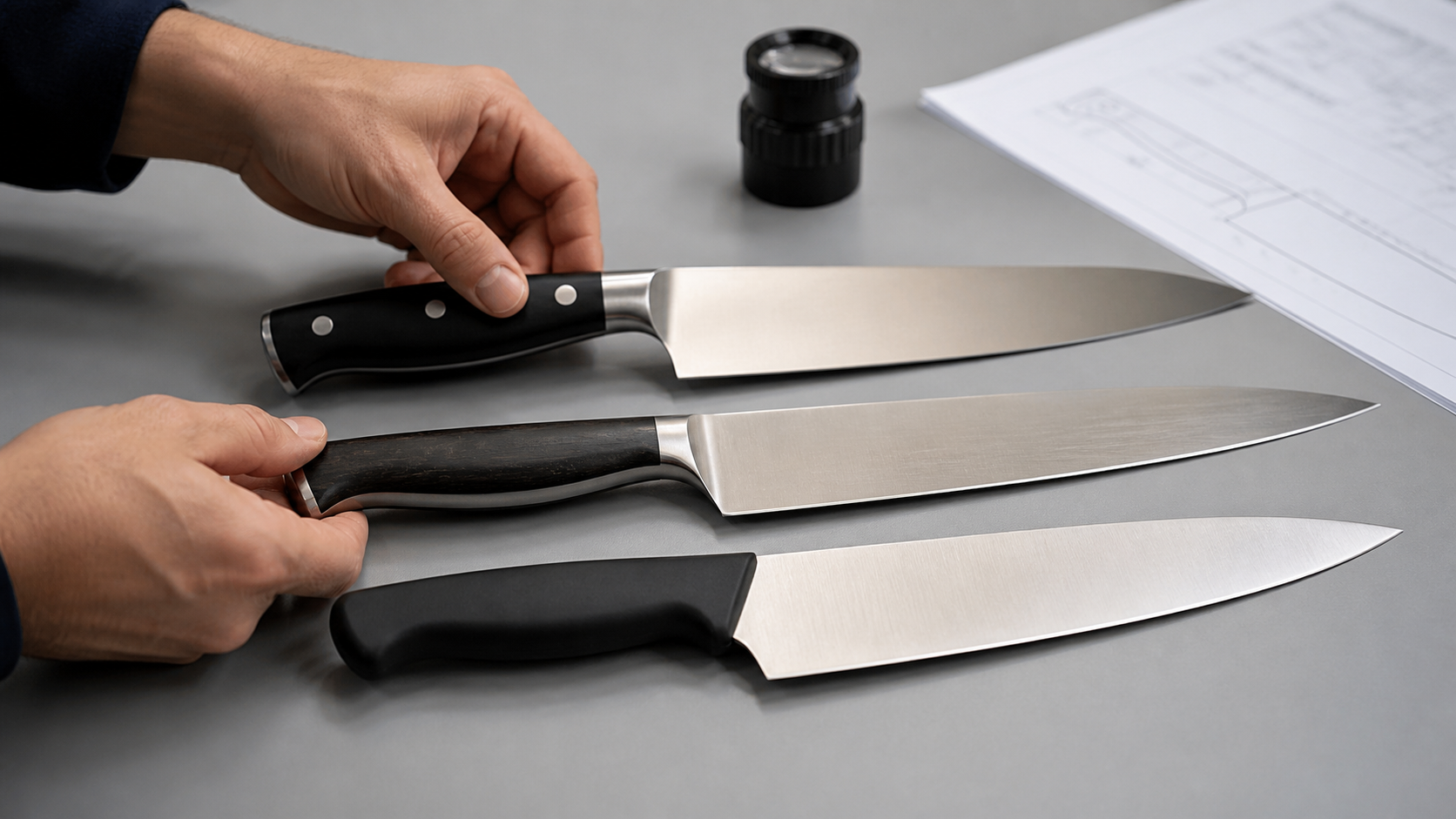
Does a Bolster Prove That a Knife Is Forged?
No. A visible bolster is not reliable standalone evidence of the blank-forming method.
A bolster may be:
- formed as part of the same blank;
- created through localized forging;
- manufactured separately and attached;
- welded to the blade;
- produced through another component-manufacturing process.
From the outside, some of these constructions can appear similar after grinding and finishing.
This means that a buyer should distinguish between:
“the knife has a bolster”
and:
“the bolster is integrally forged from the same blank.”
The first may be visible during inspection. The second is a manufacturing-history claim and normally requires process documentation, drawings, supplier confirmation, or other supporting evidence.
Appearance alone is not enough.
Does a Full Tang Prove Forging?
Full tang construction is also frequently associated with forged knives, but it is not a reliable manufacturing identifier.
Official product specifications provide examples of non-forged or laser-cut knives using full exposed tangs. There are also forged knives using concealed tang constructions.
The reason is straightforward: tang configuration and blank-forming method are separate design variables.
A flat-stock blank can be cut with an outline extending through the handle to create a full tang. A forged knife can be designed with a narrower or concealed tang.
A buyer should therefore specify the tang independently:
- full tang;
- partial tang;
- concealed tang;
- exposed tang;
- tang dimensions and length;
- handle attachment method.
“Forged” should not be used as a substitute for this information.
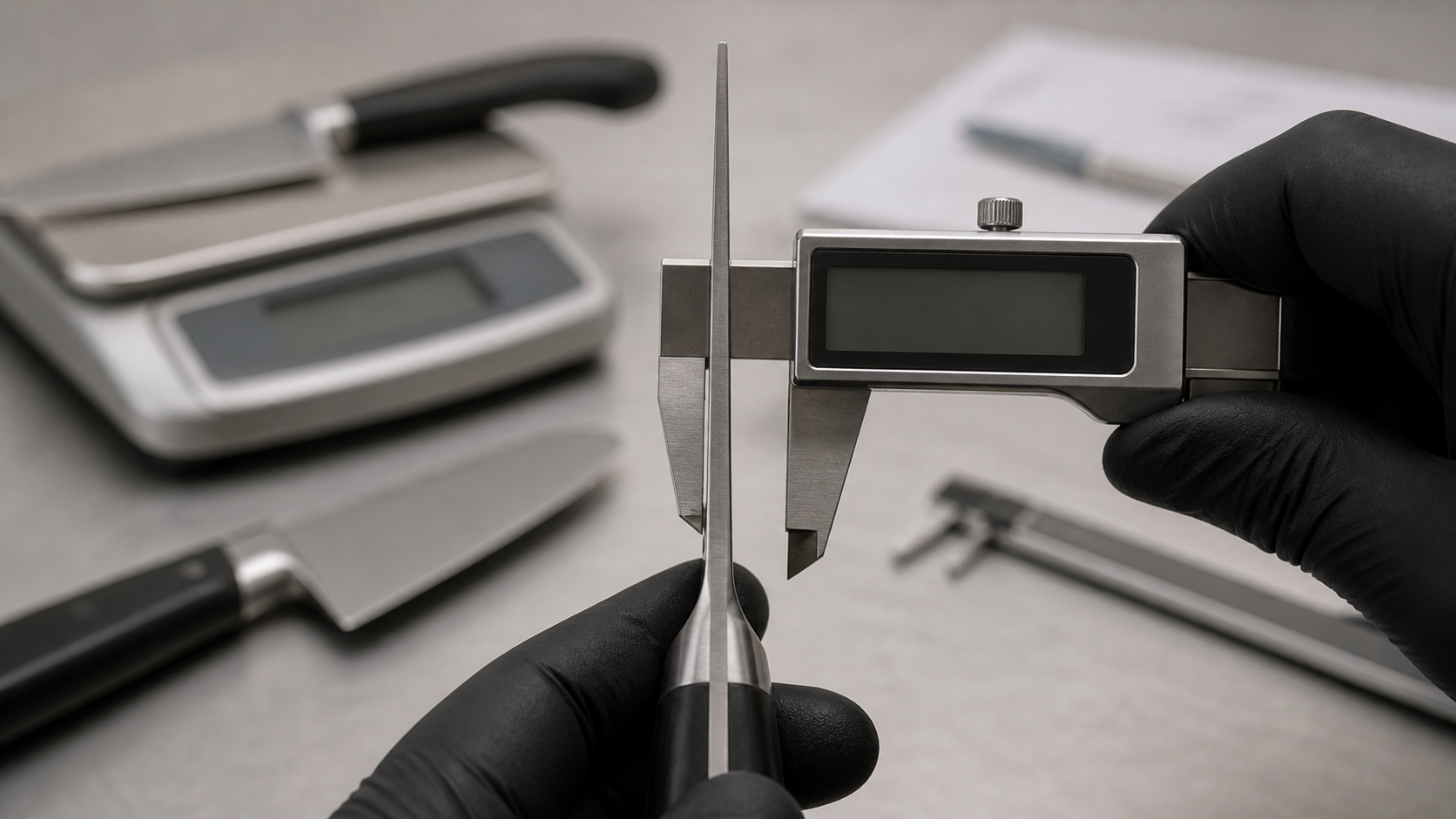
Can Blade Thickness Identify a Forged Knife?
Not reliably.
Forging can change local cross-sections through plastic deformation, but it is not the only way to create a thick or tapered blade.
Final thickness may also depend on:
- starting stock thickness;
- local forming operations;
- coining;
- surface grinding;
- taper grinding;
- blade profile;
- intended knife category.
A heavy cleaver cut from relatively thick flat stock, for example, can be substantially thicker than a lighter forged chef knife.
Thickness measurements also require a defined location. A single number labeled “blade thickness” may refer to the spine near the heel, a middle section, or another position.
For procurement, it is more useful to define a thickness map, such as:
- spine thickness near the heel;
- spine thickness at a defined mid-blade position;
- thickness near the tip;
- behind-the-edge thickness at a defined height.
Without defined measuring points, thickness values from different products may not be directly comparable.
Does Higher Weight Mean Forged Construction?
Weight is another unreliable identification method.
The finished weight of a kitchen knife reflects the entire assembly, including:
- blade dimensions;
- blade thickness;
- tang size;
- bolster configuration;
- handle material;
- rivets or fasteners;
- end caps or other hardware.
Published specifications from major knife manufacturers show that forged and non-forged chef knives of similar nominal length can have overlapping finished weights. Conversely, a heavy flat-stock cleaver may outweigh many forged chef knives.
Weight can be highly relevant to balance, handling, category positioning, and buyer preference.
It is not, however, reliable standalone evidence of forging.
Forging Does Not Automatically Establish Finished Performance
Forging can influence material flow and geometry during blank formation. In appropriate forging designs, metal flow may follow the component shape rather than simply remaining in the condition of the original flat stock.
That fact should not be expanded into an unconditional kitchen-knife performance claim.
Finished knife behavior also depends on variables such as:
- steel composition;
- starting material condition;
- heat treatment;
- microstructure;
- hardness;
- blade thickness;
- grind geometry;
- edge angle;
- surface condition;
- intended cutting task;
- maintenance;
- test method.
As a result, statements such as “forged knives hold an edge longer” or “stamped knives are less durable” require product-specific evidence.
A manufacturing label by itself does not demonstrate edge retention, toughness, cutting force, corrosion resistance, impact resistance, or service life.
This is particularly important in B2B specifications and marketing claims, where performance statements should be supported by test conditions relevant to the product being discussed.
When Different Manufacturing Routes May Make Sense
Avoiding a quality hierarchy does not mean manufacturing-route differences are irrelevant.
They can matter substantially for production design.
Forging
Forging may be useful where a design calls for controlled local deformation, changes in cross-section, an integral or locally formed structural feature, or another geometry that benefits from material displacement rather than material removal alone.
The economics depend on equipment, tooling, blank design, production volume, material, and subsequent operations.
Die Blanking
Die blanking can be relevant where a stable blade outline will be produced at sufficient volume to justify dedicated tooling. It can create repeatable profiles efficiently, but the resulting blank still requires later processes such as heat treatment, grinding, finishing, and assembly.
Laser Cutting and Flexible Flat-Stock Routes
Laser cutting can be useful for detailed profiles, development work, trials, lower-volume programs, or designs where dedicated blanking tooling is not preferred.
However, these are general manufacturing considerations rather than fixed rules. Equipment capability, labor, material utilization, downstream automation, tooling investment, and production quantity all influence the most suitable route.
A More Useful Buyer Checklist
Instead of asking a supplier only whether a knife is “forged” or “stamped,” a buyer can request a more complete manufacturing description.
1. Define the starting material
Confirm:
- material grade;
- applicable material standard;
- material condition;
- starting stock form;
- starting thickness.
2. Define how the blank is formed
Record whether the profile is:
- forged;
- locally upset-forged;
- die-blanked;
- laser-cut;
- waterjet-cut;
- produced through another identified method.
If forging is claimed, clarify which part of the blank is actually forged.
3. Define the downstream geometry
Confirm:
- spine thickness at specified locations;
- taper;
- blade-face grinding;
- behind-the-edge thickness;
- bevel geometry;
- final dimensional tolerances.
4. Treat heat treatment separately
Request appropriate documentation for:
- heat-treatment condition;
- hardness specification;
- hardness measurement method and location;
- batch records where required.
Do not treat “forged” or “stamped” as a substitute for heat-treatment information.
5. Define bolster and tang construction
Ask whether the bolster is:
- integral;
- locally forged;
- welded;
- separately manufactured and attached.
Specify the tang independently.
6. Match performance claims to evidence
If a product is claimed to provide higher toughness, better edge retention, greater durability, or another measurable advantage, request the relevant test method, samples, conditions, and report.
Without controlled testing, the manufacturing route should not be used as a proxy for these performance characteristics.
Manufacturing Route Is One Variable, Not a Quality Grade
The forged-versus-stamped distinction can be useful when it is technically defined. It becomes misleading when it is used as a universal quality ranking.
A forged knife may use localized or extensive deformation. A so-called stamped knife may be die-blanked or laser-cut. Either route can involve subsequent heat treatment, machining, grinding, sharpening, bolster construction, and handle assembly.
Likewise, features such as a full tang, bolster, thick spine, or higher finished weight do not reliably identify the original blank-forming process by themselves.
For professional buyers, the more defensible approach is to separate the questions:
How was the blank formed? How was the final geometry produced? How is the knife heat-treated? How are the bolster and tang constructed? And what product-specific evidence supports any performance claim?
Those questions provide considerably more purchasing value than treating “forged” and “stamped” as shorthand for good and bad.
References
- Forging Industry Association, Product Design Guide for Forging
- SME, Sheet Metal Stamping Dies & Processes — Fundamental Manufacturing Processes Study Guide
- NIST Advanced Manufacturing Series 200-5, Product Manufacturing Process Classification
- OSHA, Safeguarding Equipment and Protecting Employees from Amputations
- WÜSTHOF, Knives by Series — forged, non-forged and laser-cut manufacturing descriptions
- WÜSTHOF, Gourmet Series — laser-cut and stamped commercial terminology
- ZWILLING Gourmet 6-inch Carving Knife — precision-stamped, laser-cut and full-tang specifications
- ZWILLING TWIN Signature Knife Set — stamped blade and full-tang specifications
- ZWILLING Pro 10-inch Slicing/Carving Knife — forged construction and product specifications
- HENCKELS Forged Silvercap Elite Knife Set — welded manufacturing method and bolster construction
- Victorinox Grand Maître Collection — full-tang and forged-from-one-piece construction