
Knife Knowledge · Handle Ergonomics
Knife Handle Shape, Grip Style, and Ergonomics: Why Comfort Is Not Universal
Kitchen-knife handle ergonomics depends on the interaction among hand dimensions, grip style, handle geometry, knife balance, task, environment, and duration of use.
Quick answer
There is no universally ergonomic handle shape. Buyers should define representative users, grips, tasks, wet or gloved conditions, and evaluation methods before accepting an ergonomic claim.
A kitchen knife handle can feel comfortable to one user and awkward to another without either reaction being unusual. Hand dimensions differ. Grip habits differ. Some users work barehanded, while others wear cut-resistant gloves. A knife may be used for short vegetable preparation, repetitive trimming, slicing, rocking cuts, or other movements that place different demands on the hand and wrist.
For professional buyers, this is why “ergonomic” should not be treated as a description of one particular handle shape.
A curved handle, rounded profile, finger groove, textured surface, or soft-touch material may influence the way a knife feels and performs, but none of these features alone establishes that a handle will be comfortable, stable, or suitable for every intended user.
A more defensible evaluation considers the interaction among the user, handle geometry, grip style, knife mass distribution, task, environment, and duration of use.
What Does “Ergonomic” Mean for a Kitchen Knife?
Ergonomics is fundamentally a question of fit.
The U.S. National Institute for Occupational Safety and Health (NIOSH), in its guidance for selecting non-powered hand tools, emphasizes matching a tool to the job, the user’s hand, and the working posture. The same guidance discusses reducing unnecessary force, repetitive movement, awkward posture, and harmful contact pressure.
This is useful for kitchen-knife buyers because it shifts the question from:
“Does this handle look ergonomic?”
to:
“For which users, grips, tasks, and working conditions has this handle actually been evaluated?”
That distinction matters.
A visible design feature is not the same thing as demonstrated ergonomic performance. A finger groove, for example, may help locate the fingers of one user while interfering with the finger spacing of another. A larger handle may provide a useful power grip for one hand size but feel oversized to someone with a smaller hand.
There is therefore no single handle shape that public evidence supports as universally optimal.
Comfort Is Only One Part of Handle Evaluation
“Comfortable” is a legitimate user response, but it is only one measurement.
An ergonomic assessment can involve several different outcomes:
Subjective comfort describes whether a user reports that the handle feels pleasant or natural.
Localized discomfort identifies pressure or irritation at particular areas such as the palm, finger joints, thumb-index web space, or fingertips.
Pressure distribution considers where forces are concentrated across the hand.
Grip stability concerns whether the handle moves or rotates relative to the hand during a defined task.
Reachability and accessibility concern whether the user’s fingers and thumb can comfortably reach and control the intended contact areas.
Fatigue or perceived exertion addresses changes associated with repeated or prolonged activity.
These outcomes should not be treated as interchangeable.
Research on hand tools has shown that subjective comfort measurements do not necessarily track objective measurements such as muscle activity or contact pressure in the same way. In one hand-saw study, for example, electromyographic results did not correspond directly with subjective comfort and discomfort ratings.
For knife buyers, the practical implication is straightforward: a positive hand-feel comment from one evaluator does not by itself demonstrate low pressure, low muscle demand, high stability, or reduced fatigue.
Hand Size Is More Than One Dimension
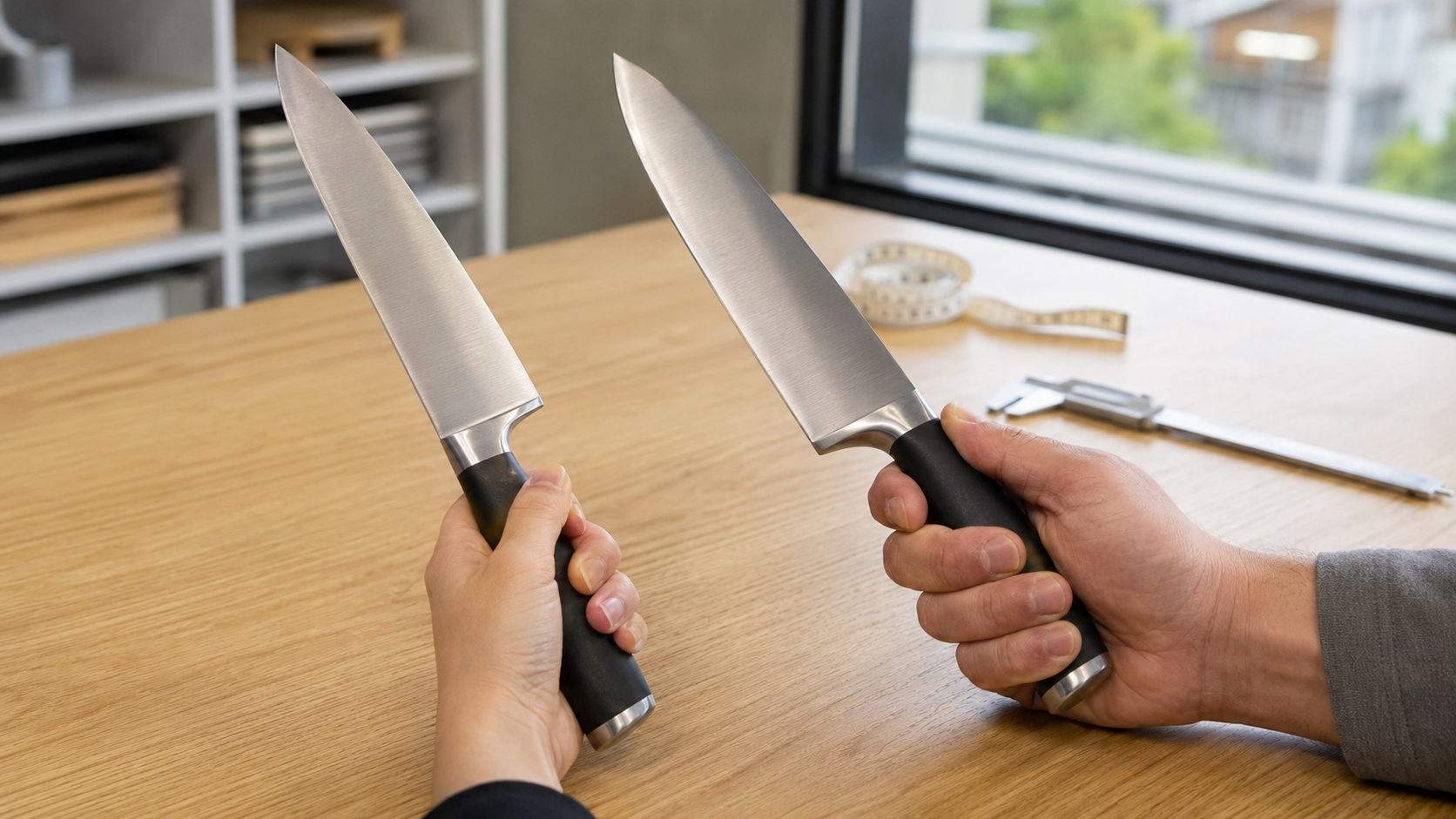
“Suitable for large hands” or “designed for small hands” may sound straightforward, but hand fit cannot be reduced to one number.
Potentially relevant dimensions include:
- hand length;
- palm or hand breadth;
- finger length;
- thumb reach;
- finger spacing;
- the circumference created when the hand encloses a handle.
ISO 7250-1 provides internationally recognized definitions for basic human body measurements, while ISO 15535 addresses the development of anthropometric databases. These standards illustrate an important design principle: user populations should be described through relevant measurements rather than assumed from a generic “average person.”
The ISO framework is not a U.S. kitchen-knife regulation, and it does not prescribe a universal knife-handle size. It is nevertheless useful when considering how a buyer or product team might structure user-fit evaluation.
Handle length matters as well. OSHA guidance for poultry-processing hand tools recommends handles long enough to extend across the hand so that the end of the handle does not press into the palm. However, that guidance applies to a specific occupational environment and should not be converted into a universal kitchen-knife dimension.
The appropriate question is therefore not simply whether a handle is “long enough,” but whether its dimensions are appropriate for the defined user population and intended grip.
Pinch Grip and Full-Handle Grip Should Not Be Confused
The term pinch grip presents an additional terminology problem.
In general ergonomics literature, NIOSH describes a pinch grip as a precision grip in which a tool or object is held between the thumb and fingertips.
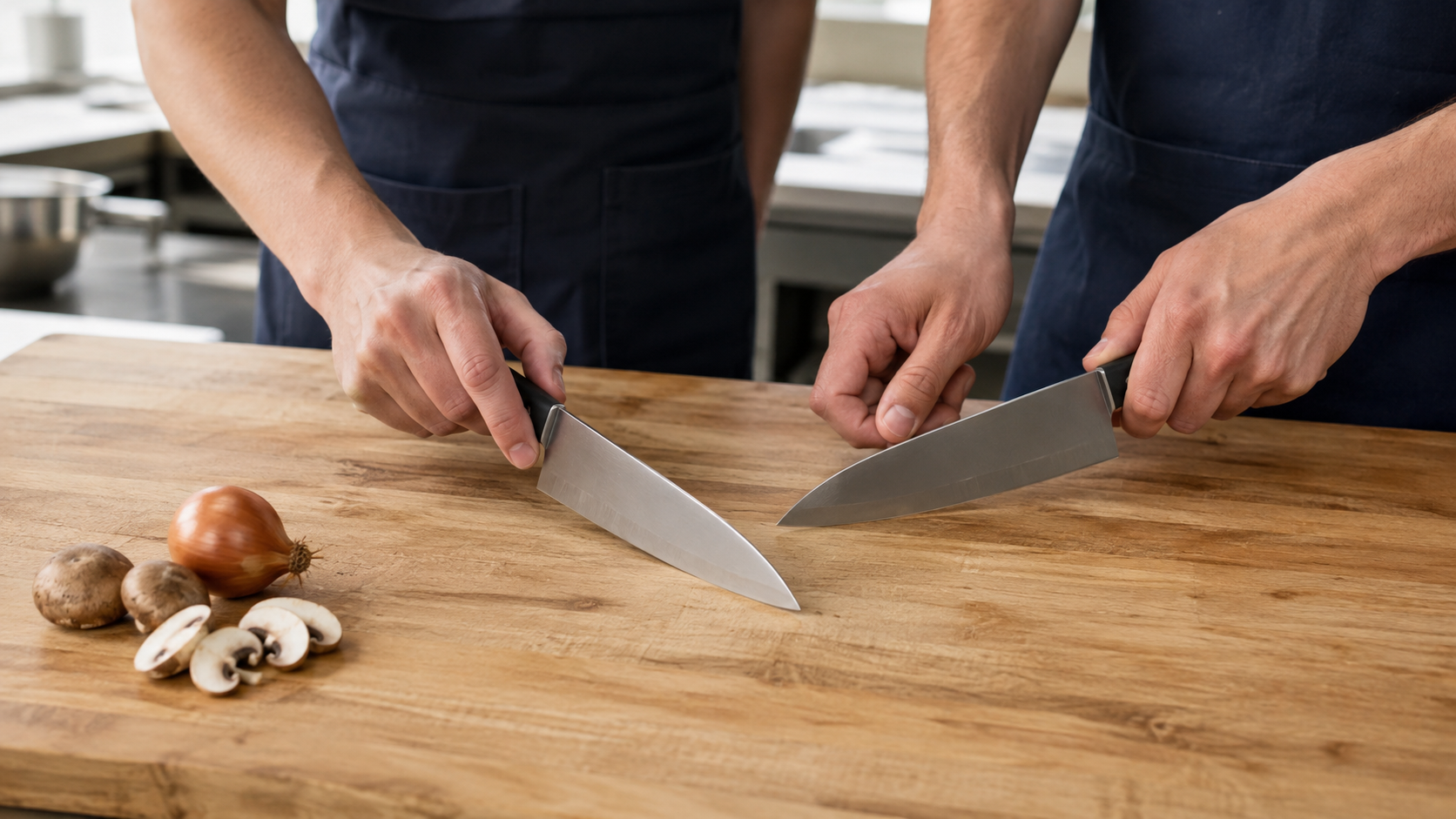
In culinary instruction, however, “pinch grip” commonly describes something different: the thumb and index finger contact the blade near the handle while the remaining fingers wrap around the forward part of the handle.
These are not mechanically identical grip configurations.
For B2B specifications and testing reports, simply stating that a knife was tested with a “pinch grip” is therefore insufficient. The report should define exactly where the thumb, index finger, other fingers, palm, and blade were positioned.
The same issue applies to expressions such as handle grip or full-handle grip. These are useful descriptive terms, but they should be operationally defined when used in testing.
Grip style can change:
- the effective lever arm between the hand and knife center of mass;
- which parts of the handle carry pressure;
- thumb and finger reach;
- wrist position;
- resistance to handle rotation;
- the way the knife responds when starting or stopping a cutting movement.
For this reason, one handle may produce different results when the same user changes grip.
Task Motion Changes the Ergonomic Question
A knife is not normally held statically.
Push cutting, draw slicing, rocking, trimming, deboning, and in-hand paring involve different directions and magnitudes of force. They may also involve different wrist movements and different contact areas between the user’s hand and the knife.
OSHA’s poultry-processing guidance illustrates this principle by connecting handle orientation with particular cutting actions. The document discusses angled handles for certain slicing movements and inline handles for stabbing-type actions.
Those recommendations are specific to occupational poultry-processing tasks. They should not be interpreted as proof that every chef’s knife should have an angled handle.
The broader lesson is more useful: handle geometry cannot be evaluated independently of the movement the user is expected to perform.
A short static grip test therefore cannot fully represent repetitive professional food preparation.
Wet Hands and Gloves Are Separate Test Conditions
Descriptions such as “good wet grip” often conceal important differences in test conditions.
A wet hand may involve plain water, perspiration, food oils, animal fat, cleaning residues, or mixtures of these substances. Each can change the contact condition between the skin and handle surface.
Experimental research on hand-surface friction has found that surface texture, contamination, applied force, and contact conditions can interact. The same research also found that higher friction was not simply equivalent to greater subjective comfort.
This means that a rougher surface should not automatically be described as both more secure and more comfortable.
Gloves introduce another set of variables.
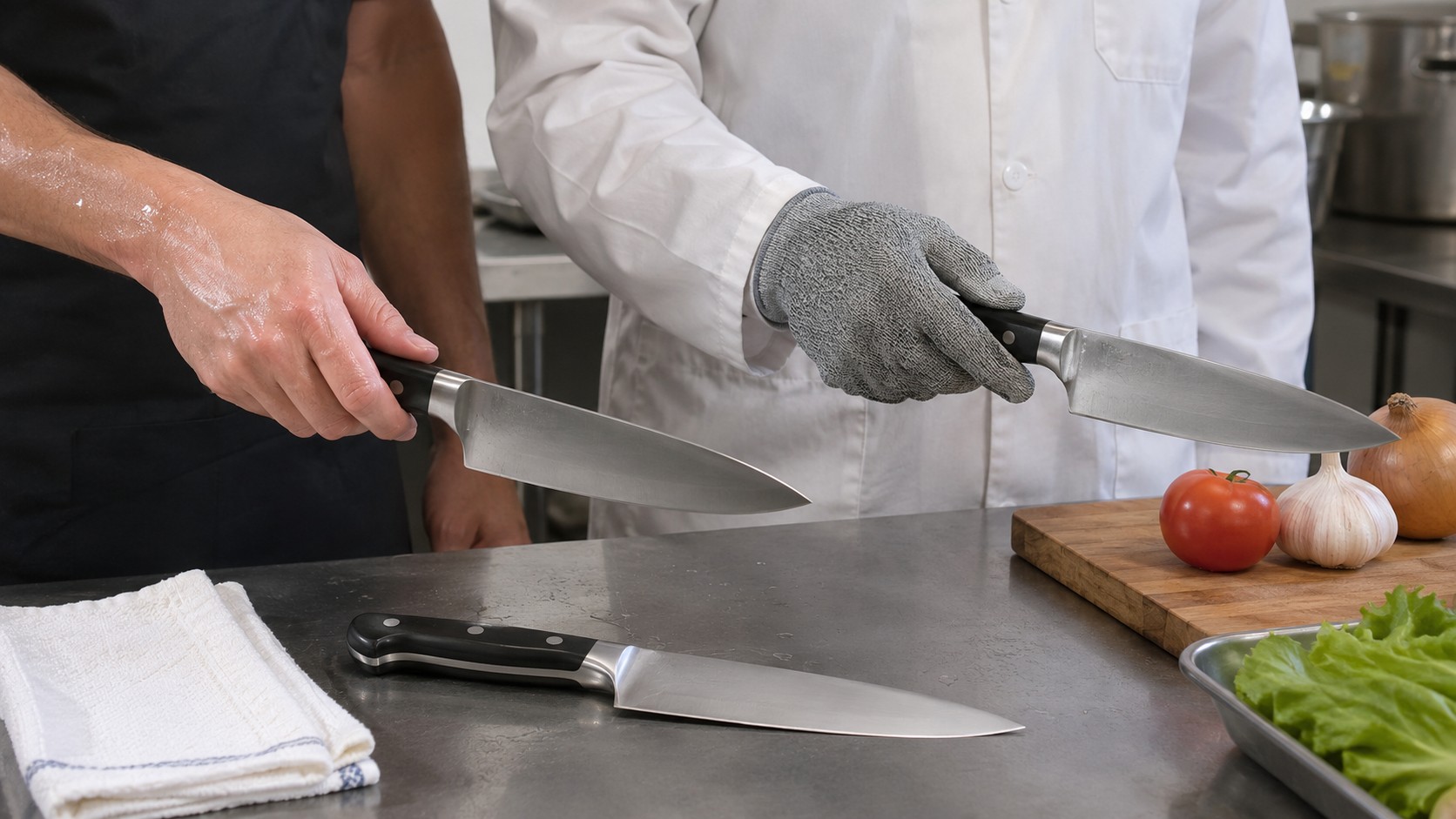
A review of protective-glove research found that gloves can affect dexterity, tactile feedback, grip capability, muscular demands, fatigue, and comfort. The direction and size of those effects depend on the glove and the task.
Individual experimental studies demonstrate why broad claims are risky. One knife-handle study found increased maximum torque under the particular Kevlar-glove conditions tested, while other studies using different glove and handle combinations found reductions in friction or maximum pulling force.
These findings are not contradictory. They show that “wearing gloves” is not a standardized mechanical condition.
A meaningful evaluation should identify the glove material, coating, thickness, size, fit, task, handle surface, contamination condition, and duration of use.
Without those details, statements such as “glove-friendly” or “non-slip when wet” remain too broad for technical comparison.
Handedness Matters, but Symmetry Does Not Prove Equal Fit
Left- and right-handed use should also be considered separately.
Research on hand strength shows considerable individual variation in the relationship between dominant and non-dominant hands. A fixed assumption that the dominant hand is always a particular percentage stronger is therefore unreliable.
For knife-handle evaluation, strength is only one issue. Asymmetric contours, thumb rests, finger grooves, handle taper, bolster geometry, and transitions between blade and handle can interact differently with left- and right-handed grips.
A geometrically symmetrical handle may reasonably be described as symmetrical.
That alone does not demonstrate that left- and right-handed users experience identical pressure distribution, accessibility, stability, or comfort.
Claims such as “ambidextrous ergonomic design” therefore require more evidence than visual symmetry.
Balance Point Is Measurable, but “Perfect Balance” Is Not Universal
Knife balance is another area where technical measurements and subjective impressions are often mixed together.
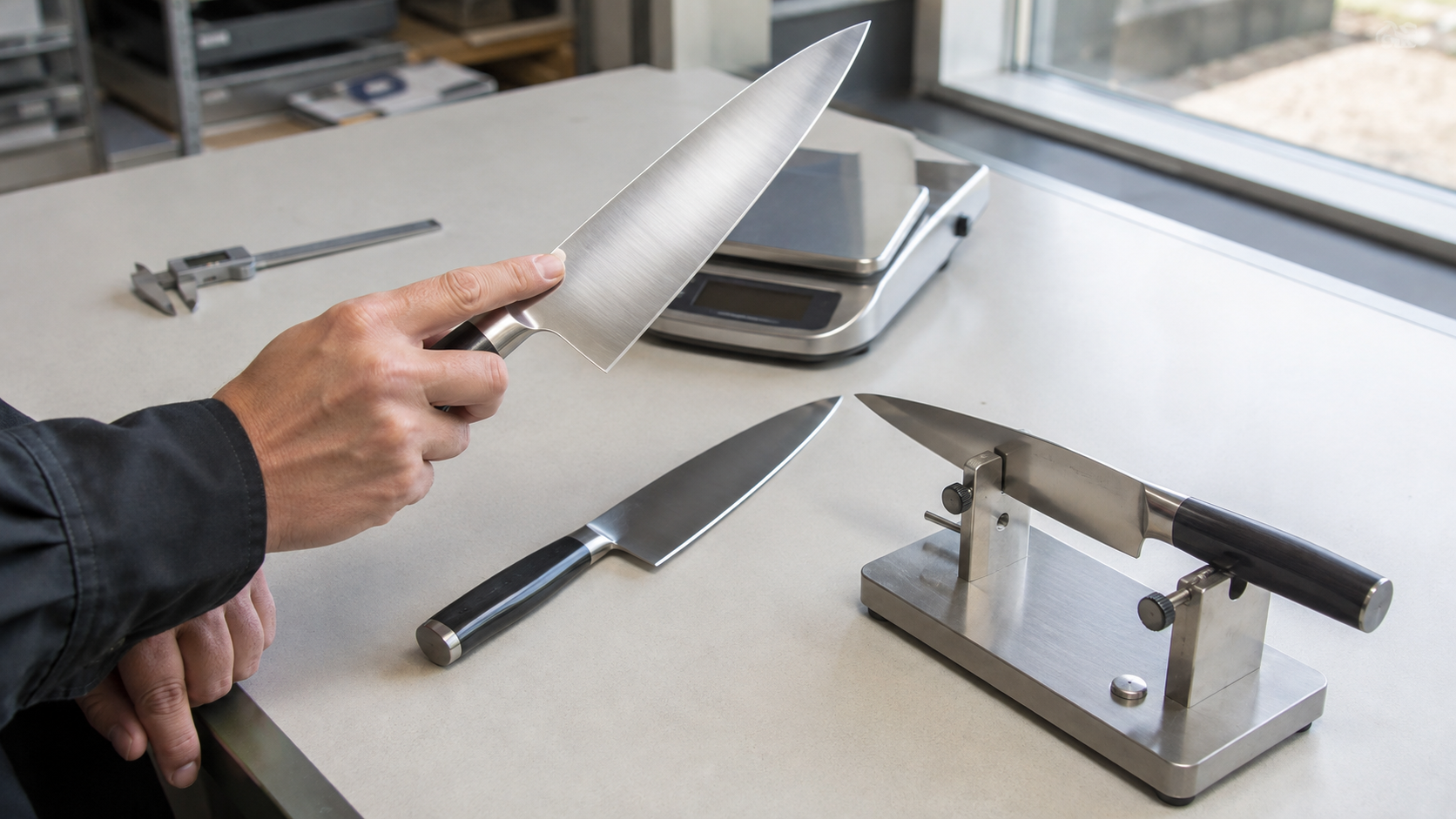
A knife’s total mass can be measured. Its center of mass can also be located using a defined procedure.
From basic mechanics, moving the center of mass farther from the hand increases the gravitational moment for a given knife mass and orientation. However, real knife handling also involves movement, acceleration, stopping, direction changes, and different grip locations.
Two knives with similar static balance points can still feel different if their mass is distributed differently along the blade and handle.
NIOSH’s general hand-tool guide specifically notes that tool weight and balance are outside the scope of that publication. It therefore should not be used as evidence for a universal kitchen-knife balance specification.
For professional purchasing documents, measurable statements such as total knife weight and center-of-mass location under a defined method are more defensible than phrases such as:
“perfectly balanced,”
“ideal balance,” or
“balanced to eliminate fatigue.”
Preference for a particular balance remains dependent on the user, grip, knife type, and task unless a narrower test establishes otherwise.
Repetitive Work Requires a Different Level of Evaluation
A user may hold a knife for thirty seconds and immediately decide that the handle feels comfortable.
That can be useful early-stage feedback.
It is not evidence that the same knife will remain comfortable over an entire shift.
Repetitive occupational work introduces exposure duration, movement frequency, force, recovery time, workstation height, cutting resistance, wrist posture, and work organization. NIOSH and OSHA occupational ergonomics guidance consistently treats repetition, force, awkward posture, and contact pressure as interacting risk factors rather than isolated product characteristics.
Similarly, ISO/TS 20646 addresses ergonomic procedures for reducing musculoskeletal workload but explicitly does not guarantee complete prevention of musculoskeletal health effects.
Therefore, a short laboratory or showroom test should be described as a short-term evaluation.
It should not be expanded into claims such as “zero fatigue,” “fatigue-free use,” or “prevents hand strain.”
How Should Buyers Evaluate Knife-Handle Ergonomics?
For sourcing and product-development teams, a more defensible evaluation begins by defining the intended use before selecting the measurement.
A practical evaluation should address the intended user population, relevant hand dimensions, handedness, experience level, expected grip styles, glove use, cutting tasks, environmental conditions, and expected duration of use.
When comparing multiple handle designs, other variables should be controlled as far as practical. Blade sharpness, edge geometry, knife weight, center of mass, blade length, food or test medium, cutting board, workstation height, and task pace can all influence the user’s experience.
The test panel should also represent the intended users rather than relying on a single product manager, buyer, designer, or chef. ISO 15537 provides an international framework for selecting test persons according to the anthropometric characteristics of an intended user population.
A useful test can combine objective and subjective observations. Depending on the question being investigated, these may include task completion, handle rotation or displacement, pressure distribution, grip force, torque, wrist posture, or muscle activity, together with separate ratings for comfort, localized discomfort, perceived exertion, stability, and preference.
The important point is not to maximize the number of measurements. It is to ensure that each measurement answers a clearly defined question.
What Buyers Should Ask Before Accepting an “Ergonomic” Claim
When a supplier, specification sheet, or packaging concept uses an ergonomic claim, buyers can ask:
- Who was the intended user population?
- What hand dimensions were represented?
- Were both left- and right-handed users included where relevant?
- How was the grip position defined?
- Which cutting tasks were tested?
- Were dry, wet, oily, or gloved conditions evaluated separately?
- What glove type and size were used?
- Were knife weight and center of mass recorded?
- Were comfort, localized pressure, stability, and task performance measured separately?
- How long did the evaluation last?
- Was the test conducted on the same product version being purchased?
- What limitations were stated in the report?
The answers help distinguish a design description from evidence supporting a specific product claim.
The More Defensible Conclusion: Ergonomics Is Conditional
Kitchen-knife handle ergonomics cannot be reduced to one curve, one material, one balance point, or one user’s first impression.
Hand size, finger reach, handedness, grip style, glove use, contamination, knife weight, balance, cutting motion, and exposure duration can all change how the same handle is experienced.
For B2B buyers, this does not mean that comfort is too subjective to evaluate. It means that the evaluation question needs to be defined more precisely.
Instead of asking whether a handle is simply “ergonomic,” a more useful question is:
For which users, grip styles, tasks, and working conditions has this handle been evaluated, and what exactly was measured?
That approach produces information that is easier to compare, easier to verify, and less likely to turn a limited user experience into an unsupported universal claim.
References
- CDC/NIOSH. Easy Ergonomics: A Guide to Selecting Non-Powered Hand Tools (2004).
- CDC/NIOSH. The Ergonomic Use of Hand Tools: Guidelines for the Practitioner.
Scope note: These sources support the general principles discussed here; they do not prove the material, performance, compliance, or production history of any specific Tastiva product. Links last checked August 24, 2026.
- U.S. National Institute for Occupational Safety and Health (NIOSH), *A Guide to Selecting Non-Powered Hand Tools*, 2004.
- U.S. Occupational Safety and Health Administration (OSHA), *Prevention of Musculoskeletal Injuries in Poultry Processing*, OSHA 3213-12R, 2013.
- ISO 15537:2022, *Principles for selecting and using test persons for testing anthropometric aspects of industrial products and designs*.
- ISO 7250-1:2017, *Basic human body measurements for technological design — Part 1: Body measurement definitions and landmarks*.
- ISO 15535:2023, *General requirements for establishing anthropometric databases*.
- ISO 6385:2016, *Ergonomics principles in the design of work systems*.
- ISO/TS 20646:2014, *Ergonomic procedures for the improvement of local muscular workloads*.
- Kuijt-Evers LFM et al., “Association between objective and subjective measurements of comfort and discomfort in hand tools,” *Applied Ergonomics*, 2007.
- Claudon L., study of knife-handle characteristics, gloves, torque, muscle activity, and subjective evaluation, *Applied Ergonomics*, 2006.
- Dianat I. et al., review of the effects of protective gloves on hand performance, *Ergonomics*, 2012.
- Bobjer O., Johansson SE., Piguet S., study of hand-handle friction and discomfort under different surface and contamination conditions, *Applied Ergonomics*, 1993.
Continue exploring practical knife specifications and buyer guidance.View all News →