
Knife Knowledge · Selection & Use
Kitchen Knife Types by Task: A Practical Selection Guide for Buyers and Suppliers
A practical B2B guide to selecting kitchen knives by task, clarifying where product names end and written specifications, samples and use cases must begin.
Quick answer
Choose by the work first: food size and condition, cutting motion, workspace, user control, cleaning limits, and maintenance plan. Product names are only a starting point; the purchase specification should define blade dimensions, profile, flexibility, handle requirements, and acceptance checks.
| Task to define first | Useful starting category | Confirm before buying |
|---|---|---|
| General preparation and repeated board work | Chef’s knife or Santoku | Blade profile, length, thickness, weight and intended motion |
| Small trimming and detail work | Paring or utility knife | Tip shape, working length, control and food size |
| Working around bones or joints | Boning knife | Stiffness, curvature, tip, edge geometry and explicit use limits |
| Long controlled portions | Slicing or carving knife | Blade length, width, flexibility and target food |
| Crusted or compressible foods | Serrated bread knife | Serration pattern, length and intended food |
| Heavy chopping or bone-related work | Cleaver | Exact material being cut, blade construction, weight and prohibited uses |
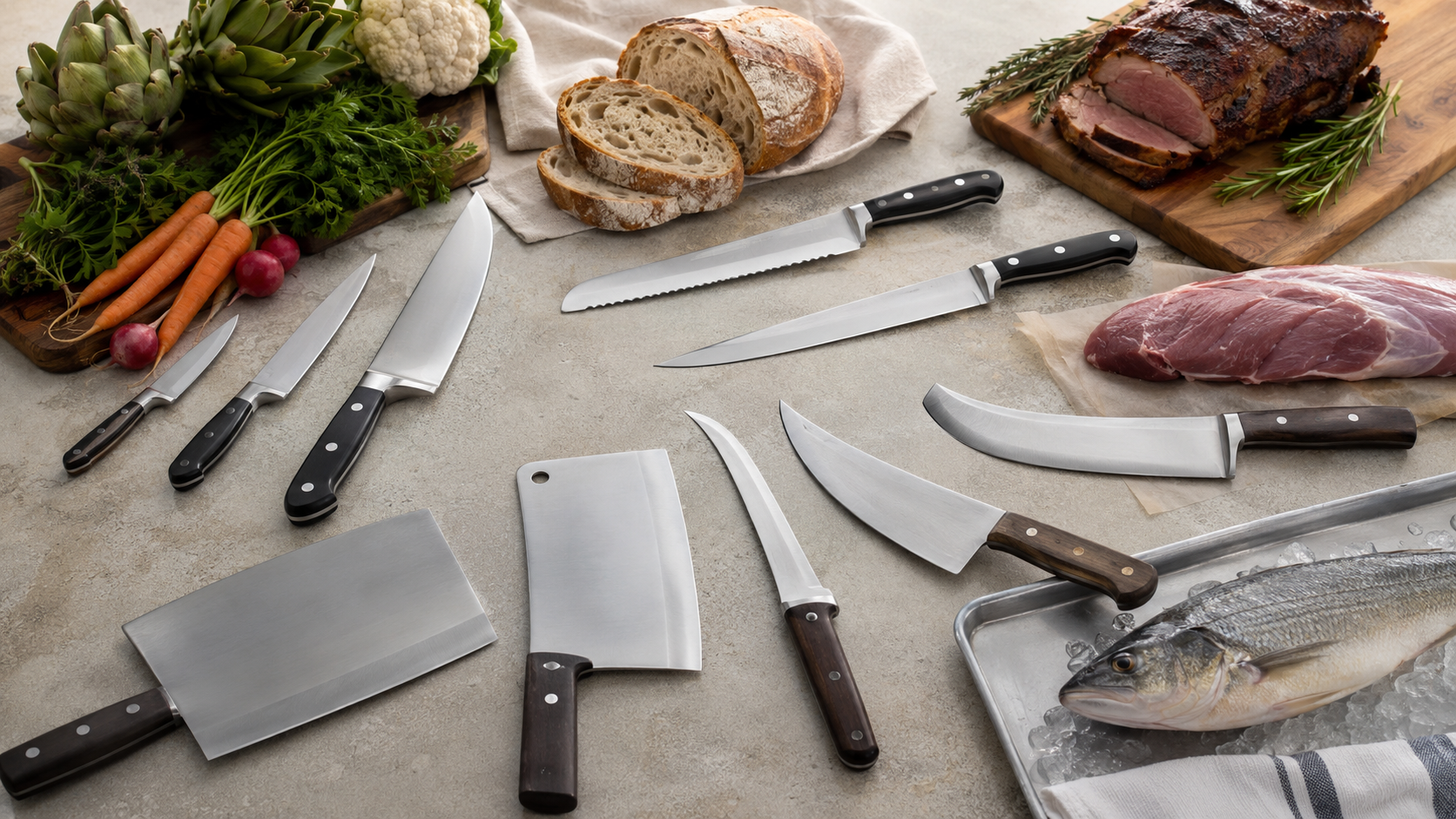
For international buyers, importers, distributors, and private-label brands, kitchen-knife selection should begin with the task—not only with the product name. Terms such as chef’s knife, boning knife, cleaver, utility knife, and butcher knife are useful commercial categories, but they do not by themselves define blade geometry, flexibility, edge construction, weight, or suitability for a specific operation.
Two knives sold under the same category name may be intended for different foods or cutting motions. A B2B buyer therefore needs both a functional description and a confirmed product specification.
Start With the Cutting Task
A practical sourcing discussion should begin with several questions:
- What food will be cut?
- Is the operation chopping, slicing, peeling, trimming, boning, carving, or filleting?
- Does the blade need to work around bone or through bone?
- Is a stiff or flexible blade preferred?
- Is a straight or serrated edge required?
University extension and professional culinary sources consistently distinguish knives by these functional differences. The knife name can narrow the search, but the operation should guide the final specification.
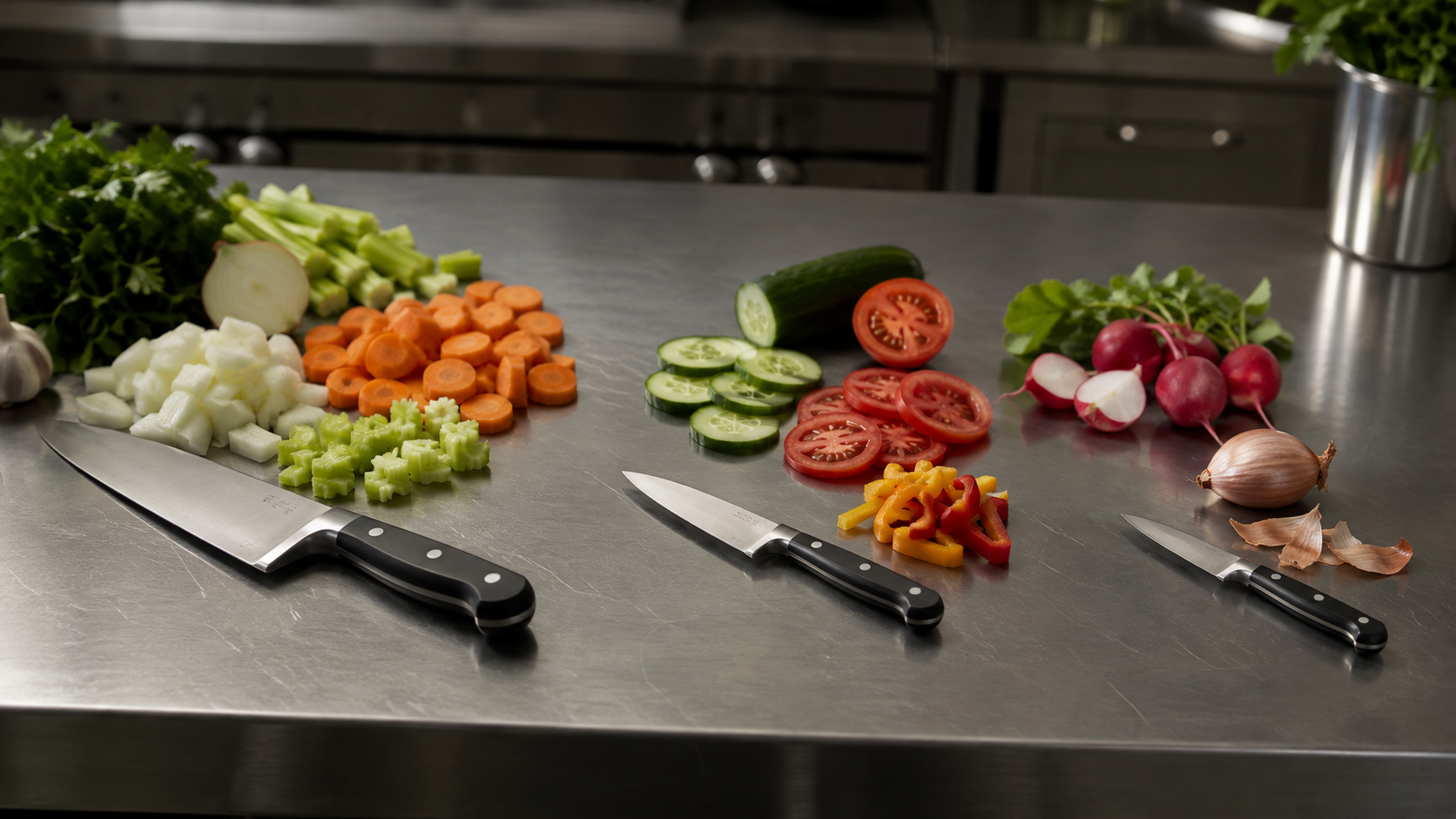
Chef’s Knife: General-Purpose Preparation
A chef’s knife is widely described as a general-purpose kitchen knife for chopping, slicing, dicing, and mincing. It is a practical choice when the buyer needs one primary preparation knife for vegetables, herbs, boneless meats, and similar routine kitchen work.
The boundary is important: “general purpose” does not mean “suitable for every task.” A chef’s knife should not automatically be treated as a bone chopper, fillet knife, or bread knife.
For B2B sourcing, the category name should be followed by confirmation of the actual blade profile, dimensions, edge configuration, weight, and intended applications. Published institutional guidance gives different dimensional ranges for chef’s knives, so one nominal length should not be presented as a universal definition.
Paring Knife: Small and Detailed Work
Paring knives are commonly associated with peeling, coring, trimming, and other controlled detail work. Their role differs from that of a larger preparation knife because access and control around small ingredients are more important than broad chopping capacity.
A common mismatch occurs when a small knife is selected simply because it looks convenient, even though the task requires greater blade length or leverage. For sourcing, state whether the knife is intended for peeling, precision trimming, or another small-scale task. Point shape, stiffness, edge style, and actual blade length remain product-specific details.
Utility Knife: A Category That Needs Clarification
Utility knives generally sit between paring knives and chef’s knives in size and function. Culinary guidance describes them as suitable for smaller slicing and preparation tasks involving foods such as vegetables, sandwiches, cheeses, and some meats.
However, “utility knife” is not a highly precise commercial term. Utility knives may be straight-edged or serrated, and suppliers may use the name for different profiles. An RFQ should therefore specify the target foods, straight or serrated edge, blade profile, and expected cutting motion rather than relying on “utility knife” alone.
Bread Knife: Serrations for Crusted or Compressible Foods
Bread knives are normally associated with serrated edges. Institutional guidance links serrated knives with bread and foods that benefit from a sawing action instead of heavy downward pressure, helping cut through a crust without unnecessarily compressing a softer interior.
The category still requires specification. Serration pattern, blade length, blade thickness, and handle configuration can vary. A safe general statement is that serrations are commonly selected for bread and similar foods; exact serration geometry and product performance require supplier confirmation.
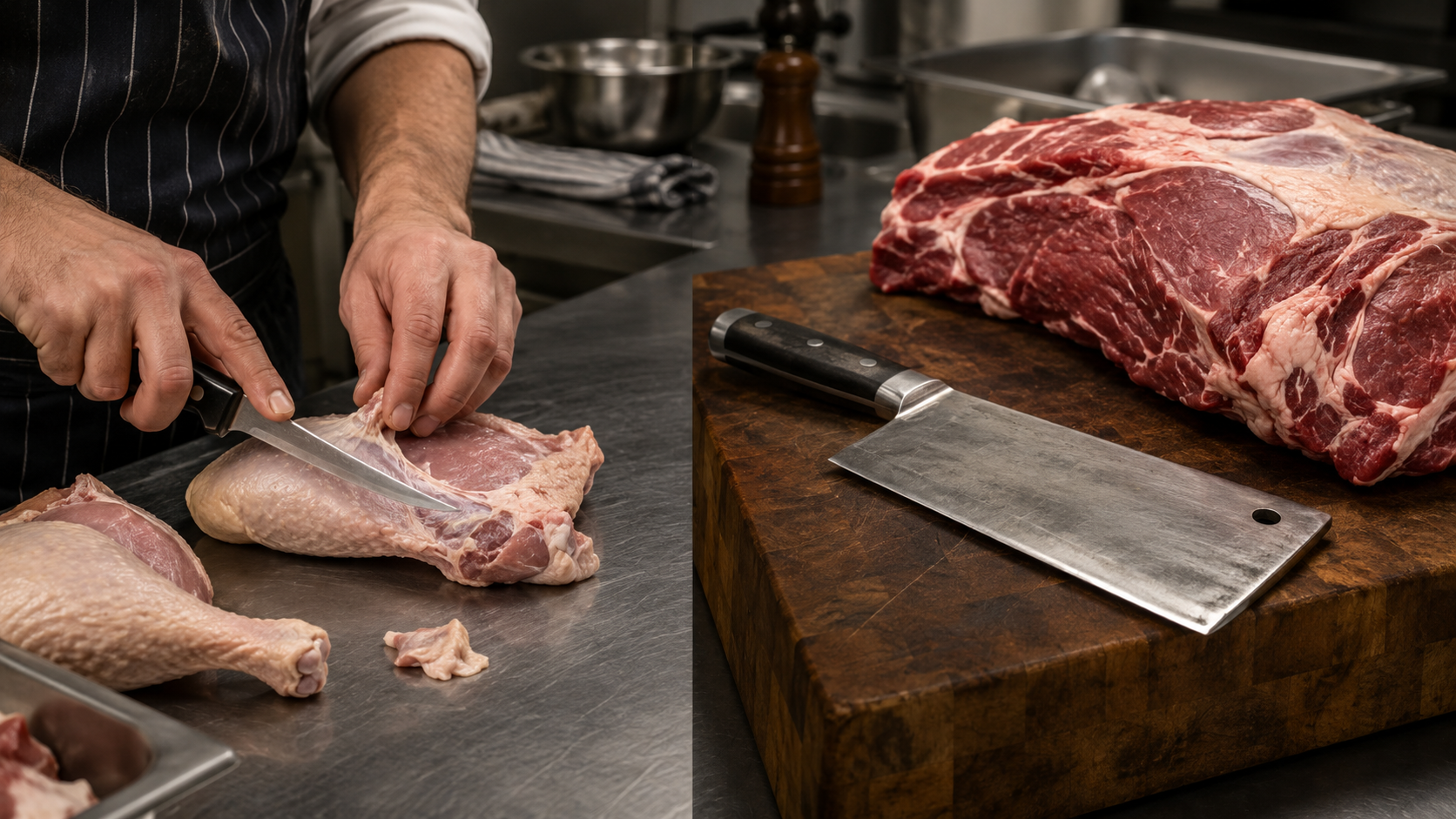
Boning Knife: Working Around Bone Is Not Chopping Bone
Boning knives are designed for controlled cuts around bones, joints, cartilage, and connective tissue. Meat-processing guidance also distinguishes between stiffer and more flexible boning knives depending on the operation.
This is a critical B2B terminology point: a boning knife is not automatically a bone-chopping knife. If a buyer requests a “boning knife for cutting bones,” the supplier should clarify the actual operation. Separating meat from bone, following curved bone surfaces, trimming around joints, and delivering chopping impact through bone are different requirements.
The supplier should confirm stiffness or flexibility, blade curve, thickness, point shape, intended food or species, and whether direct bone impact is expected. The name “boning knife” cannot replace an approved sample or written specification.
Carving and Slicing Knife: Long, Controlled Slices
Carving and slicing knives are commonly used for slicing cooked meats, roasts, poultry, and similar foods. Their role is associated with long, controlled slicing cuts rather than chopping.
Buyers should not assume that “carving knife,” “slicing knife,” “roast slicer,” and “meat slicer” are identical specifications. Supplier terminology can vary. The RFQ should identify the intended food and confirm blade length, blade height, thickness, flexibility, tip style, and edge configuration.
Cleaver and Chinese Cleaver: Similar Shape, Different Tasks
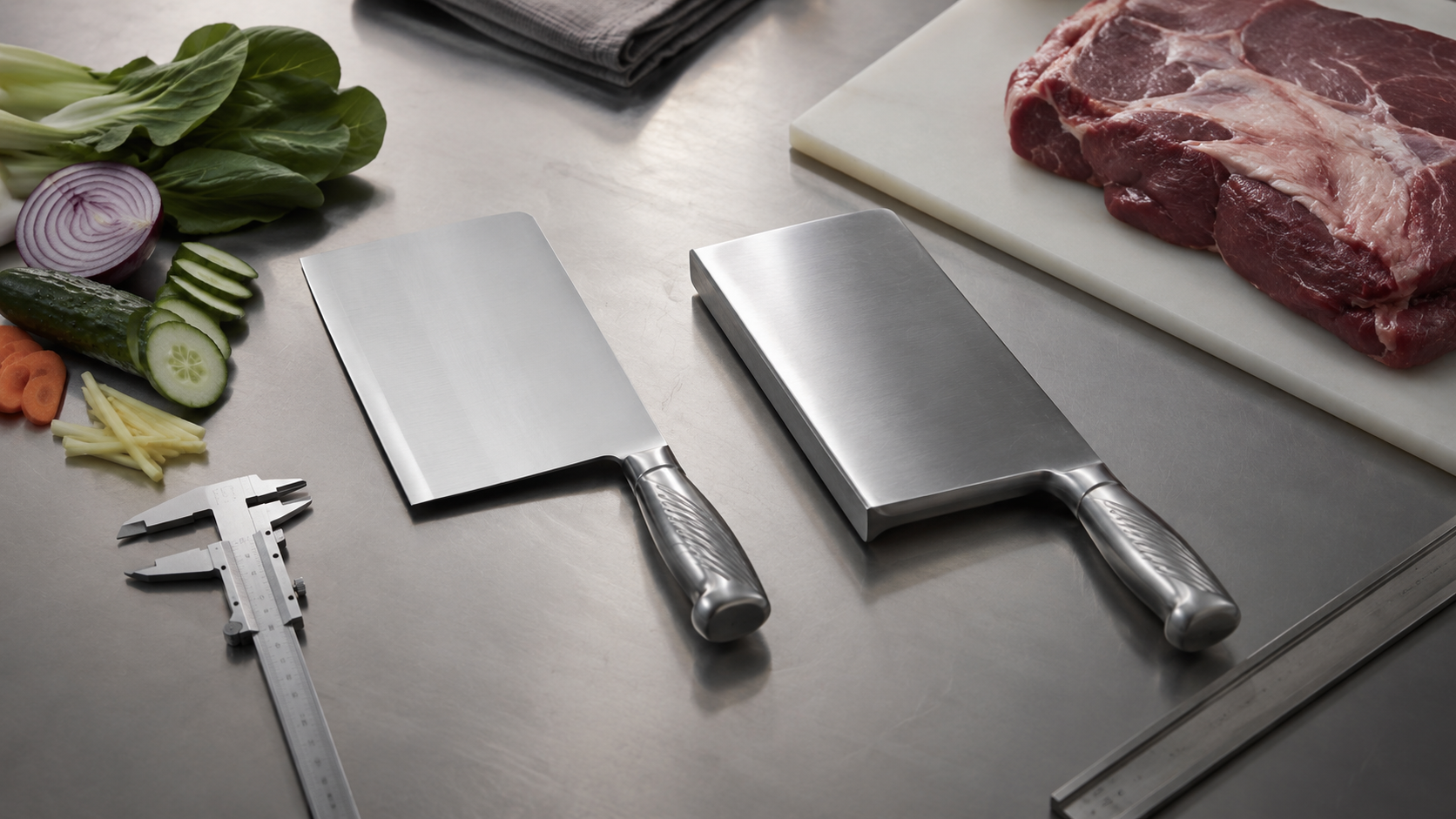
The word “cleaver” creates one of the highest risks of B2B miscommunication. A heavy meat cleaver may be intended for substantially heavier chopping work, including some soft-bone or cartilage tasks. A Chinese-style cleaver, by contrast, can function much more like a broad general-purpose preparation knife for slicing and chopping vegetables, meat, and other foods.
The rectangular blade shape does not prove which function applies. A buyer who asks only for a “cleaver” may receive a product that is too heavy, too thin, or otherwise unsuitable for the intended task. The supplier should clarify whether the request concerns a general-preparation Chinese-style cleaver, a vegetable slicer, a heavier chopper, or a meat cleaver.
Blade thickness, weight, edge geometry, blade height, and intended impact level should be confirmed through an agreed specification and, where appropriate, an approved sample. Bone-cutting capability should never be inferred from appearance alone.
Butcher Knife: Define the Meat-Processing Operation
“Butcher knife” is another broad commercial term. Government procurement documentation and professional meat-processing guidance associate butcher-style tools with operations such as cutting, sectioning, trimming, or breaking raw meat.
For B2B sourcing, the useful question is not simply “Do you need a butcher knife?” but “Which meat-processing operation must the knife perform?” The actual requirement may be closer to trimming, breaking, boning, skinning, or heavier chopping. If the operation is not defined, “butcher knife” is too broad to serve as a complete specification.
Fillet Knife: Match Flexibility to the Fish and Cut
Fillet knives are commonly associated with fish fabrication and often use relatively thin, flexible blades that can follow the contours of the fish. Flexibility, however, is not a universal “more is better” feature. A stiffer blade can be preferable for some larger or thicker fish.
For sourcing, specify the expected fish type or size, whether the task is filleting or skinning, and the required level of flexibility. Blade length, thickness, curvature, and tip shape should then be confirmed with the supplier.
Buyer Checklist
Before requesting a quotation or approving a sample, define:
- primary cutting task;
- food category and typical workpiece;
- whether the knife works around bone or through bone;
- whether chopping impact is expected;
- straight or serrated edge;
- required stiffness or flexibility;
- blade profile and intended cutting motion;
- required dimensions and tolerances;
- weight or handling requirements, if controlled;
- material and finish requirements, if specified;
- any measurable performance requirement and test method;
- drawing, specification, or sample revision used for approval; and
- target-market documentation required separately.
This is especially important for ambiguous labels such as utility knife, butcher knife, cleaver, and boning knife.

What a Supplier Should Confirm
Before producing a sample or confirming an order, the supplier should verify both the use case and the product specification.
Task and application. Confirm the primary task, intended foods, cutting motion, bone-contact requirement, and whether impact chopping is part of normal use.
Blade configuration. Confirm blade profile, dimensions, thickness, edge type, serration details where applicable, stiffness or flexibility, and any specified grind or bevel characteristics.
Material and construction. Confirm the material designation requested by the buyer, handle material, surface finish or coating if applicable, product weight where controlled, and construction details included in the specification.
Sample and document control. Confirm model number, drawing revision, sample revision, packaging version, and approved deviations. If sharpness, edge retention, hardness, corrosion resistance, or another measurable property is part of the purchase requirement, the parties should identify the test method and acceptance criterion. Descriptive phrases such as “professional quality” or “high performance” are not substitutes for measurable requirements.
Final Takeaway: Define the Job Before Defining the Knife
Kitchen-knife names are useful for organising a product range, but they are not complete technical specifications. For international B2B purchasing, a more reliable process is:
task → knife family → functional boundary → written specification → approved sample
That sequence reduces the risk of selecting the wrong geometry for the job and creates a clearer basis for quotation, sampling, inspection, and repeat ordering. The distinction is especially important for boning knives, butcher knives, utility knives, and cleavers/Chinese cleavers, where similar names or similar-looking blades may represent materially different tasks.
A productive buyer-supplier discussion should therefore begin with the operation the knife must perform and end with a confirmed specification—not with the category name alone.
References
- Virginia Tech / Virginia Cooperative Extension — The Basics of Knife Skills
- University of Illinois Extension — Knives and Cutting Tools
- University of Kentucky Extension — Selecting and Caring for Kitchen Knives
- Oregon State University Extension — The Basic Equipment for At-Home Meat Processing
- University of Illinois Extension — Carving: Turkey
- Institute of Culinary Education — Four Things I Learned About Fish Fabrication
- Materials — Engineering study of kitchen-knife edge geometry