
Knife Knowledge · Geometry & Maintenance
Kitchen Knife Edge Angle and Thickness: Why One Number Cannot Predict Cutting Performance
Edge angle matters, but it cannot predict cutting performance on its own. Buyers should compare apex condition, behind-the-edge thickness, blade geometry, material condition, test method, and intended task.
Quick answer
Edge angle is only one part of cutting geometry. Compare apex condition, behind-the-edge thickness, primary grind, blade thickness and taper, steel and heat treatment, test method, and intended food or task before judging cutting feel or durability.
When kitchen knives are compared, edge angle is often reduced to a single number: 15°, 20°, or another nominal value. For buyers, product managers, and quality teams, that number can be useful—but only when its definition and measurement conditions are clear.
A knife described simply as having a “15-degree edge” leaves several questions unanswered. Is that 15 degrees per side or a 15-degree total included angle? Is the blade double-beveled or single-beveled? How thick is the blade immediately behind the edge? Does the blade remain thin farther up the cross-section, or does it become substantially thicker? What is the actual condition of the apex after grinding and deburring?
These variables matter because cutting performance is not determined by edge angle alone. Edge geometry, blade thickness, steel condition, surface finish, cutting medium, cutting motion, and maintenance state can all affect how a knife performs.
There is therefore no single “best angle” that applies to every kitchen knife.
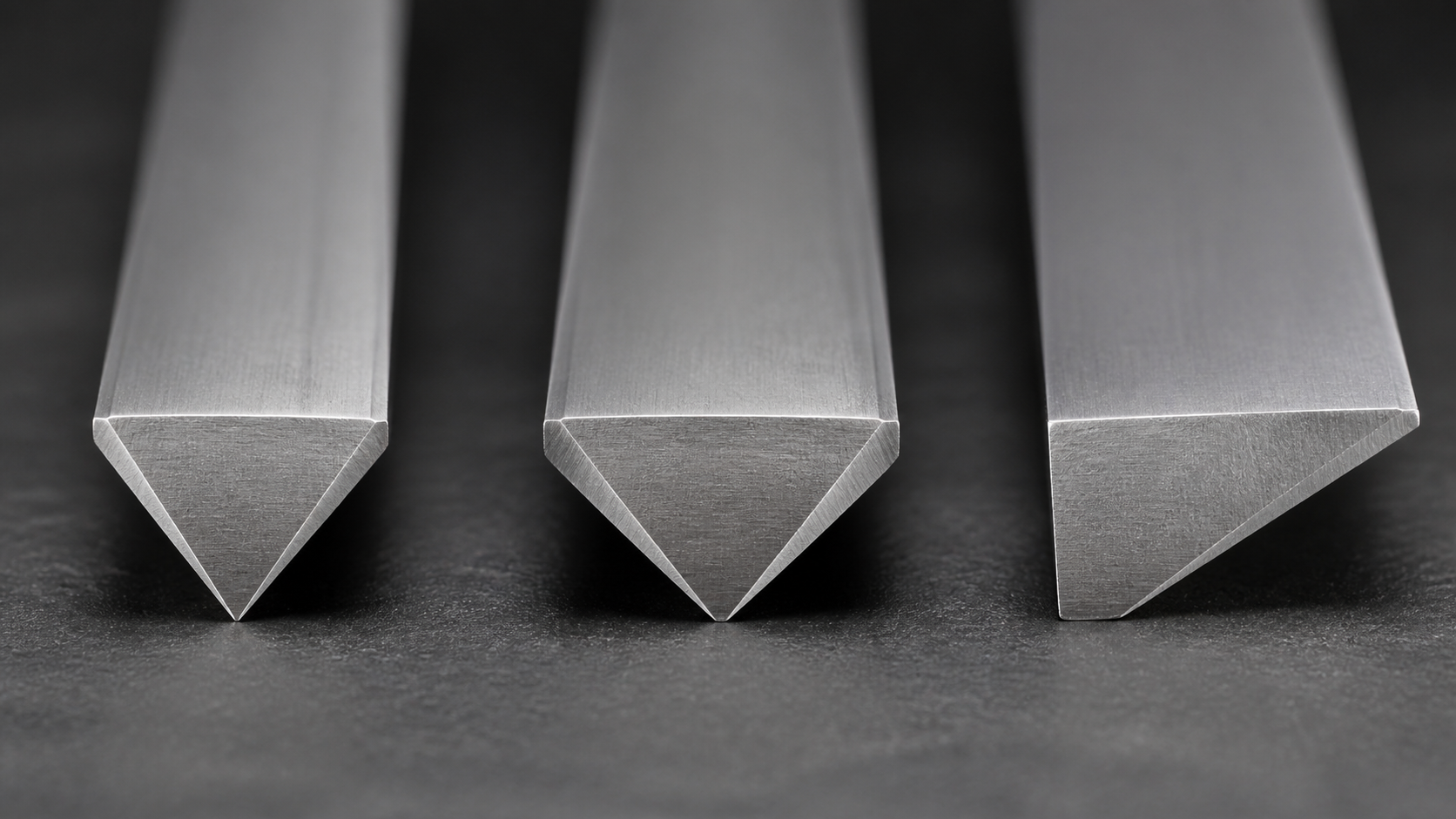
Start by Defining What the Angle Means
One of the most common specification problems is ambiguity around the term edge angle.
For a symmetric double-bevel knife, the angle may be expressed in two ways:
- Per-side angle: the angle of one edge face relative to the blade centerline.
- Included angle: the total angle between the two edge faces.
For example, a symmetric edge sharpened to 15° per side has a nominal included angle of 30°.
This distinction becomes more important with asymmetric edges. If one side is ground differently from the other, simply doubling a single angle is no longer valid. The left- and right-side angles should be specified separately.
For B2B specifications, a more useful format is therefore:
- left-side edge angle;
- right-side edge angle;
- total included angle;
- measurement reference;
- measurement location;
- allowable tolerance.
The measurement position also matters. Edge geometry near the heel may not be identical to the geometry near the center or tip of the blade.
A nominal angle without these details is incomplete as a production or QC specification.
Primary Grind, Edge Bevel, and Microbevel Are Different Features
Knife terminology is not always standardized across manufacturers, sharpeners, and technical literature.
Terms such as primary grind, primary bevel, secondary bevel, and edge bevel may be used differently by different sources. For technical communication, the geometry should therefore be defined rather than relying on terminology alone.
A practical distinction is:
Primary grind refers to the larger section of the blade where the original blade stock is reduced toward the cutting edge.
The final edge bevel is the narrow surface that directly forms the cutting apex.
A microbevel is an additional narrow bevel at the very edge, commonly formed at a somewhat larger angle than the preceding bevel.
A microbevel changes the terminal geometry of the edge, but its actual effect cannot be predicted from the word “microbevel” alone. Its angle, width, steel condition, sharpening method, and intended cutting task all matter.
The same caution applies to single-bevel and double-bevel descriptions. These terms identify a general edge structure, but they do not by themselves establish actual sharpness, durability, included angle, or cutting resistance.
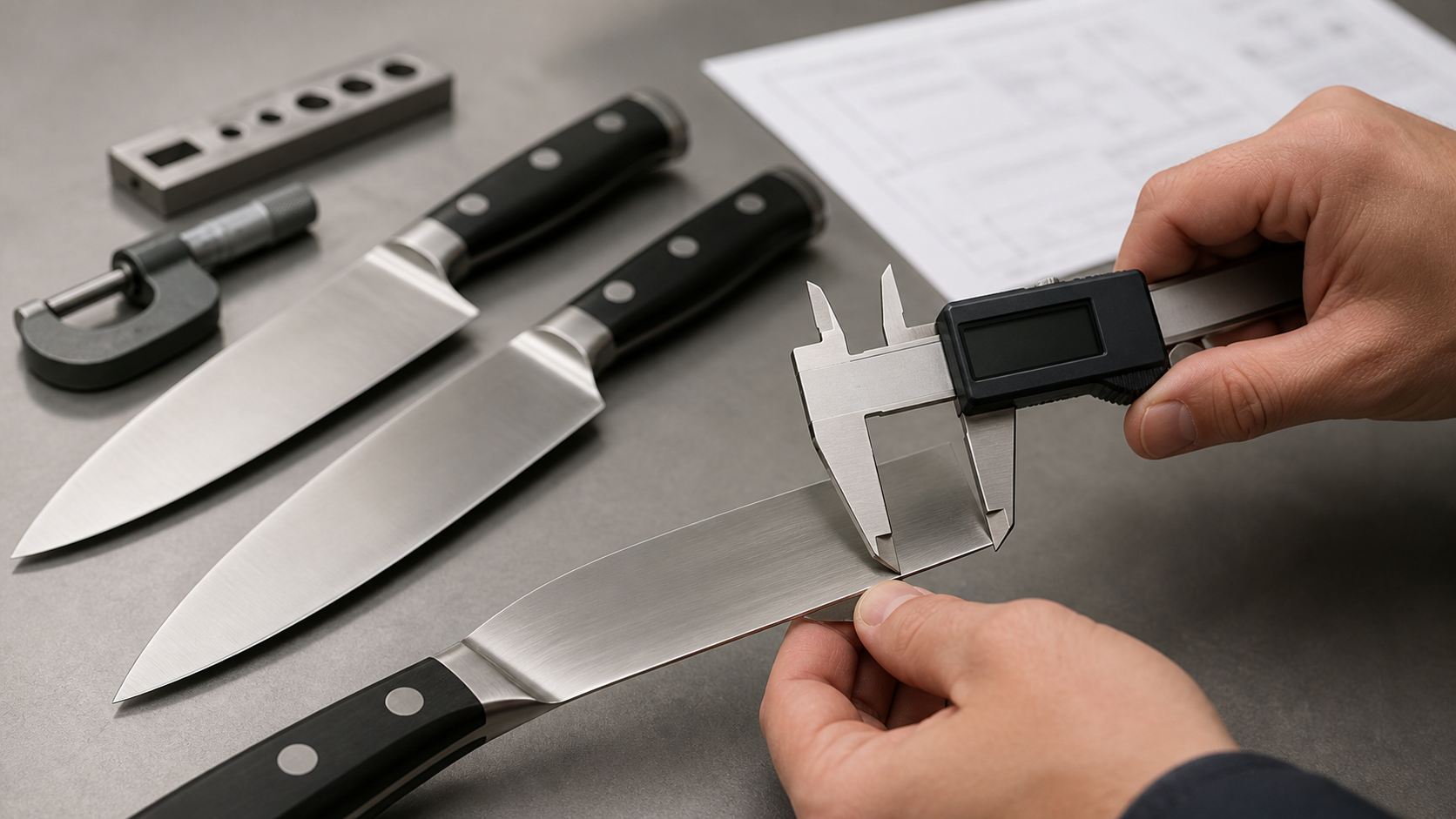
The Apex, Behind-the-Edge Thickness, and Blade Geometry Affect Different Parts of the Cut
A useful way to analyze a kitchen knife is to separate its geometry into three levels.
1. The Apex
The apex is the extreme cutting edge.
Its radius, width, burr condition, polishing level, and microgeometry influence how readily the edge begins to penetrate a material.
Research on blade sharpness has shown that edge-tip geometry can strongly affect the force required to initiate a cut. This means two knives with the same nominal sharpening angle may still behave differently if one has a cleaner or thinner apex.
Angle and apex condition are therefore separate variables.
2. Behind-the-Edge Thickness
Once the apex has entered the food, more of the blade begins interacting with the material.
This is where behind-the-edge thickness, often shortened to BTE thickness, becomes relevant.
A BTE measurement is incomplete unless the measurement distance from the apex is stated. For example, a thickness measured 1 mm behind the cutting edge cannot be directly compared with a value measured 3 mm behind the edge.
ISO 8442-1:1997 illustrates the importance of using a defined measurement position by specifying edge-thickness requirements at a stated distance from the edge for certain knife categories.
That does not mean the ISO value is a universal optimum. It shows why the measurement datum must be specified.
For procurement and QC, a statement such as “0.30 mm behind the edge” should therefore also identify:
- how far behind the apex the measurement was taken;
- where along the blade it was measured;
- which measuring method was used;
- what tolerance applies.
3. Overall Blade Geometry
The rest of the blade also contributes to cutting behavior.
Relevant variables can include:
- spine thickness;
- blade taper;
- grind height;
- convex or concave surfaces;
- blade-face asymmetry;
- thickness progression from edge to spine.
After the initial penetration, the food may contact increasingly larger portions of the blade face. Friction, deformation of the food, and material separation can then contribute to the total cutting force.
This is why two knives with identical 15° edge angles may feel very different in the same ingredient.
What Controlled Cutting Tests Actually Show
Research does provide evidence that edge angle can influence cutting behavior. The important point is that the result depends on the test.
Vegetable Compression Cutting
A 2016 study investigated nine vegetables using custom 304 stainless-steel blades under controlled vertical compression cutting.
The researchers tested several blade angles and cutting speeds. Under those specific conditions, the smaller tested angle—15° in the study—generally produced lower peak cutting forces and lower specific cutting energy.
However, the response was not identical across every vegetable.
Skin, layered structures, seeds, and differences in internal tissue affected the cutting-force curves. Onion, for example, did not follow a simple universal angle-to-force relationship.
The result supports a conditional statement:
A more acute edge can reduce cutting force under certain controlled cutting conditions.
It does not support the broader statement that a 15° edge is best for every kitchen knife.
The study also used a specific single-sided experimental blade geometry and a controlled compression movement, so its angle values should not automatically be treated as directly equivalent to the per-side angle of a conventional double-bevel chef’s knife.
Abrasive Card Testing Measures a Different Type of Performance
ISO 8442-5 provides a standardized framework for evaluating the sharpness and edge retention of hand-held knives used in food preparation.
The method uses an abrasive synthetic card medium under controlled load and reciprocating motion.
Two commonly discussed results are:
- Initial Cutting Performance (ICP), which characterizes early cutting performance;
- Total Card Cut (TCC), which represents accumulated card cutting during the test.
These tests are useful because they create repeatable conditions for comparison.
However, abrasive card is not tomato skin, onion tissue, cooked meat, fish, or a cutting board.
CATRA-type card testing should therefore be described as a controlled abrasive cutting and wear test—not as a direct simulation of every kitchen task.
Recent studies using this type of test provide an important example of the interaction between geometry and material.
A 2026 study examining several knife steels and included angles found that smaller included angles improved initial cutting performance under the tested conditions. At the same time, the more acute edges could wear faster during continued testing.
The researchers also found that long-term cutting performance was influenced by material factors such as matrix hardness and carbide characteristics.
This is an important distinction for buyers:
The geometry that improves initial cutting performance is not automatically the geometry that maximizes retained performance under every wear condition.
Real Meat-Cutting Results Can Look Different
Controlled laboratory tests are only one part of the evidence.
A professional meat-cutting study involving 21 workers examined knife edge angles under two lamb-processing operations. Researchers measured factors including grip force, cutting moment, and task duration.
Within the conditions of that study, the tested edge angles did not produce a statistically significant difference in those performance measures.
Edge finishing condition, however, affected some measurements during one of the tasks.
This does not mean edge angle is irrelevant.
It shows that in real cutting operations, the influence of angle may be combined with:
- edge finish;
- operator technique;
- food structure;
- cutting direction;
- blade condition;
- task mechanics.
Laboratory vegetable compression, abrasive card testing, and professional meat cutting are therefore not contradictory simply because they produce different results. They are measuring different systems.
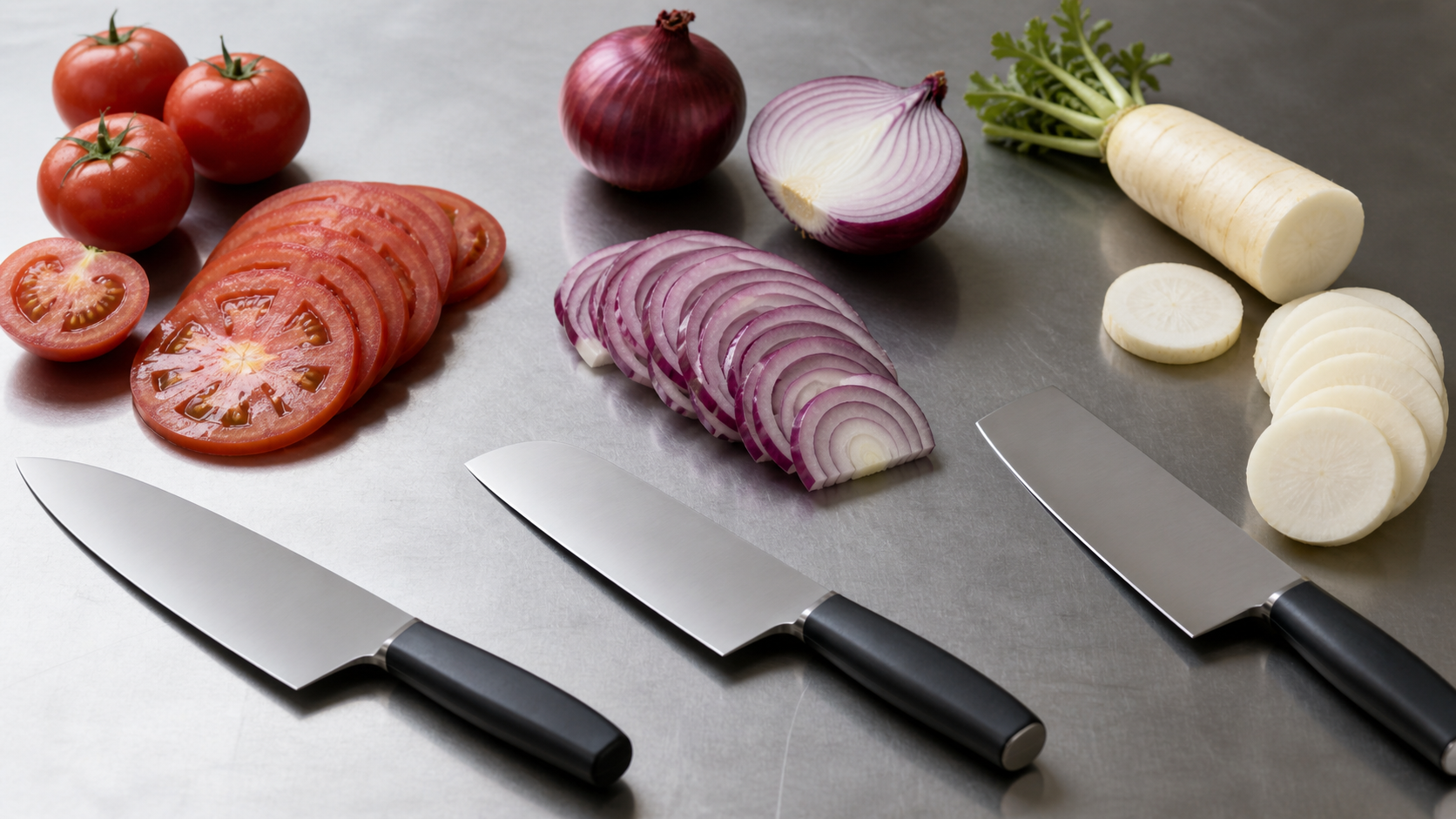
Cutting Resistance Is Not One Universal Metric
Another common mistake is treating all “sharpness” or “cutting force” tests as interchangeable.
They are not.
A test may measure:
- force required to initiate a cut;
- peak force during a single cut;
- average cutting force;
- accumulated cutting energy;
- card cut during repetitive abrasion;
- grip force used by an operator;
- cutting torque or moment.
Each measurement describes a different part of knife performance.
Even the material being cut can change the result substantially. Research on food cutting has shown that temperature, layered structures, fat, muscle tissue, cutting speed, and blade-surface contact can influence measured forces.
For this reason, procurement documents and test reports should identify the test medium and motion instead of reporting only that a knife is “sharper.”
Hardness Does Not Replace Geometry
Steel hardness is another important variable, but it should not be used as a shortcut for complete edge performance.
Rockwell hardness, including the Rockwell C scale commonly used for knife steels, is an indentation hardness measurement.
ASTM E18 defines the method and its measurement requirements. NIST also emphasizes that when hardness is being used as an indicator of another property, the relationship between hardness and that target property needs to be established.
A local HRC measurement is not a direct measurement of:
- toughness;
- fracture resistance;
- wear resistance;
- cutting force;
- edge stability;
- edge retention.
Research comparing knife steels at relatively similar hardness levels has shown different edge-retention behavior, demonstrating that microstructure and carbide characteristics can also matter.
A more useful framework is therefore:
material composition → microstructure → heat treatment → hardness and mechanical properties → edge geometry → cutting conditions → observed performance
Removing any of these variables can make a comparison misleading.
More Acute Does Not Automatically Mean Less Durable
A smaller included angle reduces the amount of material directly supporting the apex.
From a geometric perspective, that can change local stresses at the edge. Controlled abrasive testing also provides evidence that some more acute edge configurations can show faster wear.
However, it would be incorrect to convert this into a universal rule such as:
“A smaller angle always chips more easily.”
Edge failure can take different forms, including:
- abrasive wear;
- plastic rolling;
- microchipping;
- larger fracture;
- deformation caused by lateral loading.
Which mode occurs depends on the steel, heat treatment, edge geometry, cutting material, impact level, technique, and other conditions.
“Edge stability” is therefore better treated as an application-dependent behavior than as a number that can be inferred from angle or HRC alone.
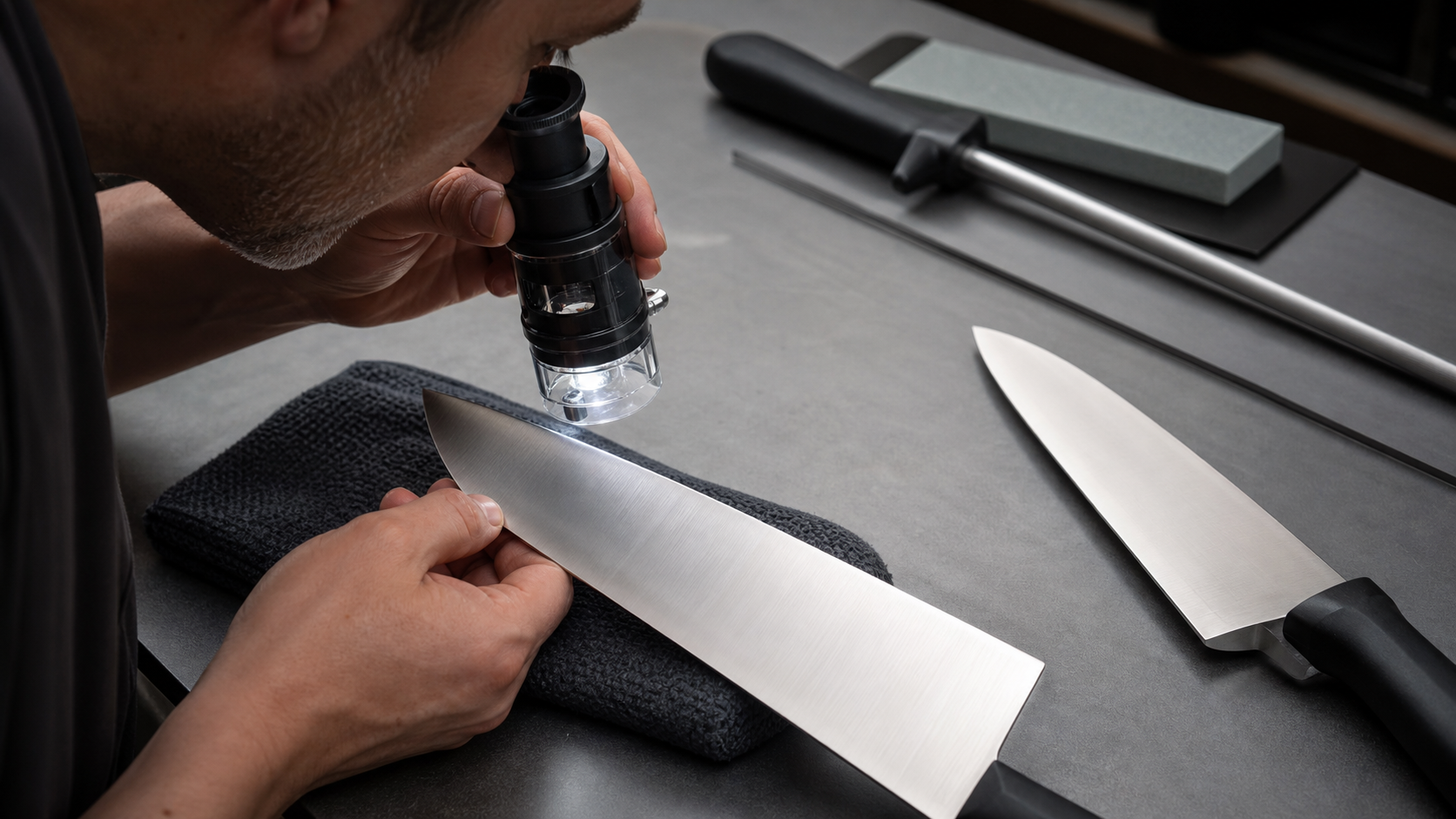
Maintenance Frequency Cannot Be Calculated from Angle Alone
The same caution applies to sharpening frequency.
Industrial meat-processing research has shown that operator skill and steeling practices can significantly affect how knife sharpness changes during a working period.
This makes fixed statements such as “a 15° knife needs sharpening every X months” technically weak unless the use conditions are defined.
A better maintenance specification uses a performance trigger rather than a calendar claim.
Examples may include:
- cutting force exceeding a defined threshold;
- a specified decline in standardized sharpness testing;
- visible rolling or chipping;
- failure to meet a defined cutting task;
- inspection at an application-specific interval.
The appropriate trigger depends on the product and use environment.
What Buyers Should Ask Suppliers to Specify
For commercial knife sourcing, the most useful approach is not to ask only for a sharpening angle.
A more complete geometry specification can include:
Edge Geometry
- left-side angle;
- right-side angle;
- total included angle;
- measurement reference;
- heel, middle, and tip measurement locations;
- edge-angle tolerance;
- microbevel geometry, where applicable.
Thickness and Blade Profile
- BTE thickness at a defined distance from the apex;
- measurement locations along the blade;
- spine thickness;
- taper;
- grind height;
- cross-sectional profile.
Material Information
- formal steel designation;
- applicable material specification;
- heat-treatment condition;
- hardness test method;
- hardness measurement locations and number of readings.
Cutting-Test Information
- test medium;
- cutting motion;
- load;
- speed;
- number of cycles;
- conditioning method;
- reported metric;
- inspection criteria for edge damage.
When these variables are defined, supplier comparisons become more meaningful.
The Main Procurement Lesson
Edge angle matters, but it is one part of a larger cutting system.
A nominal 15°, 20°, or 30° value cannot by itself establish how easily a knife will enter food, how much resistance the rest of the blade will create, how quickly the edge will wear, or how frequently the knife will require maintenance.
For B2B buyers, the stronger specification approach is to evaluate:
edge angle + apex condition + behind-the-edge thickness + overall blade geometry + material condition + test method + intended task
That framework avoids two common procurement errors: treating a single angle as a complete performance specification, and comparing results from tests that were never designed to be directly comparable.
The practical question is therefore not:
“What is the best kitchen knife angle?”
It is:
“What edge and blade geometry is appropriate for this material, this knife structure, this cutting task, and this verified test condition?”
References
- ISO 8442-1:1997, Materials and articles in contact with foodstuffs — Cutlery and table holloware — Part 1: Requirements for cutlery for the preparation of food
- ISO 8442-5:2004, Materials and articles in contact with foodstuffs — Cutlery and table holloware — Part 5: Specification for sharpness and edge retention test of cutlery
- Singh, Das and Das, “Effects of Knife Edge Angle and Speed on Peak Force and Specific Energy When Cutting Vegetables of Diverse Texture” (2016)
- McGorry, Dowd and Dempsey, “The Effect of Blade Finish and Blade Edge Angle on Forces Used in Meat Cutting Operations” (2005)
- Schuldt et al., “Analysis of the Sharpness of Blades for Food Cutting” (2016)
- Brown, James and Purnell, “Cutting Forces in Foods: Experimental Measurements” (2005)
- Zhang et al., “A Comprehensive Understanding of Knife Cutting: Effects of Hardness, Blade Angle and the Micro-Geometry of Blade Edge on the Cutting Performance” (2023)
- Xu et al., “Dynamic Cutting Analysis: How Edge Geometry and Material Microstructure Affect Knife Cutting Performance” (2026)
- ASTM E18-25, Standard Test Methods for Rockwell Hardness of Metallic Materials
- NIST, “Capability in Rockwell C Scale Hardness”
- Wu, Zhang and Liu, “Effect of Alloying Elements on the Sharpness Retention of Knife Blades Made of High Carbon Martensitic Stainless Steels” (2022)
- Karltun et al., “Maintaining Knife Sharpness in Industrial Meat Cutting: A Matter of Knife or Meat Cutter Ability” (2016)
- Savescu et al., “Objective Assessment of Knife Sharpness over a Working Day Cutting Meat” (2018)