
Knife Knowledge · Materials & Heat Treatment
Knife Hardness, Toughness, Wear and Corrosion Resistance: What Buyers Should Actually Compare
Kitchen knife specifications often place hardness, toughness, wear resistance, corrosion resistance and edge retention next to one another. The numbers can look comparable, but they describe different material responses and are often measured under very different conditions.
Quick answer
Hardness, toughness, wear resistance, corrosion resistance, and edge retention describe different properties and require different test methods. A useful comparison holds the steel, heat treatment, geometry, finish, and intended task constant instead of ranking knives by one number.
Kitchen knife specifications often place hardness, toughness, wear resistance, corrosion resistance and edge retention next to one another. The numbers can look comparable, but they describe different material responses and are often measured under very different conditions.
For importers, distributors, private-label brands and quality teams, this distinction matters. A Rockwell hardness value does not directly measure toughness. A Charpy impact result is not the same as fracture toughness. A laboratory wear test does not automatically predict how long a finished knife will remain sharp in a kitchen.
A more useful way to evaluate a knife is to consider the full chain:
material composition → microstructure → heat treatment → blade and edge geometry → use environment → test method → observed performance
No single step in that chain is sufficient to determine overall knife quality.
Hardness and Strength Are Not the Same Property
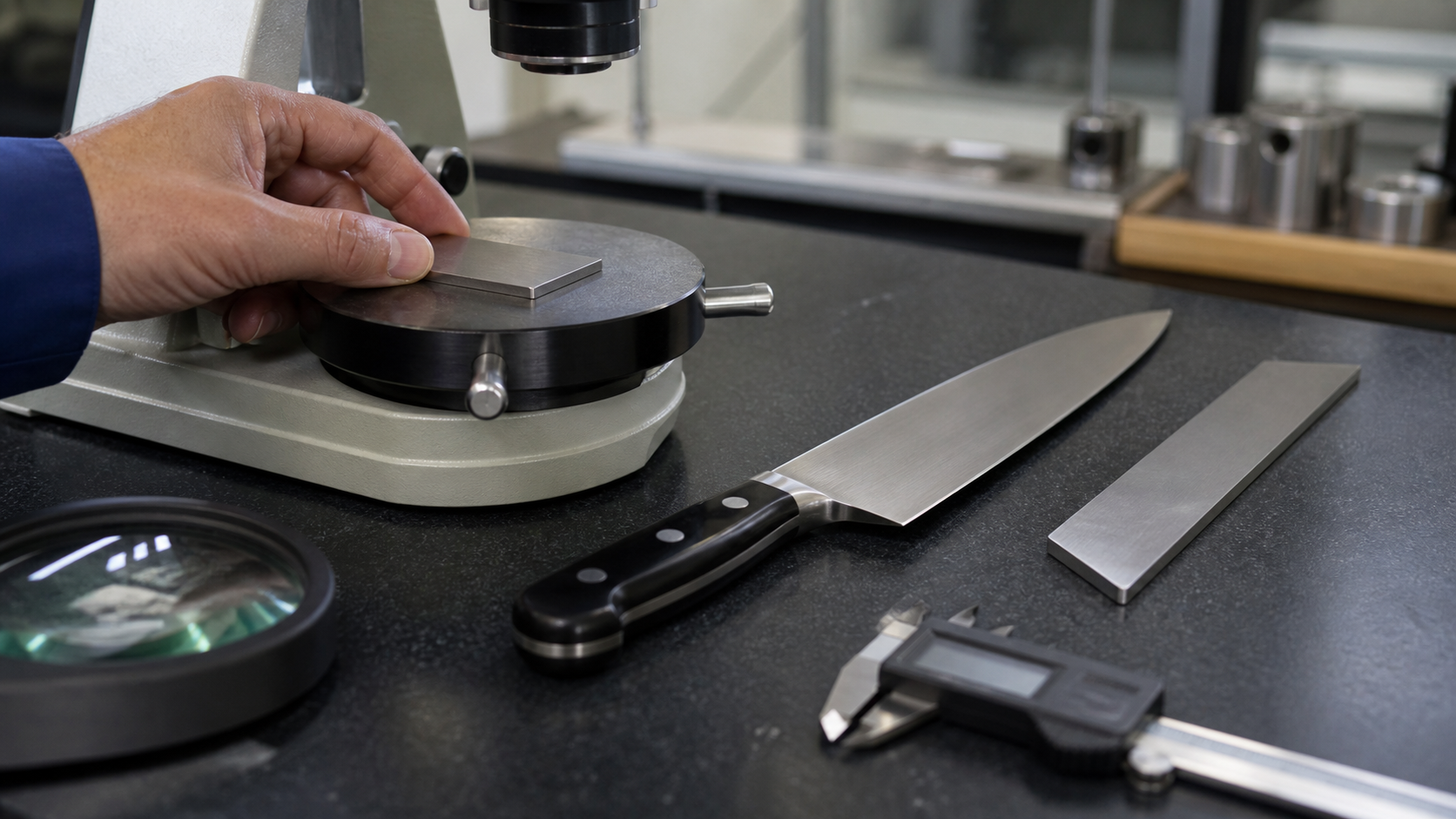
Hardness is one of the most commonly quoted specifications for kitchen knives. For hardened knife steels, it is often reported on the Rockwell C scale as an HRC value.
Rockwell hardness is an indentation measurement. Under a defined test procedure, a specified indenter and loading sequence are applied to the test surface, and the resulting indentation response is converted into a hardness number.
That number is useful, but its meaning is limited.
A hardness result does not directly measure:
tensile strength;
yield strength;
fracture toughness;
impact resistance;
wear resistance;
corrosion resistance; or
finished-edge durability.
The distinction is especially important when the word strength is used. In materials engineering, strength normally requires a loading mode and a defined endpoint. Tensile strength, yield strength, shear strength and flexural strength are different quantities.
A statement such as “this steel is stronger because it is harder” therefore requires additional evidence. Hardness and strength can show material-specific correlations under controlled conditions, but they are not interchangeable measurements.
For knife buyers, a reported HRC value should be read together with the material grade, heat-treatment condition, test location and blade geometry rather than treated as an overall quality score.
Toughness, Fracture Toughness and Impact Resistance Need Separate Definitions
These terms are frequently grouped together in knife marketing, but they do not describe the same test.
Toughness
In general materials terminology, toughness describes a material’s ability to absorb energy before fracture. It involves the material’s response to both stress and deformation.
However, “toughness” by itself is not a complete laboratory specification. A buyer still needs to know how it was measured.
Impact Resistance
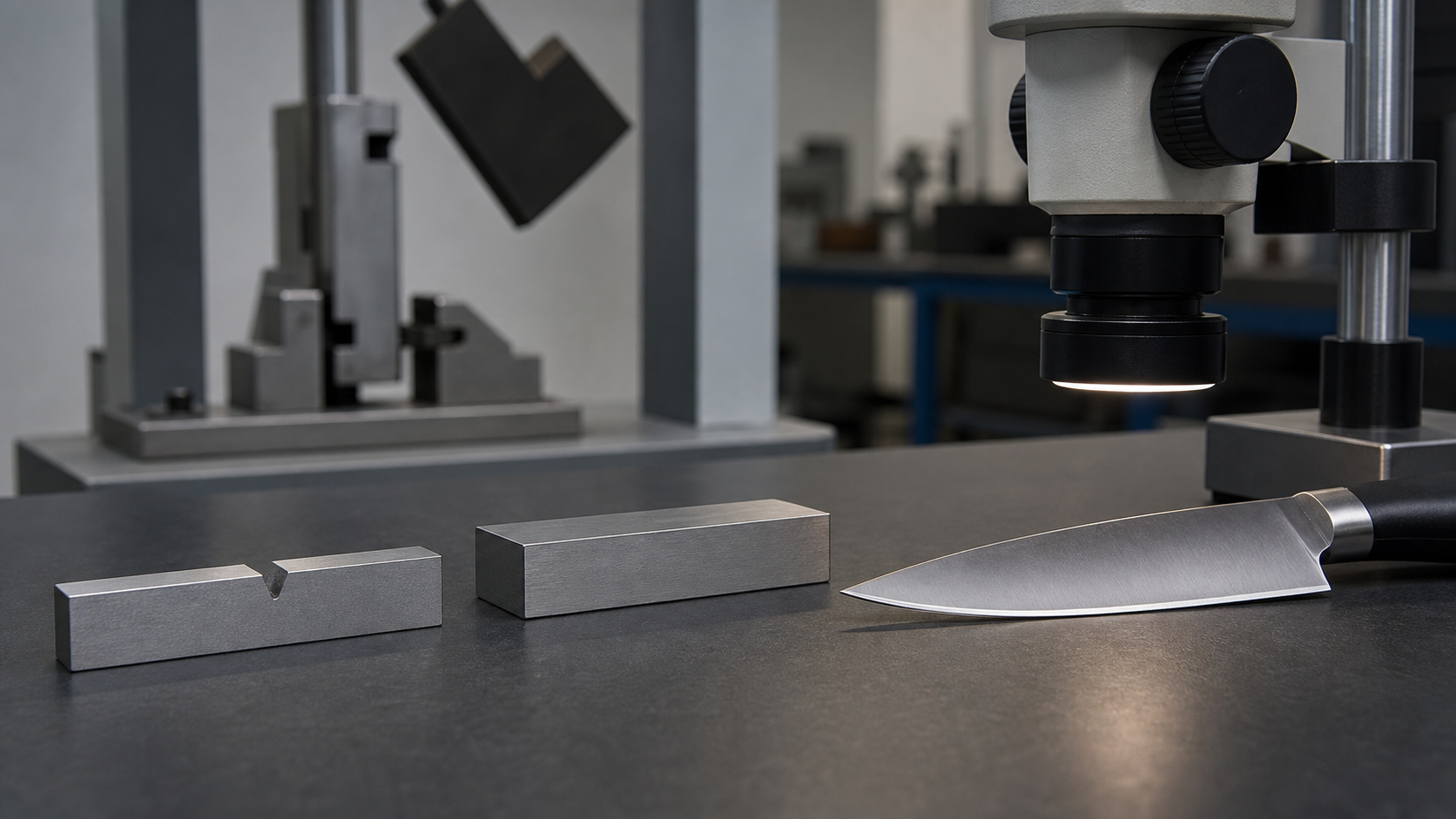
Impact resistance describes behavior under rapid loading or impact. Charpy and Izod tests are established examples for metallic materials.
These tests use defined notched specimens subjected to rapid impact. Results depend on factors including specimen geometry, notch type, temperature and loading conditions.
A Charpy absorbed-energy value can therefore be useful for comparing materials tested under the same method and conditions. It should not be translated directly into a statement such as “this knife will not chip.”
The geometry of a standardized impact specimen is very different from the geometry of a thin kitchen-knife edge.
Fracture Toughness
Fracture toughness addresses another problem: how a material containing a sharp crack resists further crack propagation.
Depending on the method and material behavior, fracture-mechanics results may be expressed using parameters such as K, KIC, J or CTOD.
These values have their own specimen, crack, thickness and validity requirements. They cannot be replaced by Charpy impact energy, and the numbers should not be compared as if they were different versions of the same scale.
For procurement teams, a supplier claim of “high toughness” is therefore incomplete unless the underlying test method and specimen are identified.
Wear Resistance Is a Property of a Wear System
Wear resistance is often associated with edge retention, but the relationship is not one-to-one.
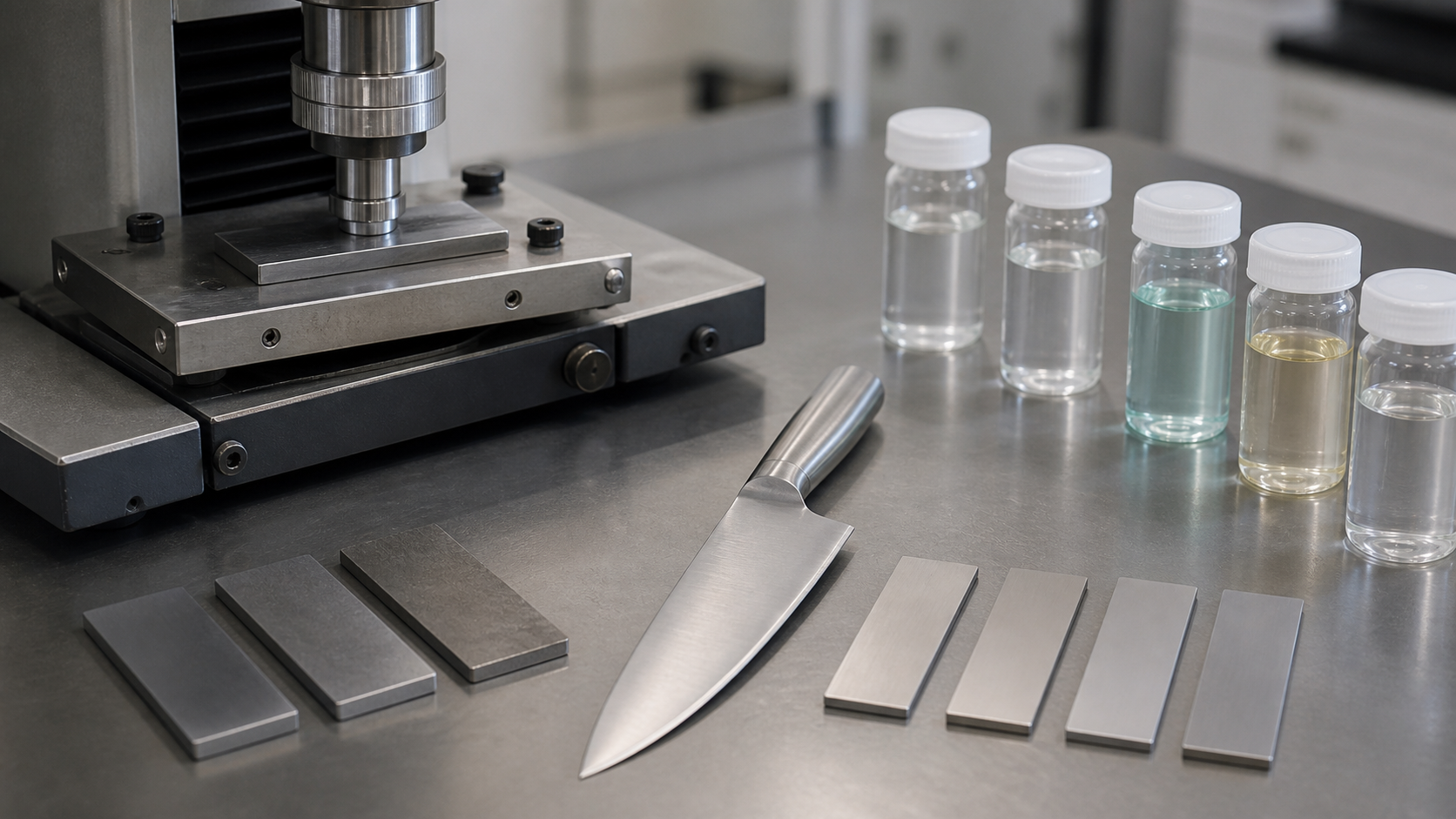
In tribology, wear occurs through mechanical interaction between surfaces. The observed result can change with:
the counter-material;
contact pressure;
sliding speed;
abrasive particles;
direction of motion;
lubrication;
temperature; and
surface condition.
A steel that performs well in one sliding or abrasive-wear test may not maintain the same ranking in another wear system.
This matters for kitchen knives because a cutting edge does not necessarily become dull through wear alone.
Edge degradation may involve several mechanisms:
progressive abrasive or adhesive wear;
plastic deformation or rolling;
micro-chipping;
local fracture;
carbide-related damage;
corrosion-assisted surface deterioration; or
combinations of these mechanisms.
For that reason, a laboratory material-wear result should not automatically be described as a knife edge-retention result.
Finished-blade testing provides different information because it includes the actual blade geometry and cutting interface.
Corrosion Resistance Always Depends on the Environment
“Corrosion resistance” also requires conditions.
In corrosion engineering, performance is evaluated within a defined corrosion system. The material, surface condition and environment all form part of that system.
Relevant variables may include:
chloride concentration;
acidity or alkalinity;
temperature;
oxygen availability;
moisture;
exposure time;
solution movement;
cleaning residues; and
surface finish.
This is why results from different corrosion tests are not automatically interchangeable.
For example, a ferric-chloride pitting test, an immersion test and exposure to real food residues represent different environments. A material ranking established under one condition may change under another.
The same limitation applies to accelerated tests. They can provide useful comparative information when procedures are controlled, but they do not prove that a knife will remain corrosion-free under every food, cleaning, storage or dishwasher condition.
For B2B communication, terms such as rust-proof or corrosion-free should therefore be avoided unless an extremely narrow and fully supported meaning has been established.
A more technically defensible statement is that corrosion behavior depends on the alloy condition, surface state and exposure environment.
What Does “Edge Stability” Mean?
Unlike Rockwell hardness or standardized fracture-toughness parameters, edge stability does not currently function as a single universal ASTM or ISO knife measurement.
In knife discussions, the term is commonly used to describe the ability of a thin edge to resist undesirable deformation or damage, particularly:
rolling;
permanent plastic deformation;
micro-chipping; and
localized fracture.
The concept is useful, but only if the test conditions are defined.
A meaningful edge-stability comparison would need to control variables such as:
edge angle;
thickness behind the edge;
edge radius or finishing condition;
applied load;
loading direction;
contact material;
number of cycles; and
the definition of failure.
Without those conditions, statements such as “30% better edge stability” are difficult to interpret or reproduce.
Edge stability should also be kept separate from sharpness and edge retention.
Sharpness describes cutting capability at a given point in time. Edge retention describes how that cutting capability changes during a defined test. Edge stability focuses more specifically on whether the geometry remains mechanically supported without rolling or fracturing.
Composition Sets the Possibilities, Not the Final Result
Steel composition is important, but a grade name or composition table does not completely define the final blade.
Composition influences which phases and carbides can form and how the steel can respond to heat treatment.
In martensitic stainless steels, for example, carbon and chromium can be distributed between the steel matrix and carbide phases. That distribution can influence several properties at the same time.
Carbides may contribute to wear resistance under some conditions. At the same time, carbide type, size, quantity and distribution can affect fracture-related behavior. Chromium tied up in carbide phases also changes the chemistry of the surrounding matrix, which can affect corrosion behavior.
The important point is not that carbides are inherently “good” or “bad.”
Their effect is conditional.
A material name alone cannot establish:
carbide size;
carbide distribution;
matrix chemistry;
final hardness;
fracture behavior;
corrosion performance; or
finished-edge retention.
Those characteristics depend on the actual material condition and processing history.
Heat Treatment Changes the Material State
Heat treatment sits between nominal composition and finished performance.
Heating, transformation, cooling, tempering and steel-specific secondary treatments can change the matrix, carbide condition, retained phases and residual stresses.
As a result, two products made from the same nominal steel grade do not necessarily have identical properties.
Hardness measurements can help verify one aspect of the final condition, but HRC alone cannot reconstruct the complete heat-treatment history or microstructure.
This is also why a buyer should be cautious when comparing published material data with finished commercial knives. Supplier datasheets, research specimens and production blades may have different thermal histories, dimensions and surface conditions.
Geometry Can Change the Result as Much as the Material
A kitchen knife is not simply a steel coupon.
Edge angle, thickness behind the edge and overall blade geometry change the stresses experienced during cutting.
Controlled cutting studies show that edge geometry can affect initial cutting performance and the way cutting ability changes with continued use. Smaller edge angles can improve initial cutting behavior under some test conditions, but the durability of that geometry remains dependent on the material, microstructure, loading and cutting medium.
This means that two knives with the same steel and the same nominal HRC can still behave differently if their edge geometry differs.
It also means there is no technically defensible universal “best edge angle” for every kitchen knife.
The appropriate geometry depends on the intended task and the acceptable failure mode.
Similar HRC Values Do Not Guarantee Similar Edge Retention
Experimental knife studies provide a useful illustration of the limits of hardness-only comparison.
Research on several martensitic stainless knife steels has found that specimens with similar hardness values can still show different sharpness-retention behavior under the same cutting method.
The result does not establish a universal ranking of those steels. It does demonstrate a narrower and more useful point:
similar hardness does not guarantee identical cutting-edge performance.
Possible reasons include differences in microstructure, carbide characteristics, matrix behavior and interactions between the material and edge geometry.
For buyers, this is a strong reason to separate hardness verification from finished-blade cutting tests.
Different Test Methods Should Not Be Directly Ranked
Before comparing two supplier reports, the first question should be whether they are actually measuring the same thing.
For hardness data, check:
test method and standard;
Rockwell scale;
test location;
surface condition;
specimen or blade thickness;
number of readings; and
reported variation.
For impact or fracture data, check:
Charpy, Izod or fracture-mechanics method;
specimen dimensions;
notch or fatigue precrack;
test temperature;
loading rate; and
validity requirements.
For wear data, check:
wear mechanism;
counter-material;
load;
speed;
movement type;
abrasive medium;
duration or sliding distance; and
result units.
For corrosion data, check:
test solution;
concentration;
temperature;
exposure time;
oxygen or agitation conditions;
surface preparation; and
evaluation method.
For knife cutting tests, check:
cutting medium;
edge angle;
thickness near the edge;
initial sharpness;
load;
cutting stroke;
number of cycles; and
failure or endpoint definition.
If those conditions differ materially, the numbers should not be presented as a direct performance ranking.
A Better Procurement Framework
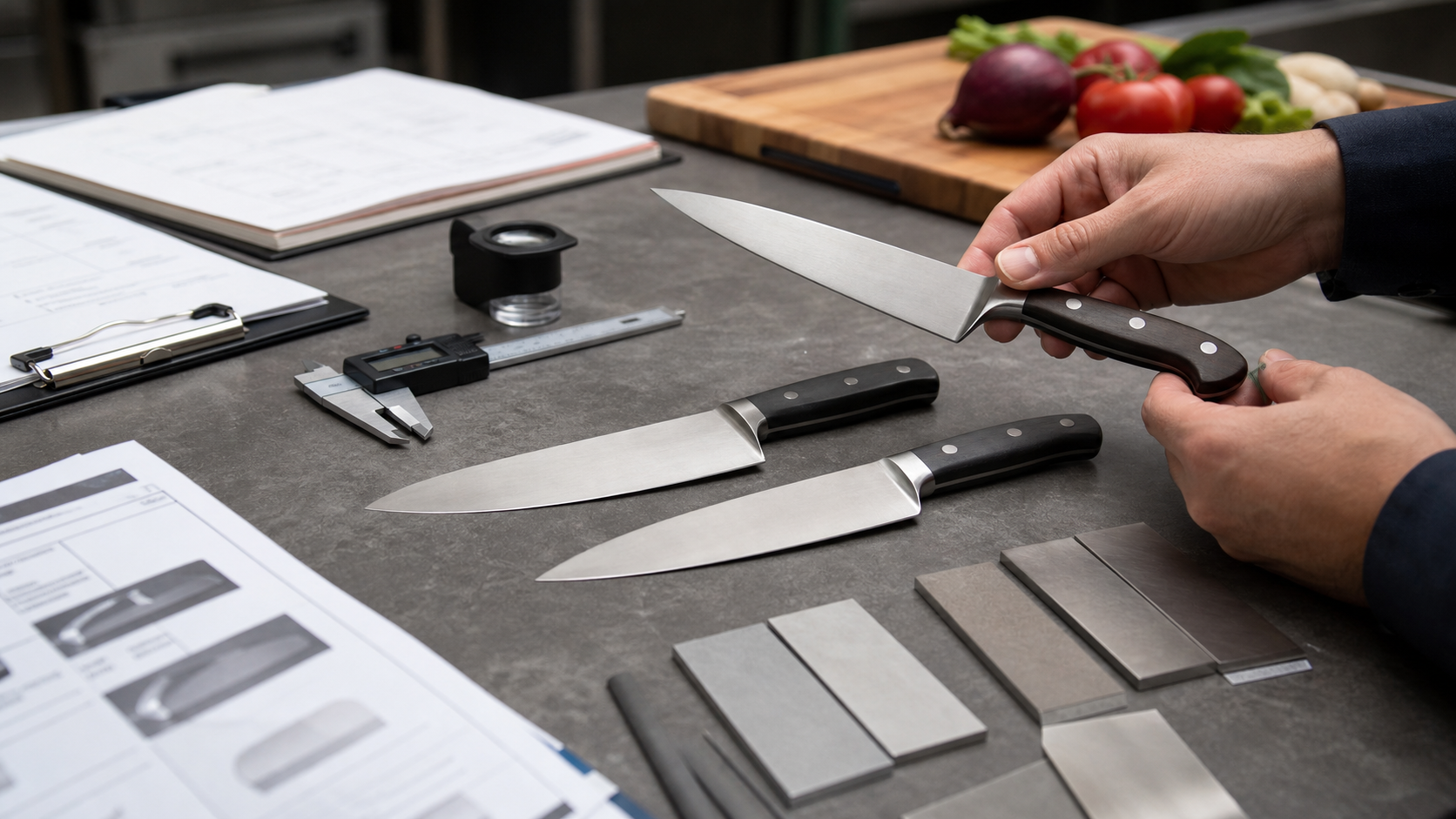
Instead of asking which single specification is highest, buyers can evaluate a knife through a linked evidence package.
A practical sequence is:
Confirm the exact material grade and applicable material standard.
Verify the reported material or batch documentation.
Identify the heat-treated product condition.
Review hardness results together with test location and method.
Define the blade and edge geometry.
Identify the intended cutting task and expected failure risks.
Match wear, corrosion, impact or cutting tests to those risks.
Compare only results produced under equivalent methods and conditions.
Separate material-coupon tests from finished-product tests.
Maintain traceability between approved samples, reports and production batches when product-specific conclusions are required.
This approach is more informative than relying on a single HRC number or an undefined statement such as “high toughness” or “superior edge retention.”
The Key Question Is Not “Which Property Is Highest?”
Hardness, strength, toughness, fracture toughness, impact resistance, wear resistance, corrosion resistance and edge stability describe different aspects of material or product behavior.
Each property can be useful. None of them is a complete measure of kitchen-knife quality.
A technically meaningful comparison therefore needs to connect:
material composition, microstructure, heat treatment, blade geometry, use environment and the correct test method.
For sourcing and quality teams, the goal should not be to find the highest individual number. It should be to determine whether the available evidence is relevant to the intended product, generated under comparable conditions and sufficient to support the specific performance claim being made.
References
- ASTM E18-25 — Standard Test Methods for Rockwell Hardness of Metallic Materials
- ISO 6508-1:2023 — Metallic materials — Rockwell hardness test — Part 1: Test method
- ASTM E8/E8M-25 — Standard Test Methods for Tension Testing of Metallic Materials
- ISO 6892-1:2019 — Metallic materials — Tensile testing — Part 1: Method of test at room temperature
- ASM International — Toughness
- ISO 148-1:2016 — Metallic materials — Charpy pendulum impact test — Part 1: Test method
- ASTM E23-25 — Standard Test Methods for Notched Bar Impact Testing of Metallic Materials
- ASTM E399-24 — Standard Test Method for Linear-Elastic Plane-Strain Fracture Toughness of Metallic Materials
- ISO 12135:2021 — Metallic materials — Unified method of test for the determination of quasistatic fracture toughness
- ASTM G40-25a — Standard Terminology Relating to Wear and Erosion
- ASTM G77-17(2022) — Standard Test Method for Ranking Resistance of Materials to Sliding Wear Using Block-on-Ring Wear Test
- ASTM G133-22 — Standard Test Method for Linearly Reciprocating Ball-on-Flat Sliding Wear
- ASTM G31-21(2025) — Standard Guide for Laboratory Immersion Corrosion Testing of Metals
- ASTM G48-25 — Pitting and crevice corrosion resistance by use of ferric chloride solution
- ASTM G119-09(2021) — Standard Guide for Determining Synergism Between Wear and Corrosion
- ISO 8044:2024 — Corrosion of metals and alloys — Vocabulary
- ISO 11845:2020 — Corrosion of metals and alloys — General principles for corrosion testing
- ISO 8442-5:2004 — Specification for sharpness and edge retention test of cutlery
- Effect of Alloying Elements on the Sharpness Retention of Knife Blades Made of High Carbon Martensitic Stainless Steels (Metals, 2022)
- A Comprehensive Understanding of Knife Cutting: Effects of Hardness, Blade Angle and the Micro-Geometry of Blade Edge on the Cutting Performance (Materials, 2023)