
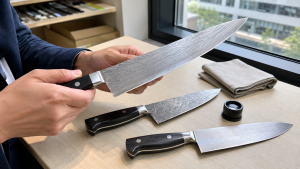
Damascus Patterns, Clad Steel, and Decorative Knife Finishes: What Buyers Can Actually Verify
Damascus can describe historical crucible steel, modern pattern-welded material, patterned cladding, or surface treatment. Buyers should verify construction and evidence rather than infer performance from appearance.
Why Stainless Steel Knives Can Still Show Spots, Discoloration, or Corrosion
Stainless steel can still show drying marks, deposits, heat tint, contamination, or localized corrosion. Buyers should classify the visible condition and verify metal loss before assigning a cause.
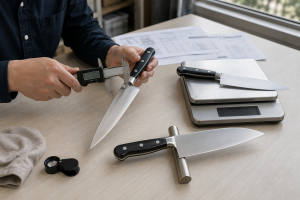
Knife Blade Thickness, Weight and Balance: What Each Specification Actually Changes
Blade thickness, total weight, mass distribution, and balance describe different properties. Buyers should measure them separately and keep subjective handling evaluations distinct from objective specifications.
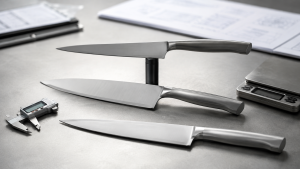
Kitchen Knife Surface Finishes: What Mirror, Brushed, Hammered and Coated Really Mean
Mirror, brushed, hammered, stonewashed, and coated describe appearance, not complete performance specifications. Buyers should connect finish names to measurable surface conditions, maintenance requirements, and product-specific tests.
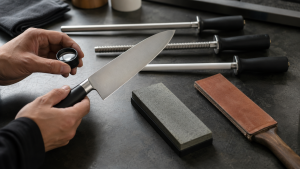
Sharpening, Honing, Steeling, Stropping, and Edge Repair: Why Knife-Care Terms Are Not Interchangeable
Sharpening, honing, steeling, stropping, thinning, and edge repair are not interchangeable. Buyers should define material removal, blade location, geometry change, and damage condition before specifying knife care.
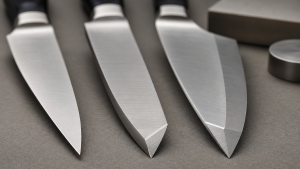
Kitchen Knife Edge Angle and Thickness: Why One Number Cannot Predict Cutting Performance
Edge angle matters, but it cannot predict cutting performance on its own. Buyers should compare apex condition, behind-the-edge thickness, blade geometry, material condition, test method, and intended task.
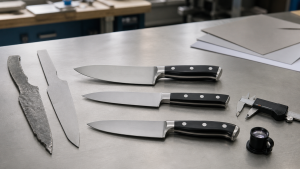
Forged vs. Stamped Kitchen Knives: Manufacturing Routes, Structural Clues, and Buyer Misconceptions
Forged and stamped describe manufacturing routes, not universal quality grades. Buyers should verify how the blank was formed, what downstream processes followed, and what product-specific evidence supports performance claims.
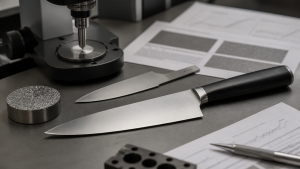
Why Heat Treatment Changes Kitchen Knife Performance
Heat treatment affects far more than HRC. Buyers should connect material identity, documented process history, measured steel condition, and finished-knife testing instead of treating one hardness value or process label as proof.
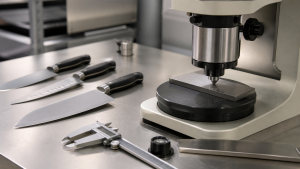
Why Higher HRC Does Not Always Mean a Better Kitchen Knife
Rockwell C hardness, usually shown as HRC, is one of the most familiar numbers on a kitchen knife specification sheet. Buyers may see two knives listed at 58 HRC and 60 HRC and assume that the second is automatically harder, more durable, or better at holding an edge.