
Knife Knowledge · Handles & Humidity
Why Wooden Knife Handles Can Shrink, Swell, or Develop Small Gaps as Humidity Changes
Wood continues to exchange moisture with its environment after assembly. Buyers should evaluate humidity, grain direction, finish, construction, and inspection conditions before assigning a cause to dimensional change.
Quick answer
Wooden handles can shrink or swell as their moisture condition changes, but no universal percentage predicts a finished knife. A visible interface line is evidence to document—not a root-cause diagnosis by itself.
Wooden knife handles are often treated as if they were dimensionally fixed components once a knife has been assembled. In practice, wood remains a hygroscopic material: it can exchange moisture with the surrounding air after machining, finishing, assembly, shipping, and storage.
As environmental conditions change, the moisture content of the wood can also change. That change can produce small dimensional movements in the handle material.
For kitchen-knife buyers, importers, product managers, and quality teams, the important point is not simply that “wood moves.” The more useful question is how wood moves, which factors control that movement, and when a visible change at a wood-to-metal interface is actually meaningful.
A small gap between a wooden handle scale and a steel tang, for example, is an observable condition. By itself, however, it does not identify the root cause or establish whether the product is outside specification.
Wood Remains Hygroscopic After a Knife Is Manufactured
Wood interacts continuously with moisture in its environment.
When surrounding air becomes more humid, wood can absorb water vapor. When the surrounding environment becomes drier, wood can release moisture. This process continues until the wood approaches a moisture condition that is in equilibrium with the surrounding environment.
This condition is commonly described as equilibrium moisture content, or EMC.
EMC is influenced mainly by environmental relative humidity and temperature, although wood species, previous moisture history, and the condition of the individual piece can also affect the result.
This means that drying wood before manufacture does not make it permanently dimensionally fixed.
Terms such as kiln-dried describe a drying process or starting material condition. They do not mean that the finished wooden handle can no longer absorb or release moisture during later storage and use.
For buyers, this distinction matters particularly when products move between different climates. A handle assembled under one environmental condition may later spend weeks in a warehouse, shipping container, distribution center, retail environment, or kitchen with a different humidity profile.
The wood may gradually adjust to those new conditions.
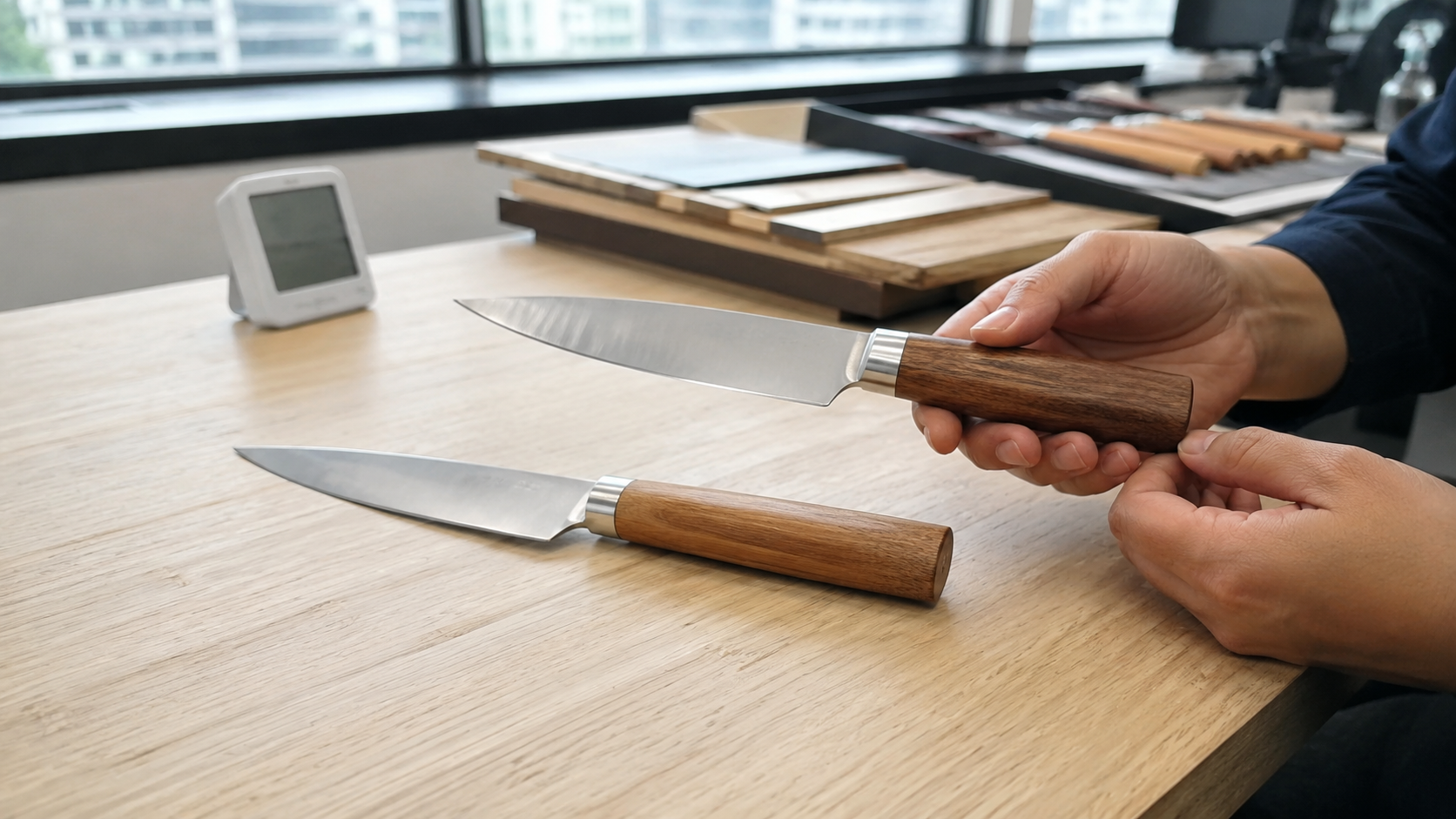
Why Moisture Changes Can Change Wood Dimensions
Much of the dimensional behavior of wood is related to water associated with its cell-wall structure.
As the moisture condition of the cell walls changes, the wood structure can contract or expand. In practical terms, loss of moisture can produce shrinkage, while moisture gain can produce swelling.
However, this relationship should not be simplified into a universal rule such as:
“Wood shrinks by X percent.”
There is no single shrinkage percentage that can be applied safely to every wooden knife handle.
Actual movement depends on multiple variables, including:
- wood species;
- the individual piece of wood;
- initial moisture content;
- final moisture condition;
- grain and growth-ring orientation;
- the direction in which dimensions are measured;
- drying and conditioning history;
- surface finish;
- handle dimensions;
- assembly design;
- and the duration and severity of environmental exposure.
Published wood-property tables can be useful for understanding general material behavior, but they should not automatically be converted into predictions for a finished knife handle.
Many published shrinkage values, for example, describe controlled wood specimens moving between specified moisture conditions. Those conditions may be very different from the relatively modest seasonal humidity change experienced by a finished kitchen knife.
Wood Does Not Move Equally in Every Direction
One of the most important characteristics of wood is dimensional anisotropy.
Wood behaves differently along different anatomical directions.
The three main directions used in wood science are:
- longitudinal — approximately along the main direction of the wood fibers;
- radial — roughly perpendicular to the growth rings, moving outward from the center of the tree;
- tangential — approximately tangent to the growth rings.
As a general wood-science principle, dimensional movement tends to be greatest in the tangential direction, smaller in the radial direction, and much smaller in the longitudinal direction.
These are general tendencies rather than fixed ratios that apply to every species and every individual piece.
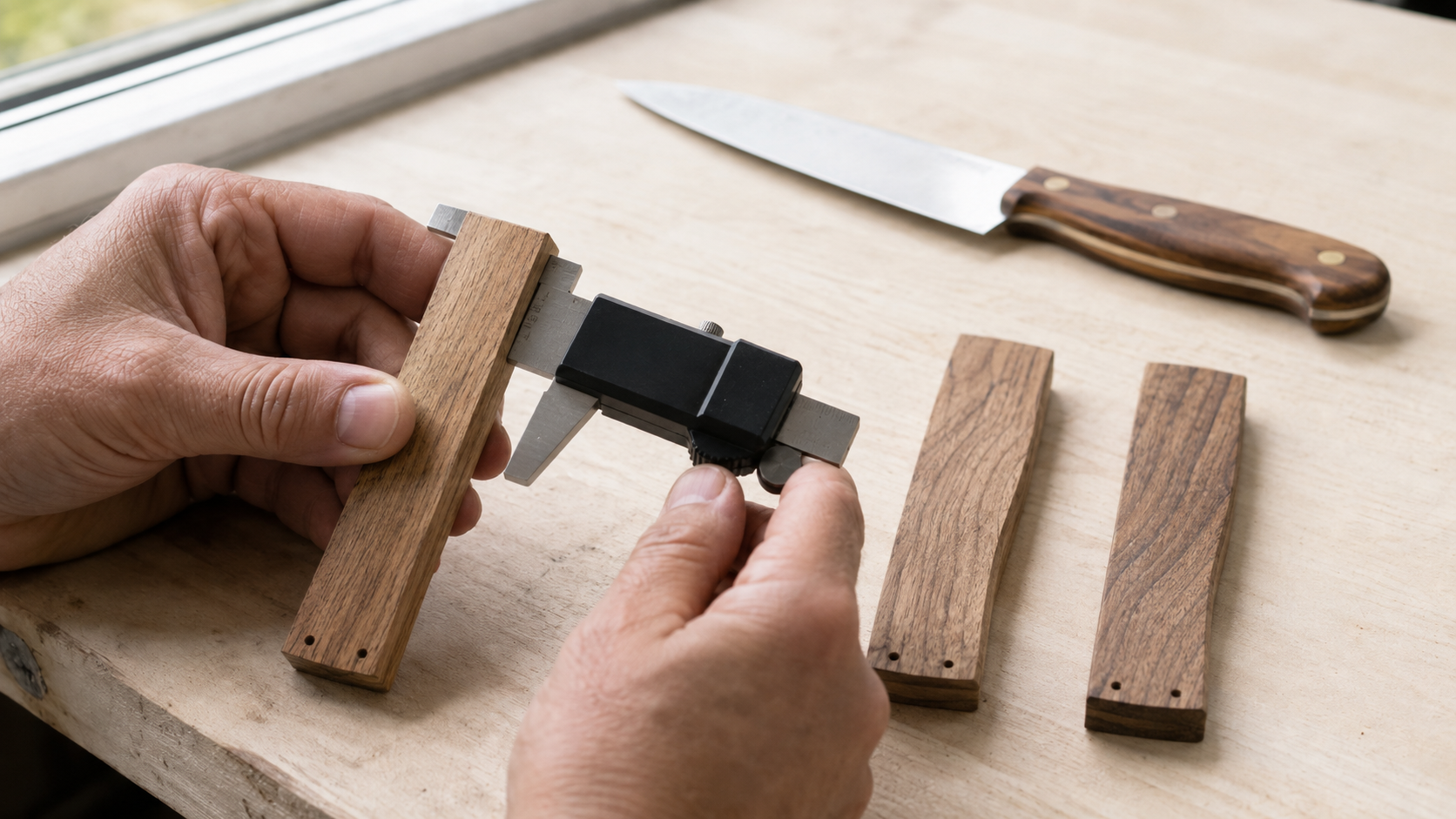
For a knife handle, the important question is how these anatomical directions correspond to the finished handle’s length, width, and thickness.
Two handle scales made from the same wood species may therefore behave differently if their growth-ring orientation is different.
This is one reason why the wood species name alone is insufficient for predicting dimensional movement.
A specification such as “walnut handle,” “olive wood handle,” or “wooden scale” does not by itself reveal the moisture condition, grain orientation, drying history, or actual dimensional response of the finished component.
A Knife Handle Is a Multi-Material Assembly
A wooden knife handle is usually not an isolated block of wood.
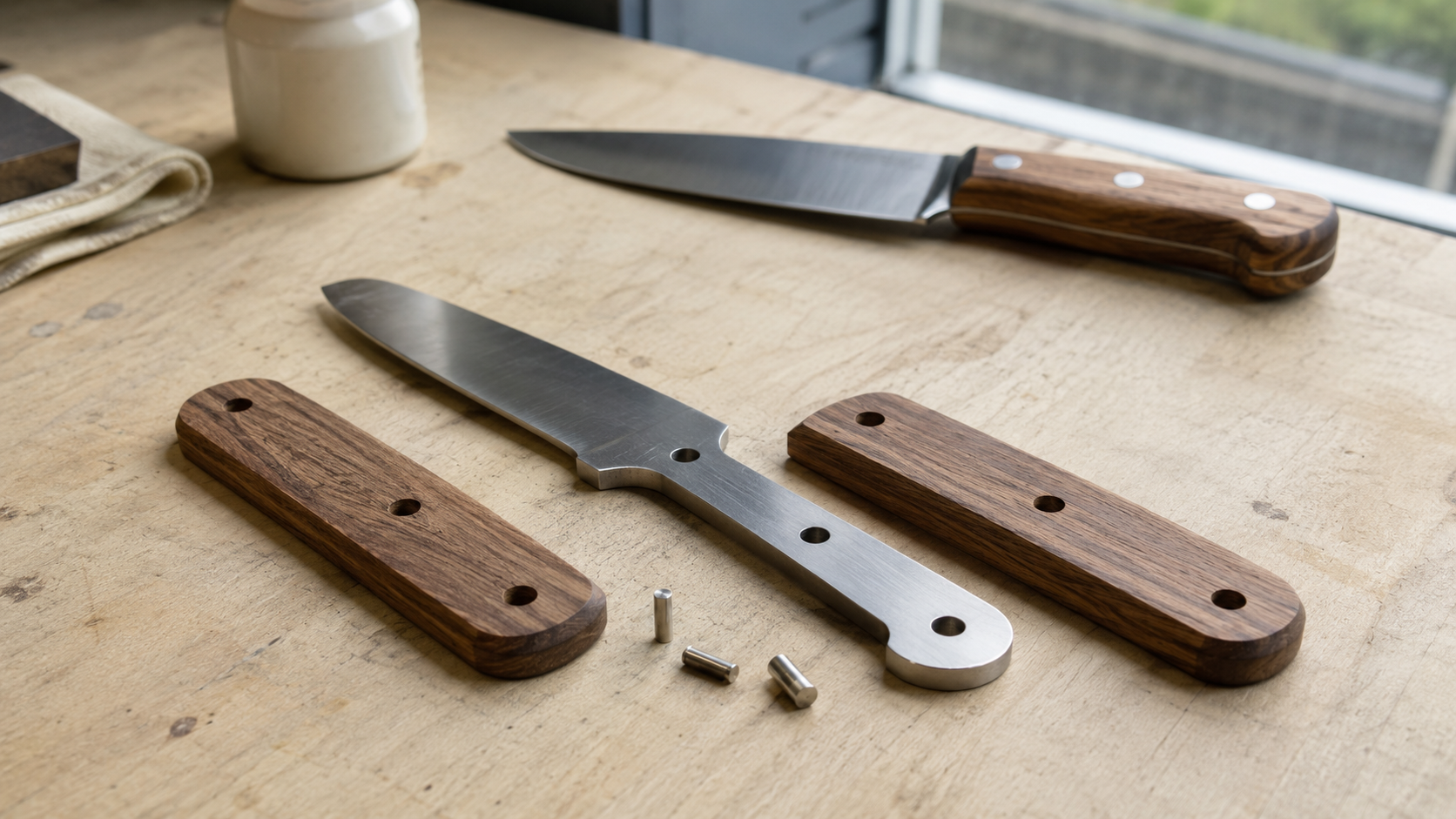
Depending on the construction, the finished handle may combine:
- wooden scales or a wooden body;
- a steel tang;
- metal pins or rivets;
- liners or spacers;
- adhesive bondlines;
- and one or more surface finishes.
These materials do not respond to environmental changes in the same way.
Wood
Wood responds strongly to changes in moisture condition and does so anisotropically.
Its dimensional response therefore depends on both environmental conditions and material orientation.
Steel Tang
Steel does not follow the same moisture-driven mechanism as wood.
Metal dimensions can change with temperature through thermal expansion, but steel does not respond to atmospheric relative humidity in the same way as hygroscopic wood.
Even within stainless steels, thermal expansion properties are not identical across every grade.
The relevant point for a knife-handle assembly is therefore not that steel is completely dimensionally fixed, but that wood and steel respond differently to the same environment.
Rivets and Pins
Metal pins and rivets introduce mechanical restraint into the assembly.
They may limit movement at particular locations, but they do not make the wood itself non-hygroscopic.
Their effect depends on factors such as:
- fastener material;
- diameter;
- hole dimensions;
- spacing;
- interference or clearance;
- wood grain orientation;
- and the overall handle structure.
The presence of more fasteners should therefore not automatically be interpreted as proof of greater dimensional stability.
Adhesive Bondlines
Adhesives introduce another material system.
Wood moisture content can affect bonding conditions, and later moisture-driven dimensional changes can create stresses within a bonded assembly.
However, general wood-bonding principles cannot be used to predict the performance of an unspecified knife-handle adhesive.
Actual behavior depends on the specific adhesive chemistry, surface preparation, bondline condition, cure process, joint geometry, moisture exposure, and service environment.
For this reason, statements such as “epoxy prevents the wood from moving” are too broad.
An adhesive can help hold components together, but it does not eliminate the hygroscopic nature of the wood.
Why Differential Movement Can Change an Interface
When wood, steel, fasteners, and adhesive are combined, they create a restrained multi-material structure.
If the wood changes dimension while the neighboring metal components respond differently, relative movement or local stresses may develop within the assembly.
Depending on the structure and environmental history, this may contribute to:
- a small change in wood-to-steel flushness;
- an interface line becoming more visible;
- localized movement around a fastener;
- changes in the adhesive interface;
- or, under more severe conditions, checking or splitting of the wood.
These are possible outcomes, not automatic consequences.
Humidity change does not mean that a wooden knife handle will necessarily develop a gap.
Predicting whether a particular handle will move enough to create a visible interface change requires product-specific information.
Finishes Can Slow Moisture Exchange, but They Do Not Make Wood Immune to Humidity
Wooden handles may be treated with oils, varnishes, lacquers, coatings, waxes, resins, or other finishing systems.
Such treatments can affect how quickly moisture moves between the wood and the environment.
Protective finishes can generally retard moisture exchange, meaning that the wood may respond more slowly to a change in environmental conditions.
That is different from completely preventing moisture exchange.
Descriptions such as sealed, finished, or coated should therefore not automatically be interpreted as moisture-proof.
The actual effect depends on the finish chemistry, application coverage, film integrity, wear, maintenance, and exposure conditions.
A specific claim about moisture resistance requires evidence for the actual finishing system rather than assumptions based on the general category name.
Moisture History Also Matters
Wood does not always follow a perfectly reversible path as humidity rises and falls.
Wood science describes phenomena including sorption hysteresis and swelling hysteresis, meaning that the relationship between moisture condition and dimensions can depend partly on the material’s previous moisture history.
In practical terms, a piece of wood that returns to approximately the same moisture content after an environmental cycle does not necessarily have to return to exactly the same measured dimension.
This does not mean that every humidity cycle permanently damages a knife handle.
It means only that environmental history can be another relevant variable when investigating dimensional changes.
Short-duration humidity changes may mainly affect material closer to the surface, while longer seasonal or storage exposures provide more time for moisture redistribution through the wood.
For B2B quality investigations, the duration of exposure can therefore matter almost as much as the nominal RH value itself.
Does a Small Gap Automatically Mean a Manufacturing Defect?
No reliable defect diagnosis can be made from the existence of a small visible gap alone.
A gap is an observation.
It does not automatically reveal whether the underlying cause was:
- moisture-related wood movement;
- an original assembly tolerance;
- machining variation;
- adhesive movement or failure;
- a wood check or split;
- fastener movement;
- damage after manufacture;
- or a combination of several factors.
The opposite assumption is also unsafe.
A buyer should not automatically dismiss every gap as “normal wood movement.”
Acceptability is a product-specific question.
It should be evaluated against defined evidence such as:
- the engineering drawing;
- agreed dimensional tolerances;
- a reference or golden sample;
- the original inspection condition;
- the environmental history;
- the location and extent of the gap;
- structural stability;
- and any relevant hygiene or service requirements.
A photograph can document appearance, location, and approximate extent. It usually cannot establish initial moisture content, adhesive integrity, original assembly condition, or root cause.
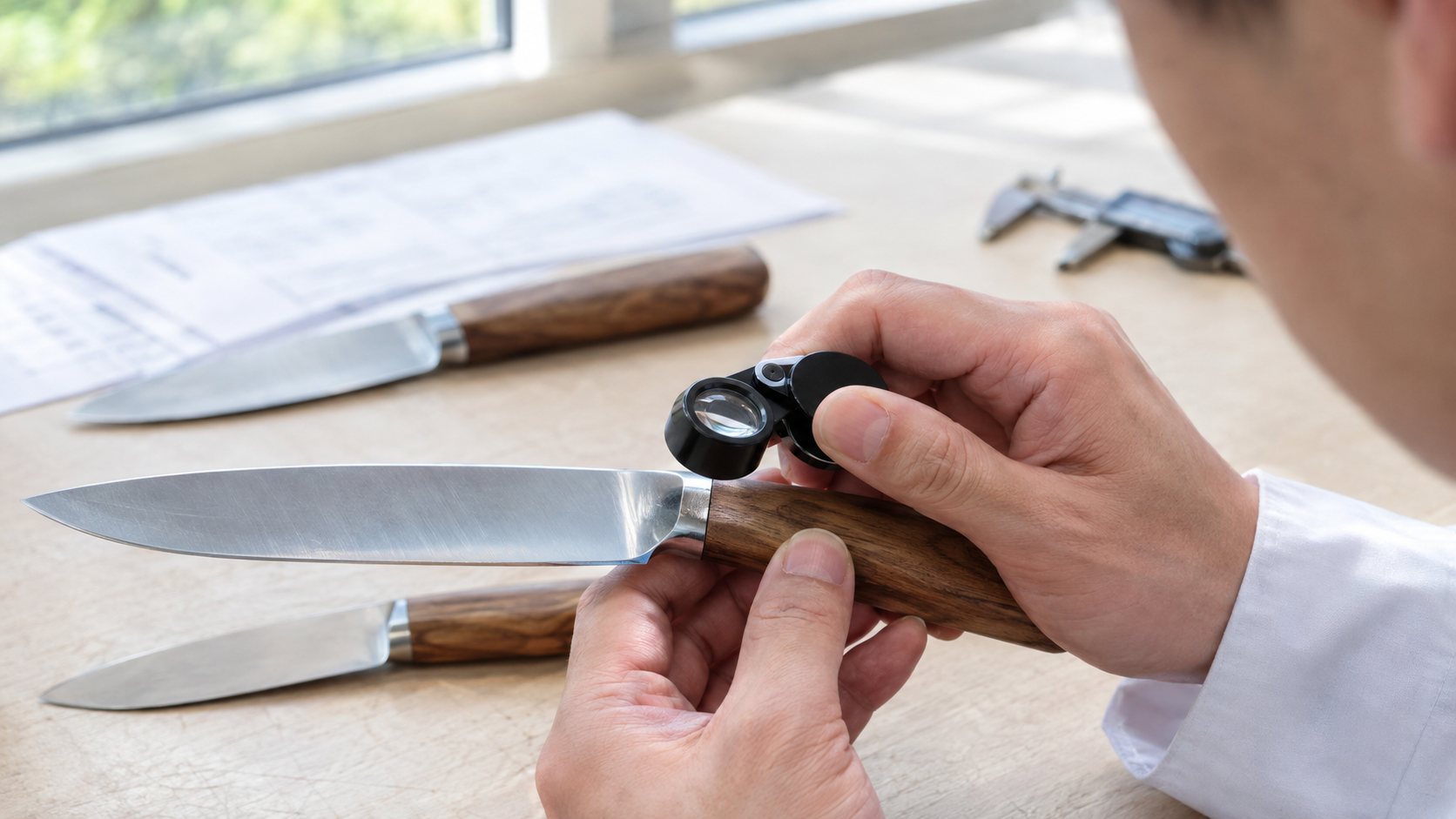
What Buyers and QC Teams Should Verify
When wood-handle dimensional stability matters commercially, specifications should move beyond the material name.
Material Information
Useful information may include:
- identified wood species or material description;
- drying or conditioning information;
- moisture-content controls where relevant;
- grain or growth-ring orientation where it affects the design;
- and the finishing system applied to the wood.
Handle Construction
Buyers may also need to understand:
- full-tang, partial-tang, or hidden-tang configuration;
- wood-scale dimensions;
- pin or rivet arrangement;
- liners or spacers;
- adhesive system;
- and relevant assembly tolerances.
None of these variables should be treated individually as proof of dimensional stability. Their interaction is what matters.
Inspection Conditions
For repeatable dimensional inspection, environmental conditions should be controlled or at least recorded.
Useful information includes:
- temperature;
- relative humidity;
- conditioning time before measurement;
- measurement locations;
- measuring method;
- and the reference specification or sample.
Comparing measurements taken immediately after unpacking in a dry warehouse with measurements taken after long conditioning in a humid environment can produce misleading conclusions if environmental history is ignored.
When Environmental Testing Is Needed
If a buyer needs to establish how a particular handle construction behaves through humidity changes, general wood-property tables are not enough.
A more defensible evaluation would use:
- actual production-style assemblies or representative samples;
- defined temperature and humidity conditions;
- documented conditioning times;
- measurements before and after exposure;
- consistent measurement positions;
- and predetermined acceptance criteria.
The resulting conclusions should then remain limited to the materials, structure, test conditions, and samples evaluated.
The Main Purchasing Lesson
Wooden knife handles should be understood as environment-responsive components within a multi-material assembly.
The basic science is well established: wood is hygroscopic, its moisture condition changes with the surrounding environment, and moisture changes can produce direction-dependent dimensional movement.
What cannot be established from that principle alone is exactly how much a finished knife handle will move or whether a particular visible gap represents a manufacturing defect.
For professional buyers and QC teams, the appropriate approach is therefore not to rely on a universal shrinkage percentage or on appearance alone.
Material identity, moisture condition, grain orientation, finishing system, handle construction, environmental history, product specification, and inspection method all need to be considered together before a reliable product-level conclusion can be made.
References
- USDA Forest Products Laboratory. Wood Handbook, Chapter 4 — Moisture relations and physical properties of wood (2021).
Scope note: These sources support the general principles discussed here; they do not prove the material, performance, compliance, or production history of any specific Tastiva product. Links last checked August 24, 2026.
Continue exploring practical knife specifications and buyer guidance.View all News →