
Knife Knowledge · Sharpening & Maintenance
Sharpening, Honing, Steeling, Stropping, and Edge Repair: Why Knife-Care Terms Are Not Interchangeable
Knife-care terms are not interchangeable. Buyers should define material removal, blade location, geometry change, and damage condition before specifying maintenance tools or repair work.
Quick answer
Sharpening, honing, steeling, stropping, thinning, reprofiling, deburring, and edge repair can involve different tools, material-removal levels, and blade regions. Define the physical process and target geometry instead of relying on the marketing term alone.
For kitchen-knife buyers, product managers, and quality teams, edge-maintenance terminology can create avoidable specification problems.
Terms such as sharpening, honing, steeling, stropping, reprofiling, thinning, deburring, and edge repair are often used as if they describe interchangeable versions of the same operation. They do not.
The difficulty is that some of these words also change meaning between engineering literature, knife manufacturers, sharpening-equipment suppliers, and retail marketing. “Honing” is a particularly clear example: in industrial machining it can describe an abrasive material-removal process, while some kitchen-knife brands use the same word for light edge maintenance or straightening.
For B2B knife specifications, the process name alone is therefore not enough. A more useful approach is to ask four questions:
- Does the operation remove material?
- Which part of the blade does it affect?
- Does it preserve or change the existing geometry?
- What type of edge condition or damage is it intended to address?
This distinction matters when evaluating knife-care instructions, accessories, repair services, and supplier specifications.
Sharpening Usually Means Creating or Restoring a Cutting Edge
In the narrower kitchen-knife sense, sharpening normally involves removing steel to create or restore a functional cutting edge.
Abrasive stones, grinding systems, abrasive belts, wheels, pull-through sharpeners, and some abrasive rods can all perform sharpening, although their material-removal rates and resulting geometries can differ substantially.
The important feature is not the tool shape. It is that material is removed from the edge region to form a new apex or restore an existing bevel.
Manufacturers including Wüsthof and Victorinox distinguish this type of sharpening from lighter maintenance operations by explaining that sharpening removes steel and creates a new edge.
However, buyers should still be cautious with the word itself. In commercial knife-care catalogs, sharpening may also be used as an umbrella category containing honing steels and other maintenance tools.
A specification such as “supplied with sharpening steel” therefore does not establish how aggressively the rod removes material.
Why “Honing” Is Particularly Ambiguous
Few knife-maintenance terms create more confusion than honing.
In engineering terminology, honing is not inherently a non-abrasive process. ASM technical literature describes honing as a machining and surface-finishing process that uses bonded abrasives and removes material.
Kitchen-knife marketing often uses the same word differently.
Some knife manufacturers describe honing as a maintenance operation that straightens or realigns an edge between more substantial sharpening sessions. At the same time, sharpening-equipment manufacturers may call the use of ceramic abrasives, fine abrasive wheels, or abrasive compound-loaded leather wheels “honing.”
These operations clearly do not share one material-removal mechanism.
For a buyer or product manager, the practical rule is simple:
Do not infer what a honing tool does from the word “honing” alone.
Instead, identify:
- the tool material;
- whether the working surface is smooth, grooved, ceramic, diamond-coated, CBN-coated, or otherwise abrasive;
- whether a polishing or abrasive compound is applied;
- the intended edge condition;
- and whether the stated purpose is straightening, deburring, refining, sharpening, or another operation.
“Honing” can be useful terminology only when the physical process is also defined.
Steeling Describes an Operation, Not One Universal Mechanism
Steeling generally refers to drawing a knife edge along a rod-shaped tool. That description says relatively little about what happens at the edge.
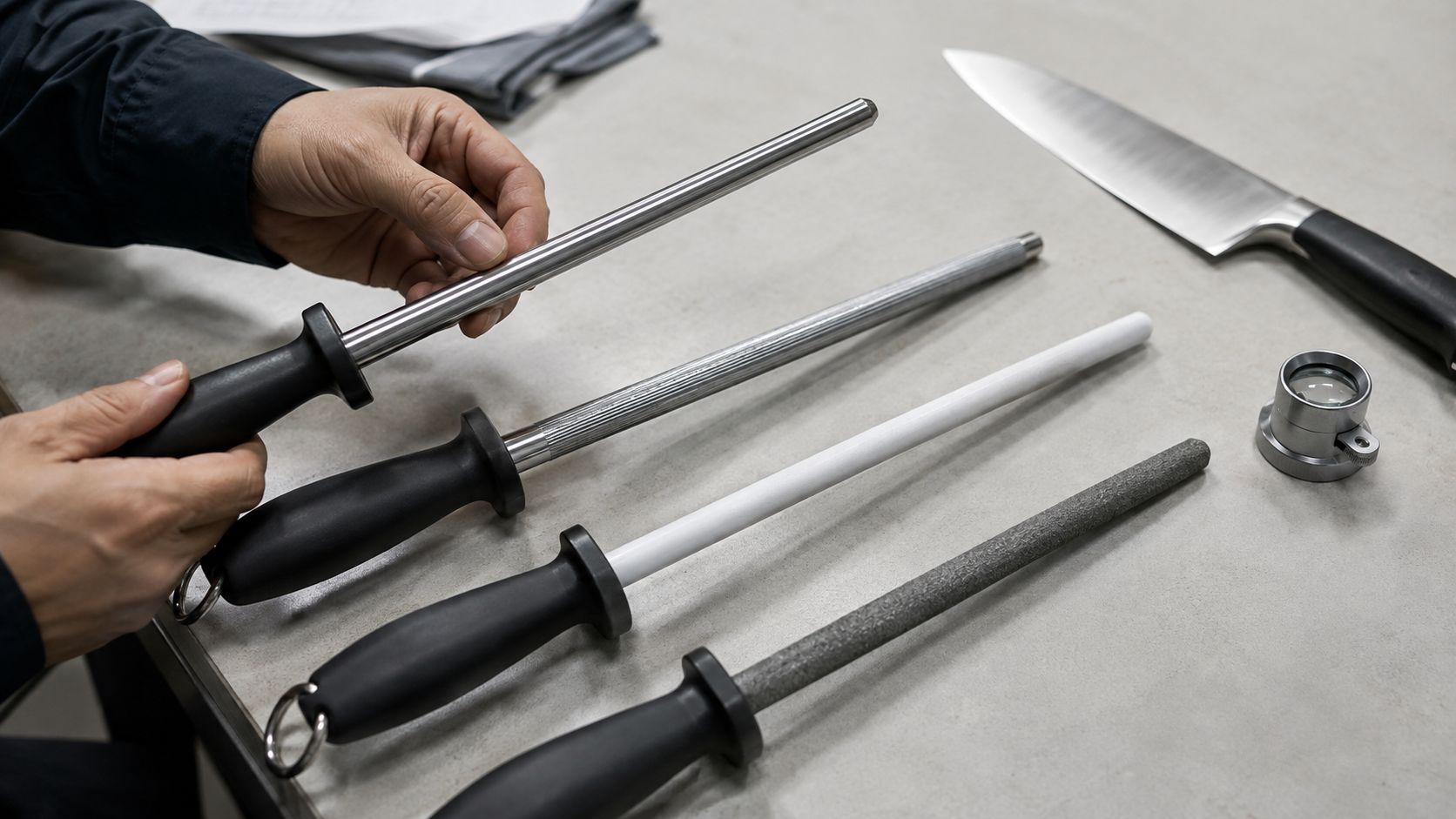
A polished steel rod, a deeply grooved steel rod, a ceramic rod, and a diamond-coated rod may all look broadly similar from a distance, but they should not automatically receive the same technical description.
Smooth or Polished Steel Rods
A traditional polished steel has no intentionally abrasive coating or pronounced cutting grooves.
Friedr. Dick, for example, describes its polished steels as being intended primarily for straightening and polishing, with no designed abrasive cut.
That is meaningfully different from a ceramic or diamond abrasive.
However, it is safer to describe such tools in terms of their intended low-abrasion straightening or burnishing role rather than making the absolute claim that they can never remove any metal.
Actual contact behavior can depend on edge geometry, pressure, surface condition, steel condition, and measurement sensitivity. Public sources do not justify treating “zero material removal under all conditions” as a universal physical law.
Grooved or Cut Steel Rods
Traditional steel rods can also have different surface cuts.
Manufacturers distinguish rough, standard, fine, and polished surfaces because the working surface changes how aggressively the rod interacts with the edge.
A coarse or strongly cut rod can have materially different effects from a polished rod.
For procurement purposes, “steel honing rod” is therefore incomplete information. The rod’s surface pattern and intended abrasion level should also be specified.
Ceramic, Diamond, and CBN Rods
Ceramic rods are different again.
Friedr. Dick’s technical information for an alumina ceramic sharpening steel explicitly describes metal being abraded from the knife edge and deposited on or in the ceramic surface. Surface loading can subsequently reduce cutting action.
Diamond-coated and CBN rods are also abrasive tools. Some are designed specifically for faster stock removal or for edges requiring more substantial sharpening or reprofiling.
Calling all of these products “honing rods” can obscure an important difference: some are primarily low-abrasion maintenance tools, while others are intentionally abrasive sharpening tools.
Stropping and Deburring Are Related, but They Are Not Synonyms
Stropping normally describes the way an edge is passed over a substrate such as leather, fabric, felt, or another compliant surface, often in an edge-trailing direction.
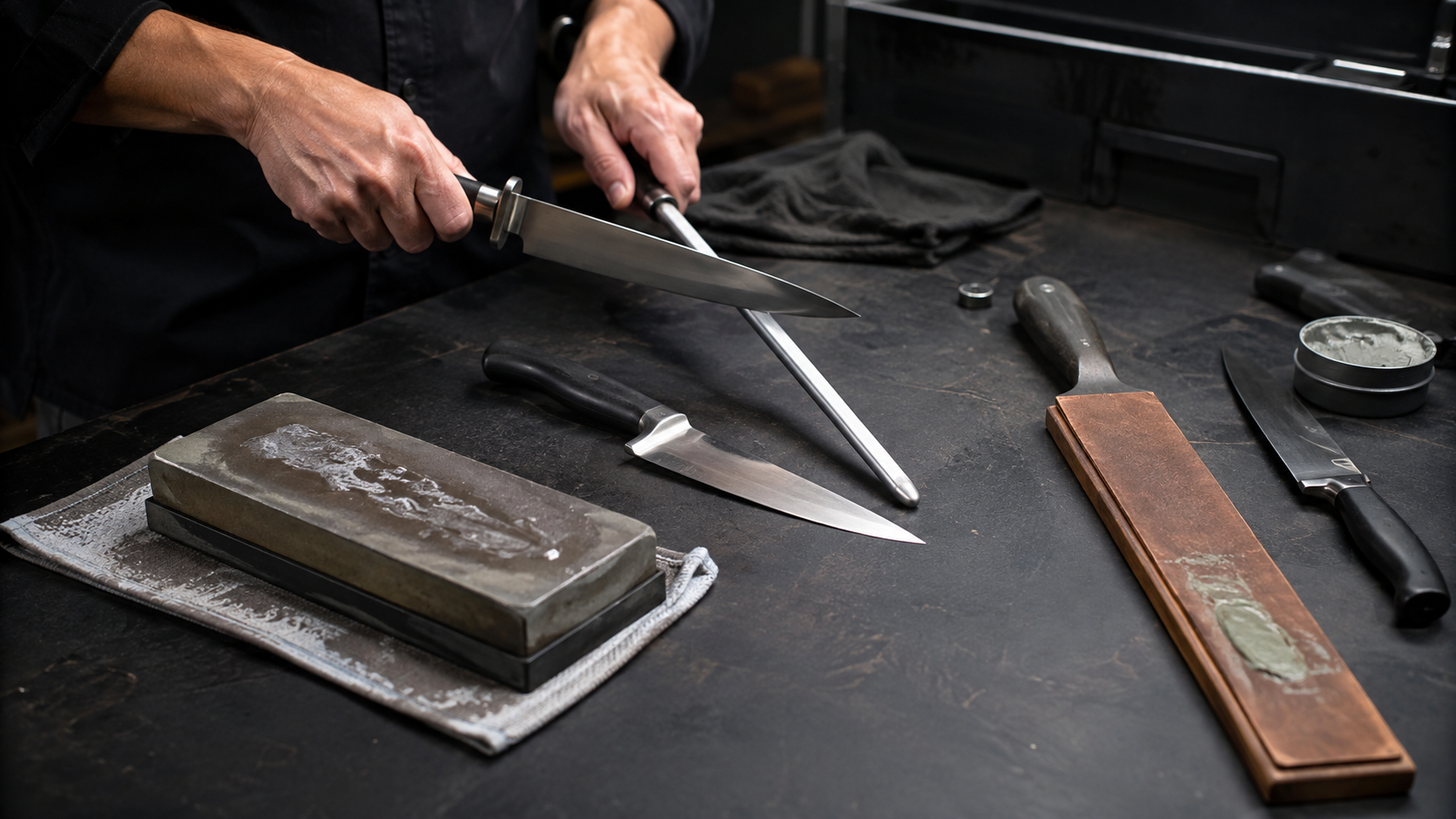
But a strop does not have one fixed abrasive character.
A leather surface loaded with fine abrasive compound is different from an unloaded surface. Work Sharp and Tormek, for example, use abrasive compounds on stropping or honing surfaces specifically to refine the edge and remove small burrs.
For this reason, the statement “stropping does not remove metal” is too broad. A compound-loaded strop uses abrasive particles and can remove small amounts of material.
Deburring, by contrast, describes an objective rather than a specific tool.
A burr can form during abrasive edge creation when thin material is displaced or remains attached near the apex. The purpose of deburring is to remove that unwanted residual material so that it is not simply folded from one side of the edge to the other.
ASM uses deburring more generally for the removal of burrs and unwanted sharp projections from manufactured parts.
On a knife, deburring may be performed with a fine stone, ceramic surface, steel, loaded strop, honing wheel, or another appropriate method.
The key distinction is:
- stropping describes a type of operation and substrate;
- deburring describes the result being sought.
They may occur together, but they are not interchangeable terms.
Reprofiling Changes Geometry More Substantially
Routine sharpening attempts to restore an edge within an acceptable existing geometry.
Reprofiling goes further.
In knife-maintenance literature, the term can refer to resetting the edge angle when an edge has become badly worn, inconsistent, or unsuitable for the intended specification.
It can also be used more broadly for changing the physical profile of a blade—for example, reshaping a point or altering part of the edge outline.
These are not necessarily the same job.
A purchase specification or repair instruction should therefore distinguish between:
- edge-angle reprofiling, where the bevel geometry is being reset; and
- blade-profile reshaping, where the outline of the blade or edge is being changed.
Both normally require more material removal than a light maintenance operation.
Thinning Is Not the Same as Sharpening the Apex
Another frequently confused process is thinning.
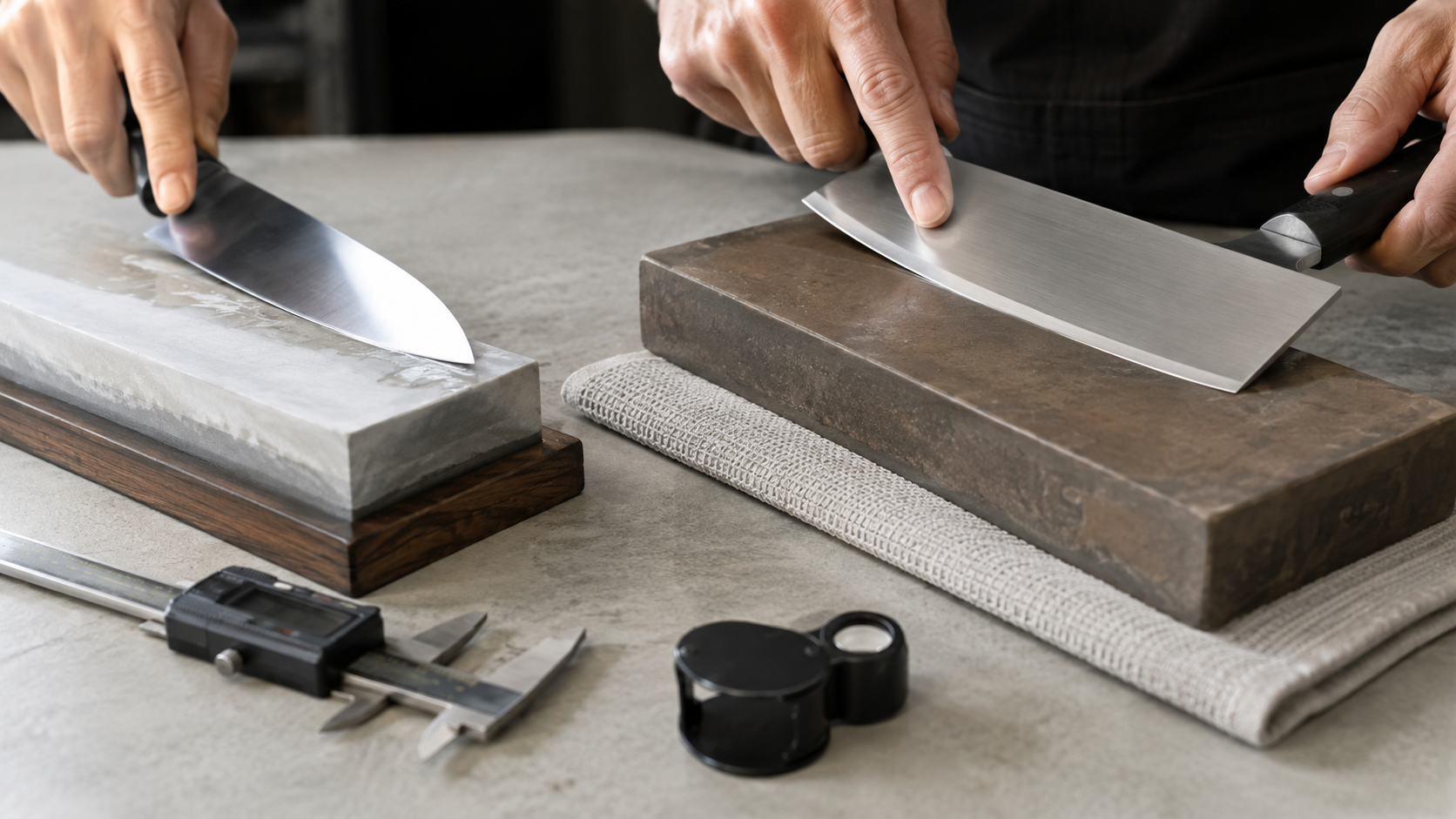
A knife can have a newly sharpened apex and still become relatively thick behind the cutting edge after repeated sharpening.
In that situation, further work only at the apex does not necessarily address the geometry farther up the blade.
Thinning removes material from the region behind the cutting edge, from a primary bevel, or from another lower section of the blade depending on its construction.
This is geometrically different from simply establishing a new secondary bevel.
The distinction is particularly important for Japanese-style knives, single-bevel structures, clad blades, convex grinds, and other constructions where the blade faces themselves form an important part of the cutting geometry.
Thinning can also alter surface finishes, grind marks, cladding appearance, or blade markings. It should therefore not be treated as a cosmetic-free version of routine sharpening.
No fixed thinning interval can be applied responsibly to every knife. The need depends on the starting geometry, previous material removal, cutting requirements, construction, and acceptable finished dimensions.
Edge Repair Begins with Identifying the Damage
Edge repair is best treated as a broad category covering identifiable damage rather than ordinary uniform dulling.
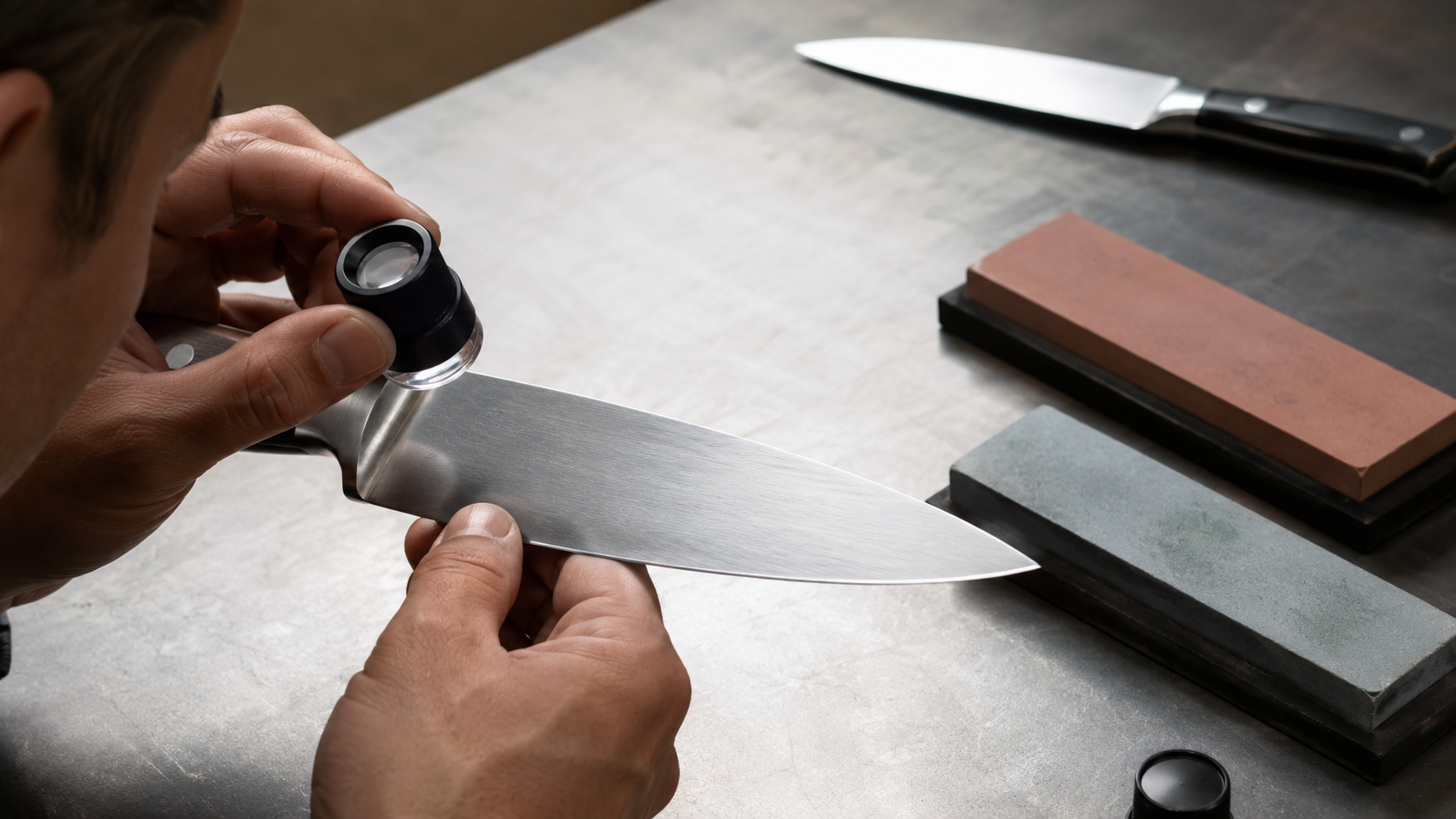
Examples may include:
- chips;
- flat spots;
- localized deformation;
- damaged tips;
- discontinuities in the edge line;
- or other localized defects.
A chipped edge illustrates why the distinction matters.
Repairing a chip generally requires removing enough surrounding material for the new edge line to reach below the deepest part of the defect. Work Sharp’s chip-repair guidance explicitly describes grinding the edge down to the bottom of the chip before rebuilding and refining the edge.
That usually involves substantially more stock removal than a normal sharpening touch-up.
But this does not mean every damaged edge should be treated as a chip. A rolled section, broken tip, severe wear area, or structural crack may require a different diagnosis and process.
“Edge repair” should therefore be followed by a more precise damage description whenever possible.
“开刃” and “修刃” Need Context-Specific English
Chinese commercial terminology adds another translation problem.
开刃 should not automatically be translated as “edge opening.” Depending on the manufacturing or maintenance context, it might refer to:
- initial edge formation;
- initial bevel grinding;
- factory sharpening;
- final edge sharpening;
- or edge reprofiling.
These operations are technically different.
Likewise, 修刃 may describe anything from a light touch-up to deburring, straightening, reprofiling, chip repair, or another corrective operation.
For B2B documentation, describing the actual operation is more useful than forcing these Chinese terms into one fixed English equivalent.
The same principle applies to 磨刀棒.
Rather than using only “honing steel” or “sharpening steel,” specifications can identify the physical tool more precisely:
- polished steel rod;
- grooved steel rod;
- ceramic sharpening rod;
- diamond-coated sharpening rod;
- CBN sharpening rod.
That information tells a buyer far more about the expected mechanism.
What Buyers Should Confirm in Knife-Maintenance Specifications
When a knife, maintenance tool, or repair service is being evaluated, useful questions include:
- What is the edge configuration—double bevel, single bevel, asymmetric, serrated, or another design?
- What part of the blade is being modified: apex, secondary bevel, primary bevel, behind-the-edge region, or complete edge profile?
- Is the process intended to remove no material by design, remove a small amount, or perform substantial stock removal?
- What is the tool material and working surface?
- If an abrasive is present, what abrasive type and grading system are specified?
- Is the objective straightening, sharpening, deburring, polishing, reprofiling, thinning, or damage repair?
- What damage condition was identified before work began?
- What target geometry is expected afterward?
- Could the work affect blade height, surface finish, cladding appearance, coatings, or markings?
- How will the finished edge be evaluated?
For a specific production knife, restoring an original edge angle, behind-the-edge thickness, symmetry, or “factory geometry” normally requires product-specific reference information such as drawings, specifications, approved samples, dimensional records, or inspection data.
The maintenance term itself cannot supply that information.
There Is No Universal Knife-Maintenance Sequence
It is tempting to turn these terms into a fixed sequence: steel first, sharpen second, strop last, and repeat at a predetermined interval.
That approach is too broad for professional specification work.
Knife material, heat-treatment condition, blade geometry, edge thickness, bevel configuration, damage mechanism, cutting task, sharpening equipment, operator technique, and previous maintenance history can all affect what process is appropriate.
Specialized knives may also require specialized equipment. OSHA guidance for poultry-processing operations, for example, distinguishes maintenance methods for different industrial knife types and notes that rotary knives require dedicated sharpening and steeling systems rather than ordinary long rods.
The more defensible approach is therefore condition-based rather than sequence-based.
Identify the edge state first. Then select the process and tool appropriate to that geometry and damage condition.
Conclusion
Sharpening, honing, steeling, stropping, reprofiling, thinning, deburring, and edge repair describe different—and sometimes overlapping—parts of knife-edge maintenance.
The terms become unreliable when they are treated as complete technical specifications.
For professional buyers, the critical information is more concrete:
What material is being removed, from which part of the blade, with what tool, for what edge condition, and toward what target geometry?
That framework avoids the common mistake of assuming that every “honing rod” only straightens an edge, every “sharpening” operation has the same material-removal level, or every damaged knife should follow the same maintenance sequence.
In B2B knife documentation, describing the physical process is usually more useful than relying on the marketing label.
Reference Sources
- ASM International, Honing, ASM Handbook, Volume 16: Machining.
- ASM International, Glossary of Metallurgical and Metalworking Terms.
- U.S. Occupational Safety and Health Administration, Prevention of Musculoskeletal Injuries in Poultry Processing, OSHA 3213.
- Wüsthof, How to Sharpen Your WÜSTHOF Knives.
- Victorinox, How to Sharpen and Hone Your Kitchen Knife.
- Friedr. Dick, Sharpening Steel Manual and sharpening-steel technical materials.
- Tormek, knife-sharpening and PA-70 Honing Compound technical guidance.
- Work Sharp, technical guidance on honing, stropping, reprofiling, and chipped-edge repair.
- Spyderco, Gauntlet sharpening-system product guidance.
References
- International Organization for Standardization. ISO 8442-5:2004 — Sharpness and edge retention test of cutlery.
- Virginia Cooperative Extension. The Basics of Knife Skills.
Scope note: These sources support the general principles discussed here; they do not prove the material, performance, compliance, or production history of any specific Tastiva product. Links last checked August 24, 2026.