
Knife Knowledge · Geometry & Handling
Knife Blade Thickness, Weight and Balance: What Each Specification Actually Changes
Blade thickness, total weight, mass distribution, and balance describe different properties. Buyers should measure them separately and keep subjective handling evaluations distinct from objective specifications.
Quick answer
Spine thickness, taper, thickness behind the edge, total mass, center of gravity, and perceived balance are not interchangeable. Report measurement locations and test conditions before connecting any one number to handling or cutting performance.
When kitchen knives are compared for sourcing or product development, blade thickness, weight and balance are often discussed as if each were a single specification.
In practice, they describe several different properties.
A knife may have a relatively thick spine but become much thinner toward the edge. Two knives may have the same finished weight but distribute that mass differently between the blade and handle. A knife may also have a measurable static balance point without every user describing it as equally “well balanced.”
For importers, brands, product managers and quality teams, a more useful approach is to separate the measurable specifications from the subjective handling experience.
Seven variables are especially important:
- spine thickness;
- blade taper;
- thickness behind the edge;
- blade height;
- total knife weight;
- mass distribution;
- center of gravity.
Understanding what each variable measures—and what it does not measure—helps prevent a single number from being turned into an unsupported performance claim.
Spine Thickness Is Only One Part of Blade Geometry
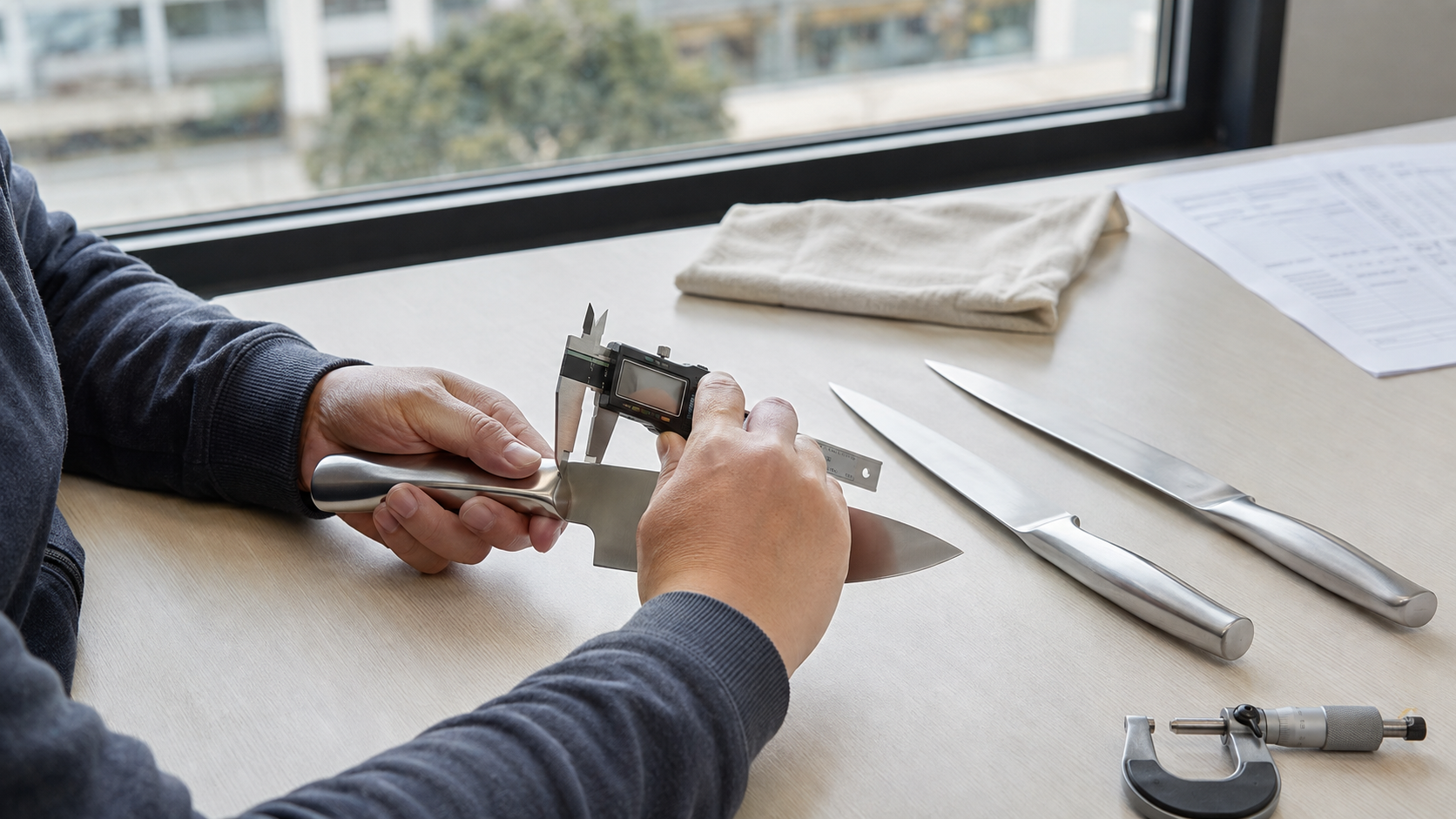
Spine thickness describes the thickness of the blade at the spine at a specified location.
The location matters.
A measurement near the heel, one at the middle of the blade and another closer to the tip may produce different results on a tapered knife. For that reason, a specification such as “2 mm blade thickness” is incomplete unless the measurement position is also defined.
More importantly, spine thickness does not describe the complete blade cross-section.
Two knives with similar spine measurements can have different grind heights, different tapers toward the edge and different thicknesses immediately behind the cutting edge. Those differences can change how much blade material enters the food during a cut.
Therefore, buyers should avoid treating spine thickness as a direct measure of:
- sharpness;
- cutting resistance;
- strength;
- durability;
- suitability for a particular food.
It is a useful dimensional specification, but it is only one part of the geometry.
Blade Taper Describes How Thickness Changes
A blade does not necessarily maintain the same thickness from heel to tip.
Blade taper, often called distal taper when referring to thickness reduction along the blade length, describes how the blade changes as it approaches the tip.
Instead of describing a knife simply as “tapered,” buyers can obtain more useful information by measuring thickness at several defined positions.
For example, a comparison might record thickness near the heel, at mid-blade and at another defined point closer to the tip.
This provides a clearer picture of the blade profile than a single maximum thickness measurement.
Taper can also affect mass distribution because removing material from different regions changes where the total mass of the knife is located. However, taper alone cannot determine how the finished knife will feel. Handle construction, blade height, tang structure and other components also contribute to the final mass distribution.
Thickness Behind the Edge Is Different From Spine Thickness
Thickness behind the edge, commonly abbreviated as BTE, describes blade thickness close to the cutting edge rather than at the spine.
This distinction is important because the part of the blade entering food immediately behind the cutting edge is geometrically different from the spine.
However, BTE values require careful interpretation.
A BTE measurement is not meaningful unless the measurement method defines at least:
- how far behind the cutting edge the measurement is taken;
- where along the blade length the measurement is taken;
- how the cutting edge and bevel are identified;
- what measuring method is used.
A measurement taken very close to the apex cannot be directly compared with one taken farther behind the edge.
For this reason, a supplier specification stating only “BTE: X mm” may not be sufficient for reliable comparison unless the measurement location is also specified.
Published food-cutting research supports the broader conclusion that wedge geometry, edge geometry and cutting conditions can influence cutting force. It does not establish one universal commercial BTE number that predicts kitchen-knife performance in every food or cutting task.
Blade Height Is a Separate Dimension
Blade height is another specification that should not be confused with thickness.
It normally describes the distance between the cutting edge and the spine at a defined position, often near the heel.
Blade height changes the overall blade geometry and may also affect total blade mass, depending on thickness, taper and construction.
But blade height by itself does not establish that a knife is:
- easier to control;
- more stable;
- better for chopping;
- less tiring;
- more suitable for a specific ingredient.
Those conclusions would require the complete knife design and defined user testing.
For purchasing specifications, blade height should therefore be treated primarily as a dimensional characteristic rather than a performance grade.
Total Weight and Mass Distribution Are Not the Same Thing
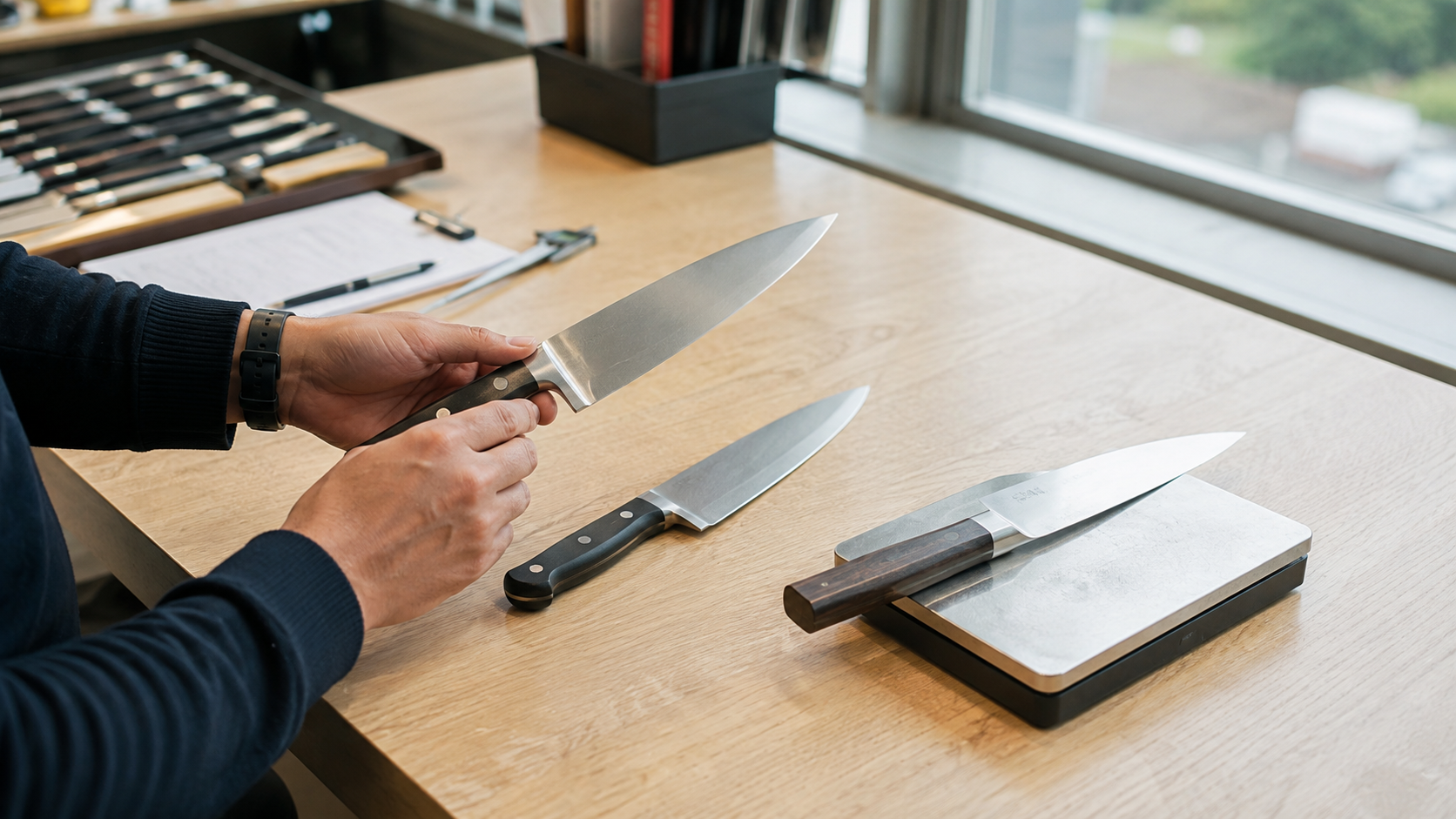
Finished kitchen knives are usually described commercially by their weight, commonly expressed in grams or ounces. In engineering terms, the directly measured quantity is mass.
Total mass matters because it contributes to both the load the user must support and the inertia of the knife during movement.
But total weight does not tell buyers where that mass is located.
Consider two finished knives that both weigh the same.
One may place more mass in a long or relatively substantial blade. Another may use more material in the handle, tang, bolster or end component.
The scale can show the same number while the knives behave differently when picked up, accelerated or rotated.
That difference is described by mass distribution.
This is why statements such as “a 200 g knife feels like this” are incomplete. Mass alone cannot describe the complete handling characteristics of a finished knife.
Why Mass Distribution Matters During Movement
The position of mass affects more than static balance.
In rigid-body mechanics, rotational inertia depends on how mass is distributed relative to the axis around which the object is rotating.
For a kitchen knife, that effective axis can change depending on the user’s grip and cutting movement.
This provides an important explanation for a common sourcing observation: two knives with similar overall weight can still feel different during direction changes, rocking motions or repeated slicing.
The reason is not necessarily a difference in the total number of grams. The spatial distribution of those grams also matters.
However, this basic mechanical relationship should not be turned into simple product rankings.
It does not automatically mean:
A blade-heavy knife is better for chopping.
or:
A handle-heavy knife is more precise.
Those are user- and task-dependent conclusions that require defined comparisons.
Center of Gravity Is a Measurable Property—“Balance” Is Broader
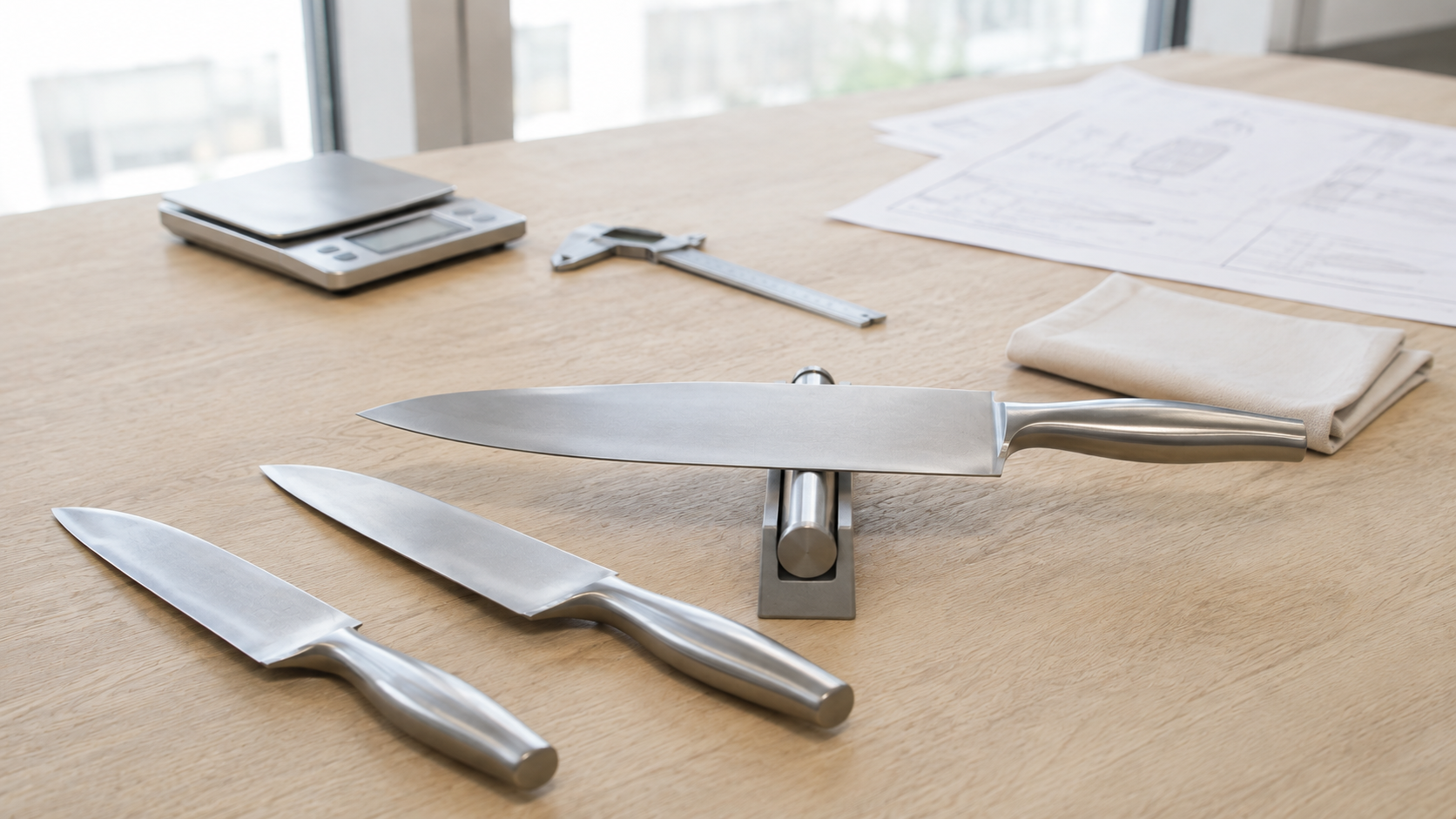
The center of gravity is the point through which the resultant gravitational force can be considered to act.
For a knife in normal terrestrial conditions, its position is closely related to how mass is distributed through the blade and handle.
A simple static balance test can be used to approximate this position.
The result becomes useful for quality comparison when it is reported relative to a consistent reference point, such as a defined position on the handle or heel.
For example, recording that the balance point is a certain distance forward of a defined datum is more informative than simply calling the knife “balanced.”
This distinction matters because balance point and subjective balance are not the same thing.
A center-of-gravity measurement is an objective physical property.
“Feels balanced” is a user response.
Grip Position Changes the Experience
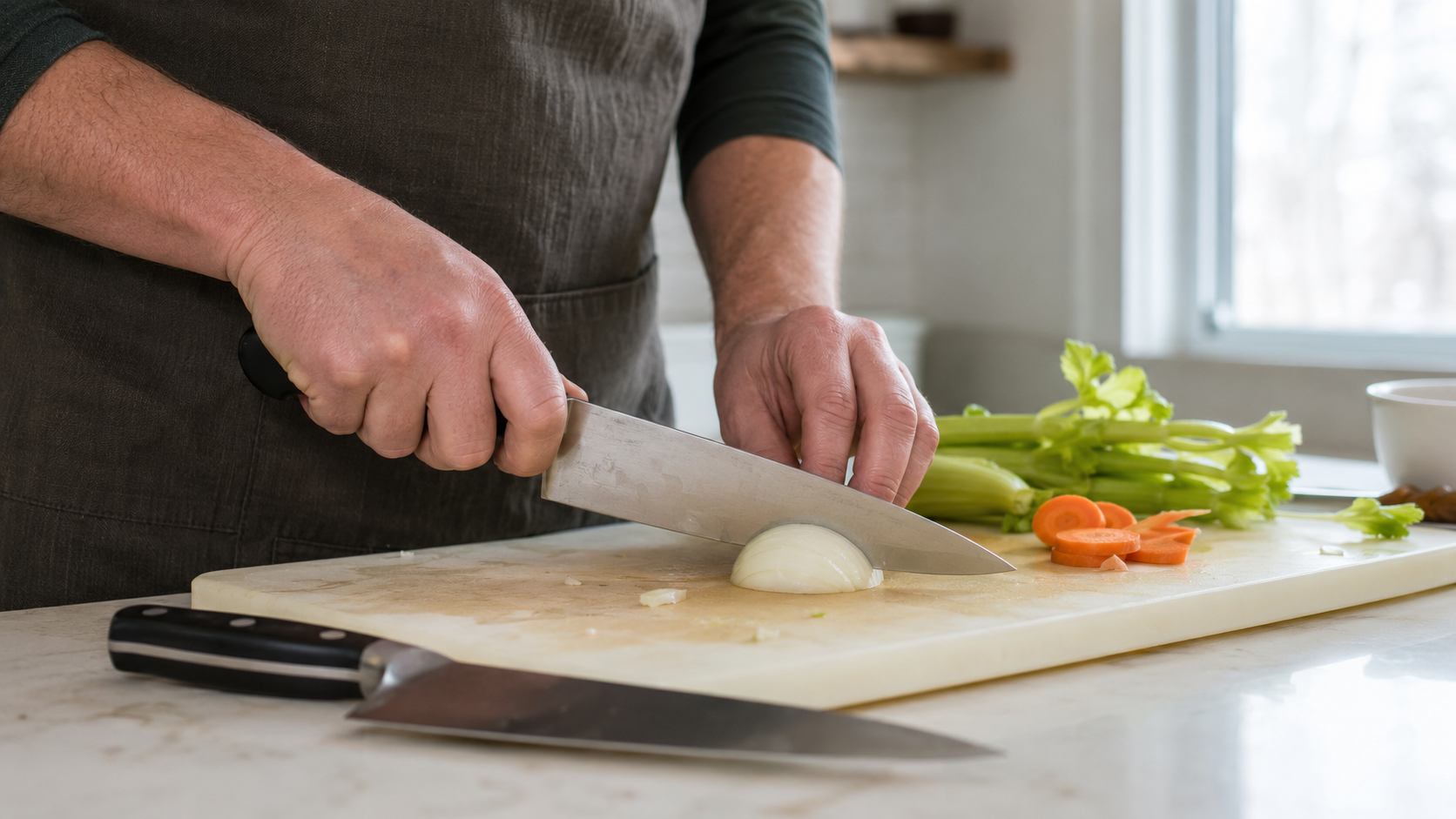
A knife’s physical center of gravity does not change when the user changes grip, but its position relative to the hand does.
That difference can alter the lever arm between the user’s grip and the knife’s center of mass.
A conventional handle grip and a pinch grip, for example, place the effective hand position at different locations on the knife.
As a result, the same knife may feel more forward-weighted or more neutral depending on how it is held.
This is one reason why a universal statement such as:
“The ideal balance point is exactly at the bolster.”
is not technically justified for all kitchen knives, users and cutting tasks.
The useful specification is the measured center-of-gravity position. Whether that location is preferred requires a defined user and task context.
Cutting Motion Also Changes What the User Experiences
Kitchen-knife use involves different combinations of translation and rotation.
Examples include:
- push cutting;
- draw slicing;
- rocking;
- short repeated chopping motions;
- trimming and directional changes.
Cutting mechanics research shows that sliding along the cutting edge and perpendicular penetration into the material are mechanically different components of a cut.
This means the effect of knife mass and mass distribution cannot be discussed independently of movement.
A knife that feels comfortable in repeated straight slicing may not produce the same subjective response during rapid directional work.
For B2B comparisons, the cutting motion should therefore be defined rather than allowing each tester to use an entirely different technique.
Food Type Is Another Important Variable
Blade dimensions and weight are only part of the cutting system.
Published food-cutting research shows that cutting force can change with variables such as:
- material being cut;
- food structure;
- temperature;
- cutting velocity;
- edge condition;
- blade geometry.
A dense root vegetable, layered onion, soft tomato and cooked meat do not present the same mechanical cutting conditions.
For this reason, it is difficult to support claims such as:
“This thickness cuts with less resistance.”
unless the comparison also defines the food, edge condition, cutting movement and other important test variables.
A dimensional difference can be measured objectively. Its practical significance must be evaluated under specified conditions.
Weight and Wrist Effort Require Careful Interpretation
General hand-tool ergonomics provides useful guidance here.
A heavier tool increases the load the user must hold and control. Weight distribution can also influence the muscular effort required to stabilize a hand tool.
For kitchen knives, however, this does not mean that lighter is always better.
A lower-mass knife has less mass to support, but a user may prefer a different mass or distribution depending on grip, cutting technique and task. A heavier knife also has greater inertia, but that does not prove that it reduces total user effort during cutting.
The statement:
“More weight means less work for the wrist.”
is therefore too broad.
A more accurate interpretation is that mass, mass distribution, grip, posture, cutting resistance and movement pattern all contribute to user effort.
Specific claims about fatigue reduction require actual ergonomic testing with defined users and tasks.
Separate Objective Measurements From Subjective Evaluation
For sourcing and sample approval, one of the most useful practices is to maintain two different categories of data.
Objective Product Measurements
These can include:
- finished knife mass;
- overall length;
- blade length;
- blade height at specified locations;
- spine thickness at defined stations;
- thickness behind the edge using a defined measurement method;
- blade taper measurements;
- center-of-gravity position relative to a defined datum;
- handle length and relevant construction details.
These measurements should be repeatable between samples and production batches.
Subjective User Evaluation
A separate test can record observations such as:
- perceived maneuverability;
- perceived stability;
- forward- or rear-weighted feel;
- perceived wrist or forearm effort;
- ease of directional changes;
- comfort during a defined task;
- tester preference.
These are valid product-development observations, but they should remain clearly identified as subjective or user-test results.
They should not be converted into universal engineering claims.
Four Variables to Control When Comparing Complete Knives
Even when two knives are being compared primarily for weight and balance, at least four additional factors should be considered.
Handle Length
Changing handle length alters both the physical structure and the relationship between the hand and the knife’s mass.
Handle Material and Construction
Wood, POM, PP, G10 and other handle-material names do not determine finished balance by themselves.
The result depends on the specific material grade, density, volume, tang structure, fasteners, bolster construction and other components.
Grip Position
The user’s hand position changes the effective relationship between the grip and the knife’s center of gravity.
Comparisons should therefore use a defined grip or record which grip each tester used.
Cutting Action
A static balance test cannot predict every dynamic movement.
Rocking, slicing, push cutting and short chopping movements place different movement demands on the knife and user.
A More Useful B2B Specification Approach
Instead of asking whether a kitchen knife is simply “light,” “heavy” or “well balanced,” buyers can ask more precise questions:
Where was the spine thickness measured?
At what distance behind the edge was BTE measured?
Does the blade taper, and how is that taper documented?
Is the quoted weight the complete finished-product mass?
Where is the center of gravity relative to a defined reference point?
Did the handle material, handle length or construction change between samples?
Were subjective handling comparisons made with the same grip, cutting movement and food?
These questions turn vague product descriptions into specifications that can be checked and reproduced.
No Single Number Defines the “Best” Knife
Blade thickness, weight and balance describe different aspects of kitchen-knife design.
Spine thickness is not the same as thickness behind the edge. Total weight is not the same as mass distribution. Mass distribution affects the center of gravity, but a static balance point does not fully describe dynamic handling or user preference.
Most importantly, there is no publicly established single knife weight or center-of-gravity position that is universally optimal for every user, knife style and cutting task.
For professional buyers, the more defensible approach is to measure geometry and mass properties separately, define the test conditions and keep subjective handling evaluations distinct from objective specifications.
That produces more useful comparisons—and avoids turning one number into a performance claim it cannot support.
References
- National Institute of Standards and Technology. Uncertainty and Dimensional Calibrations.
- International Organization for Standardization. ISO/IEC Guide 98-4:2012 — Measurement uncertainty in conformity assessment.
Scope note: These sources support the general principles discussed here; they do not prove the material, performance, compliance, or production history of any specific Tastiva product. Links last checked August 24, 2026.
Continue exploring practical knife specifications and buyer guidance.View all News →