
Knife Knowledge · Selection & Use
How to Choose Kitchen Knife Length by Food Size, Workspace, and User Control
Knife length should be matched to food dimensions, cutting motion, workspace, storage, and user control—not selected from a universal size rule.
Quick answer
Start by separating blade length, overall length, usable cutting-edge length, and blade height. Then test the proposed knife with the intended foods, board, workstation, storage system, and representative users.
Kitchen knife length is often presented as a simple choice between sizes such as 6, 8, or 10 inches. For professional buyers, however, that approach leaves out several important specification questions.
An advertised size does not necessarily describe every relevant dimension of the knife. Blade length, overall length, usable cutting-edge length, and blade height describe different aspects of the product. The appropriate combination also depends on what the knife is expected to cut, how much working space is available, how it will be stored, and how the intended users handle it.
For importers, distributors, private-label brands, product managers, and quality teams, the more useful question is therefore not:
What is the best kitchen knife length?
It is:
Which dimensions are required for the intended task, workspace, storage system, and user group?
There is no single length that can be treated as optimal for every kitchen or every user.
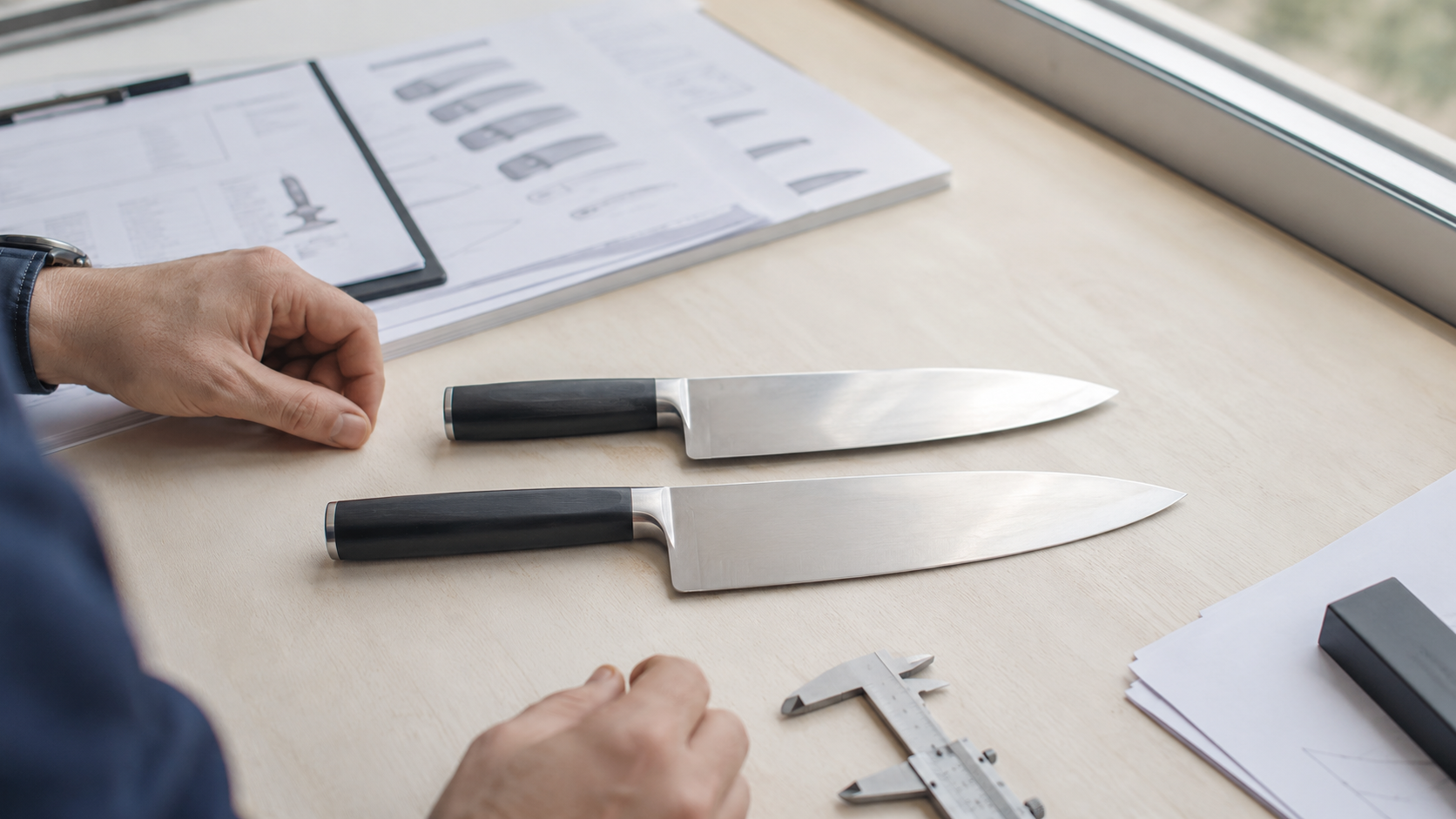
Blade Length, Overall Length, and Cutting Length Are Not the Same
Before comparing knife sizes, buyers should first define what is actually being measured.
Blade Length
Blade length normally describes the longitudinal size of the blade, but purchasing documents should not rely on the term alone.
A specification should identify the measurement start point and end point, particularly when the knife includes features such as a bolster, choil, curved tip, or other geometry that could affect how different suppliers interpret the dimension.
This matters because a commercial size label is not necessarily identical to a precise engineering dimension.
For example, current manufacturer specifications show products marketed as 8-inch chef’s knives while their detailed blade-length fields may be slightly below exactly 8.00 inches.
This does not mean the labeling is incorrect. It illustrates the difference between a nominal product size and a controlled technical dimension.
For sourcing purposes, the drawing and agreed measurement method should therefore take priority over the marketing name.
Overall Length
Overall length describes the complete knife rather than only its blade.
It becomes particularly important when evaluating:
- drawer storage;
- knife rolls and cases;
- packaging dimensions;
- workstation clearance;
- transportation;
- rack or organizer compatibility.
Two knives with similar blade lengths can still have noticeably different overall lengths because handle dimensions and construction vary.
Buyers should therefore avoid treating blade length and overall length as interchangeable specification fields.
Effective Cutting Length
Another useful concept is the portion of the sharpened edge that can actually participate in the intended cutting motion.
This may be described in purchasing discussions as effective cutting length, usable cutting-edge length, or similar terminology.
However, buyers should be cautious about treating this as a universally standardized measurement. Publicly accessible standards information does not establish a single cross-market definition that can safely be applied to every kitchen knife.
If this dimension matters to a project, the buyer and supplier should define it explicitly in the drawing or specification.
For example, the specification may need to clarify whether the measured section includes:
- the curved portion near the tip;
- the heel area;
- the entire sharpened edge;
- only the continuous section intended for the main cutting stroke.
The important point is consistency, not the terminology alone.
Blade Height
Blade height is another independent dimension.
It should not be confused with blade length, and generic website fields such as “height” or “width” should not automatically be assumed to represent the same engineering measurement.
For purchasing control, it is better to specify both the measurement location and the direction of measurement—for example, an edge-to-spine dimension at a defined position near the heel.
This makes supplier quotations, inspection results, and reference samples easier to compare.
Start With the Food and the Cutting Motion
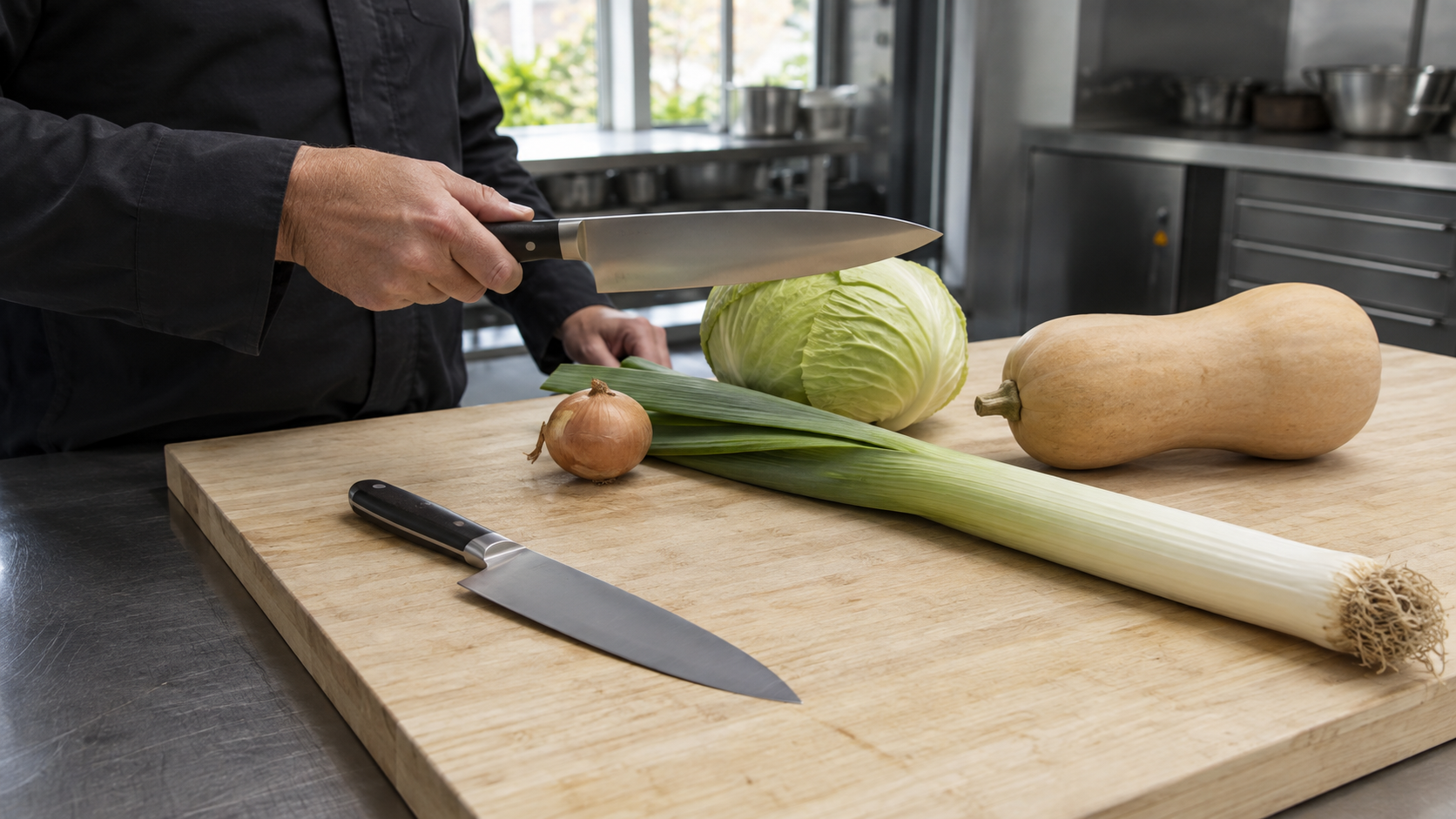
Food size is one reason different knife lengths exist, but it does not produce a universal sizing formula.
A buyer should begin by asking what the knife must repeatedly cut.
A knife intended mainly for small trimming operations presents a different dimensional problem from one expected to make long slicing strokes through large portions of cooked meat.
For longer draw-slicing tasks, additional usable cutting-edge length may be worth evaluating because the cutting motion itself can require more edge travel.
By contrast, where the work consists mainly of short, localized movements, adding blade length beyond what the task requires may not provide a practical advantage.
U.S. Occupational Safety and Health Administration guidance for poultry-processing operations provides a useful occupational example. OSHA notes that using a knife blade longer than necessary for the task can increase the finger force required to control the tool and recommends selecting knives appropriately sized and designed for the work.
That guidance applies specifically to occupational poultry-processing conditions and should not be converted into a universal household knife rule. It does, however, support a broader purchasing principle:
More blade length is not automatically better. The required length should be related to the task.
At the same time, buyers should avoid creating unsupported formulas such as:
- the blade must always be a fixed number of inches longer than the food;
- the blade must be a certain percentage longer than the ingredient;
- every large ingredient requires a long chef’s knife.
Ingredient dimensions are only one part of the evaluation. Blade profile, cutting motion, knife type, food geometry, and user technique also influence the result.
Cutting Board Size Can Limit Practical Knife Length
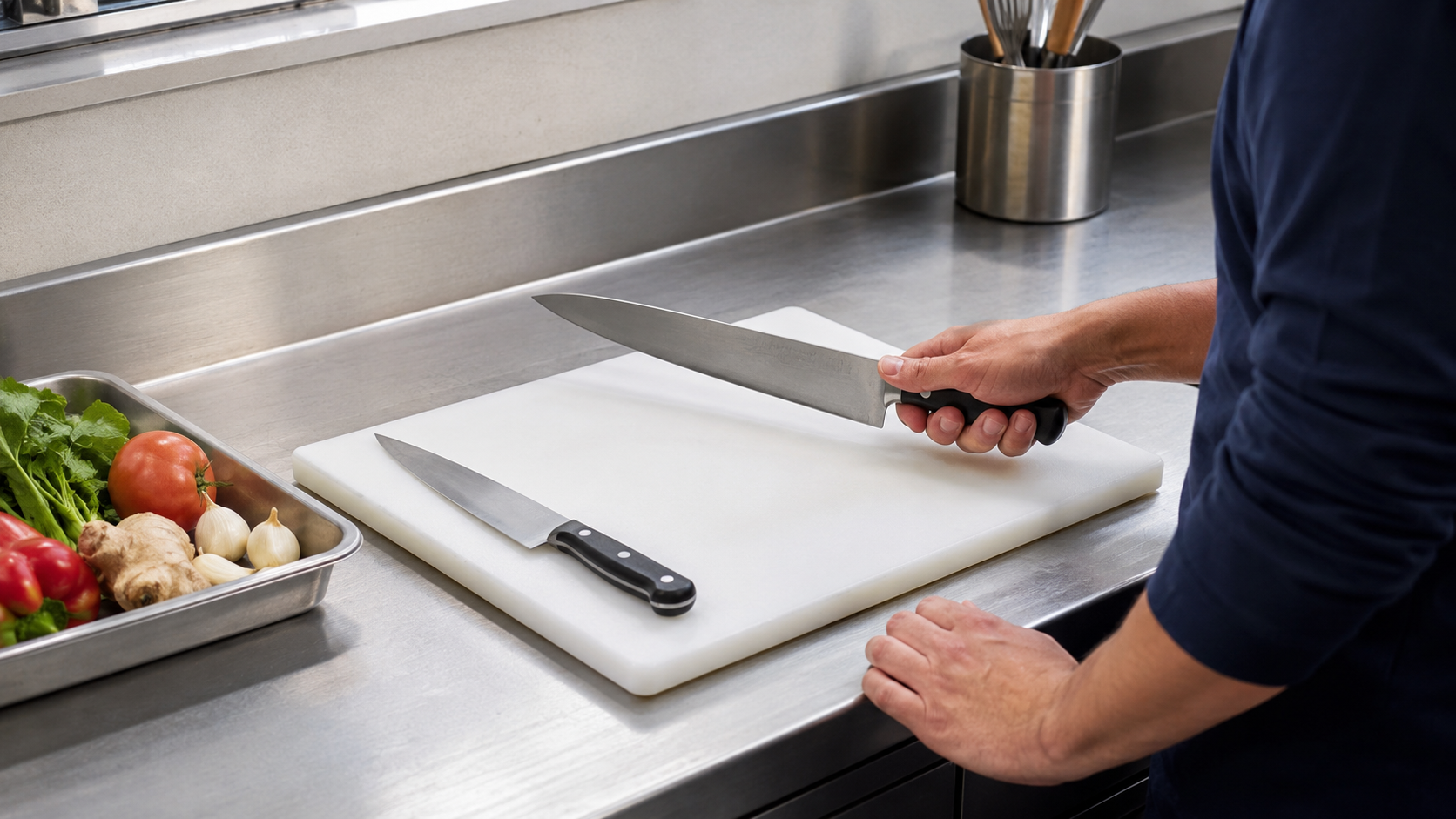
Knife sizing should also be checked against the actual working area.
The relevant measurement is not necessarily the outside dimension printed on the cutting-board packaging.
In a real kitchen, part of the board or counter may already be occupied by:
- ingredients waiting to be processed;
- containers;
- trays;
- utensils;
- waste;
- adjacent equipment.
The buyer should consider the usable cutting area remaining during the intended task.
A knife that is physically compatible with a large open test table may feel very different when used on a smaller board next to ingredient pans, a backsplash, or another employee’s workstation.
Professional environments may require particular attention to this issue because several spatial constraints can occur simultaneously.
OSHA ergonomics guidance for food-processing work emphasizes appropriate working surfaces and sufficient workspace around employees. It does not establish a fixed mathematical ratio between board size and knife length.
Therefore, claims such as:
“The cutting board should always be X inches longer than the knife.”
should be avoided unless they are based on a clearly defined internal test or application-specific requirement.
For sourcing, a better approach is to reproduce the intended workstation and determine whether the complete cutting motion can be performed without interference.
Hand Size Does Not Directly Determine Blade Length
One of the most common oversimplifications is to match hand size directly to knife length.
For example:
- small hands should use short blades;
- large hands should use long blades.
Public ergonomic evidence does not support such a simple relationship.
OSHA guidance discusses hand size more directly in connection with handle fit. Handles that are too large or too small for the user can affect grip efficiency and the amount of finger force required to maintain control.
That is a different issue from deciding how much blade length a task requires.
For professional product evaluation, buyers should therefore separate two questions.
First:
Does the handle fit the intended users?
Then:
Does the blade length fit the intended cutting task and can those users control the complete knife?
A user with small hands may still perform a task requiring substantial cutting length, provided the overall knife design and handle are appropriate. Likewise, a user with large hands does not automatically benefit from a longer blade.
Other factors also influence perceived control, including:
- handle geometry;
- grip style;
- glove use;
- total knife weight;
- mass distribution;
- blade profile;
- working height;
- user experience.
Blade length is only one variable in that system.

Cutting Motion Changes the Length Requirement
Knife length should also be considered together with how the knife moves.
Draw Slicing
Long slicing strokes may place greater importance on usable cutting-edge length.
The buyer should consider whether the intended food can be sliced in the desired motion without excessive repositioning.
This does not mean that longer is automatically more efficient. Any efficiency claim would require actual comparative testing under defined conditions.
Push Cutting and Rocking
For push cutting or rocking motions, blade length interacts with blade profile and the amount of edge that contacts the board during the stroke.
Two knives of the same nominal length can behave differently if their edge curves, blade heights, or balance characteristics differ.
For that reason, a purchasing decision should not be based on length alone.
Trimming, Boning, and Tip-Led Work
Specialized meat-processing tasks provide another example of why knife sizing cannot be reduced to one number.
OSHA ergonomics guidance distinguishes between different cutting actions, including slicing-type and stabbing-type movements, because tool orientation and wrist posture can differ.
Published occupational research on professional meat cutters also shows that different boning and trimming operations create different mechanical demands.
These findings do not establish a specific ideal length for each task. Instead, they reinforce the need for task-specific evaluation.
Professional Use Should Be Evaluated Differently From a Generic Consumer Recommendation
A knife used occasionally in a home kitchen and a knife used repeatedly during a commercial shift may share the same nominal blade length while facing very different operating conditions.
Professional evaluation may need to account for:
- repetitive motions;
- multiple users;
- gloves;
- workstation height;
- narrow processing areas;
- sanitation procedures;
- specialized food dimensions;
- storage constraints;
- standardized portioning routines.
A shared commercial tool may also need to accommodate a wider user population than a knife purchased by one individual.
This makes sample testing particularly important.
Instead of approving a size because it is commonly marketed as a “professional” dimension, a buyer can test representative samples with the actual foods, work surfaces, storage systems, and user group.
The objective is not to prove that one length is universally superior. It is to confirm that the proposed dimensions fit the defined operating conditions.
Storage Can Create a Hard Length Limit
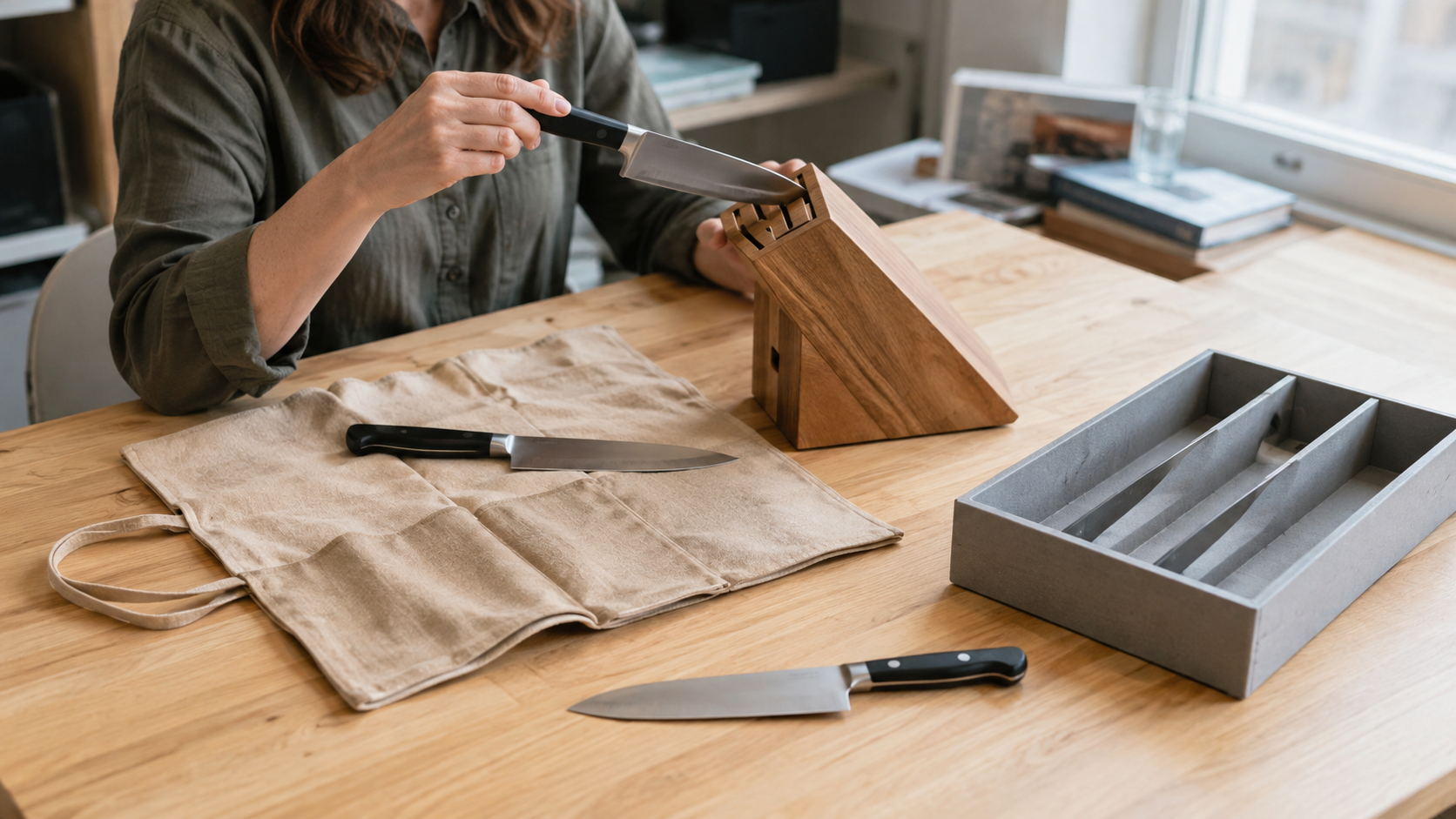
Storage is often treated as an afterthought, but it can create a clear dimensional constraint.
Different storage systems depend on different knife measurements.
A knife block may be limited by:
- slot depth;
- slot width;
- opening geometry.
A knife guard or sheath may depend more heavily on:
- blade length;
- blade height;
- blade thickness.
A knife roll or drawer insert may instead be limited by the complete overall length.
Manufacturer guidance for specific storage products shows that such limits can be product-specific. For example, some knife blocks specify a maximum compatible blade length while also noting that width compatibility depends on the individual knife.
This is why buyers should avoid vague statements such as:
“Fits standard knife blocks.”
Unless “standard” has been defined, the statement provides little technical assurance.
Actual internal storage dimensions or sample-fit verification are more useful.
Why 8 Inches and 20 Centimeters Need Careful Specification
International sourcing also introduces a unit-conversion issue.
According to the U.S. National Institute of Standards and Technology:
1 inch equals exactly 25.4 millimeters.
Therefore:
- 8 in = 203.2 mm;
- 8 in = 20.32 cm;
- 20 cm ≈ 7.87 in.
So 20 cm and 8 inches are close, but they are not mathematically identical dimensions.
In commercial catalogs, manufacturers may round converted values for presentation. For example, an 8-inch product may be shown as 20.3 cm.
That is normally understandable as a rounded display value.
Problems arise when both rounded numbers are copied into a purchasing document without identifying which one controls production.
A more reliable specification method is to select one master unit.
For example:
Blade length: 203.2 mm nominal
Reference conversion: 8.00 in
or:
Blade length: 200 mm nominal
Reference conversion: approximately 7.87 in
The drawing should then define the permitted tolerance.
This helps prevent a supplier from treating 200 mm and 203.2 mm as simultaneously controlling dimensions.
A Conditional Selection Matrix for Buyers
Rather than ranking knife sizes, buyers can use a conditional framework.
| Condition | What to Evaluate |
|---|---|
| Large ingredients or long slicing strokes | Required usable cutting-edge length |
| Small trimming or detail work | Whether additional blade length is actually necessary |
| Limited cutting-board space | Blade length and complete motion envelope |
| Restricted counter clearance | Overall length and movement clearance |
| Small or large user hands | Handle fit first; blade length separately |
| Multiple professional users | Representative user testing |
| Gloves used regularly | Handle fit, grip and complete-knife control |
| Repetitive processing work | Task-specific length and ergonomic evaluation |
| Knife block storage | Slot depth, width and blade dimensions |
| Drawer or knife-roll storage | Overall knife length |
| Blade guard or sheath | Blade length, height and thickness |
| Inch/mm specifications | Master unit, conversion method and tolerance |
The matrix does not produce one universal answer. Its purpose is to identify which variable becomes the controlling constraint in a particular project.
Questions Buyers Should Confirm Before Approving a Knife Size
Before finalizing a sample or purchase specification, buyers should confirm:
- What does the advertised size actually refer to?
- What are the blade-length measurement start and end points?
- What is the overall knife length?
- How much continuous sharpened edge is available?
- Where is blade height measured?
- What dimensional tolerance applies?
- Which unit—inch or millimeter—is the controlling unit?
- What are the largest recurring foods or portions?
- What cutting motion is expected?
- What is the usable cutting-board area?
- Is there sufficient rear and side workstation clearance?
- Will the knife be used with gloves?
- Will one person or multiple employees use it?
- What storage system must accommodate the knife?
- Has the actual sample been evaluated under the intended working conditions?
These questions provide more useful purchasing information than simply asking whether a knife should be 6, 8, or 10 inches long.
Choose the Task Before Choosing the Length
Kitchen knife length is best treated as a specification and application question rather than a universal recommendation.
A longer knife is not automatically more professional, more efficient, or better suited to a large-handed user. A shorter knife is not automatically safer or easier to control.
Professional buyers should instead separate the dimensions involved and evaluate them systematically:
Define the dimensions → identify the food and task → evaluate the cutting motion → check the board and workstation → confirm storage limits → evaluate representative users → test the sample → record the agreed dimensions and tolerances.
That process provides a more defensible basis for product selection than relying on nominal size labels alone.
References
- Virginia Cooperative Extension. The Basics of Knife Skills.
- Illinois Extension. Know Your Knives.
Scope note: These sources support the general principles discussed here; they do not prove the material, performance, compliance, or production history of any specific Tastiva product. Links last checked August 24, 2026.
Continue exploring practical knife specifications and buyer guidance.View all News →