
Knife Knowledge · Selection & Use
Chef’s Knife, Santoku, Boning Knife, Slicing Knife, and Cleaver: Which Tasks Fit Each Type?
A task-first guide for comparing chef’s knives, Santoku knives, boning knives, slicers, and cleavers without relying on category names alone.
Quick answer
Knife names are starting points, not complete specifications. Buyers should match the task to blade profile, length, thickness, stiffness, weight, edge geometry, and explicit use limits.
| Knife type | Useful task starting point | Verify in the specification | Do not infer from the name |
|---|---|---|---|
| Chef’s knife | General preparation and board work | Profile, length, thickness, weight and balance | One universal geometry or preferred motion |
| Santoku | Multipurpose preparation | Profile, edge shape, blade height and length | That every Santoku performs the same way |
| Boning knife | Trimming and working around bones or joints | Stiffness, curvature, tip and use limits | Suitability for chopping through bone |
| Slicing knife | Long controlled slices through prepared foods | Length, width, flexibility and target food | A fixed distinction from every carving knife |
| Cleaver | Vegetable work or heavy chopping, depending on design | Intended material, construction, weight and prohibited uses | Bone-cutting ability from rectangular shape alone |
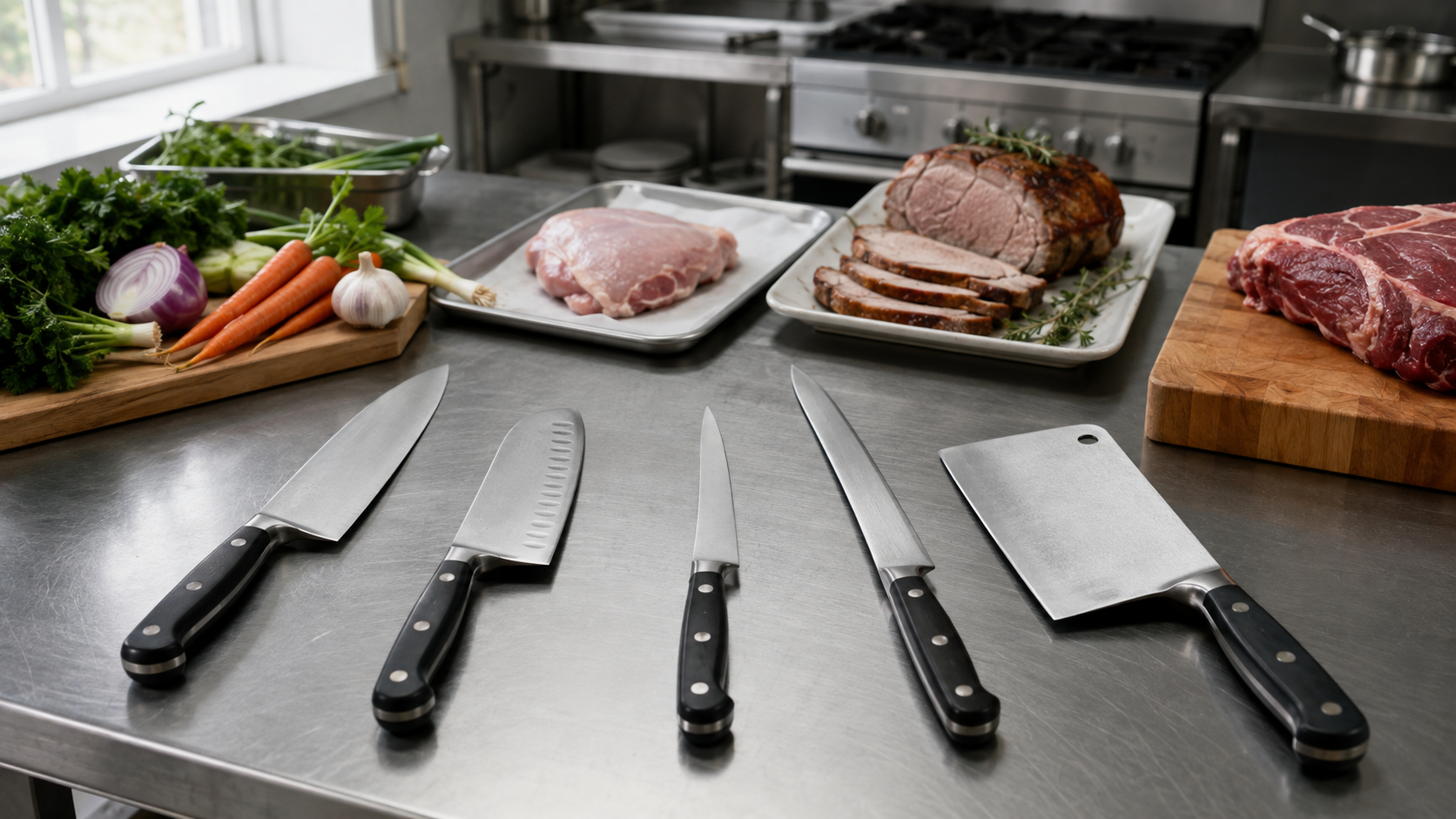
Kitchen knife names are useful for organizing a product range, but they are not complete technical specifications.
For importers, distributors, private-label brands, product managers, and quality teams, terms such as chef’s knife, Santoku, boning knife, slicing knife, carving knife, Chinese-style cleaver, and meat cleaver should normally be treated as starting points. Two knives sold under similar category names can differ substantially in blade length, edge profile, thickness, stiffness, weight, and intended use.
This is especially important with cleavers. A wide rectangular blade may be intended for vegetable preparation, general slicing, or heavy meat work. Its appearance alone does not establish that it is suitable for cutting bone.
A more reliable comparison starts with the task and then confirms the relevant product specifications.
Start With the Cutting Task, Not the Category Name
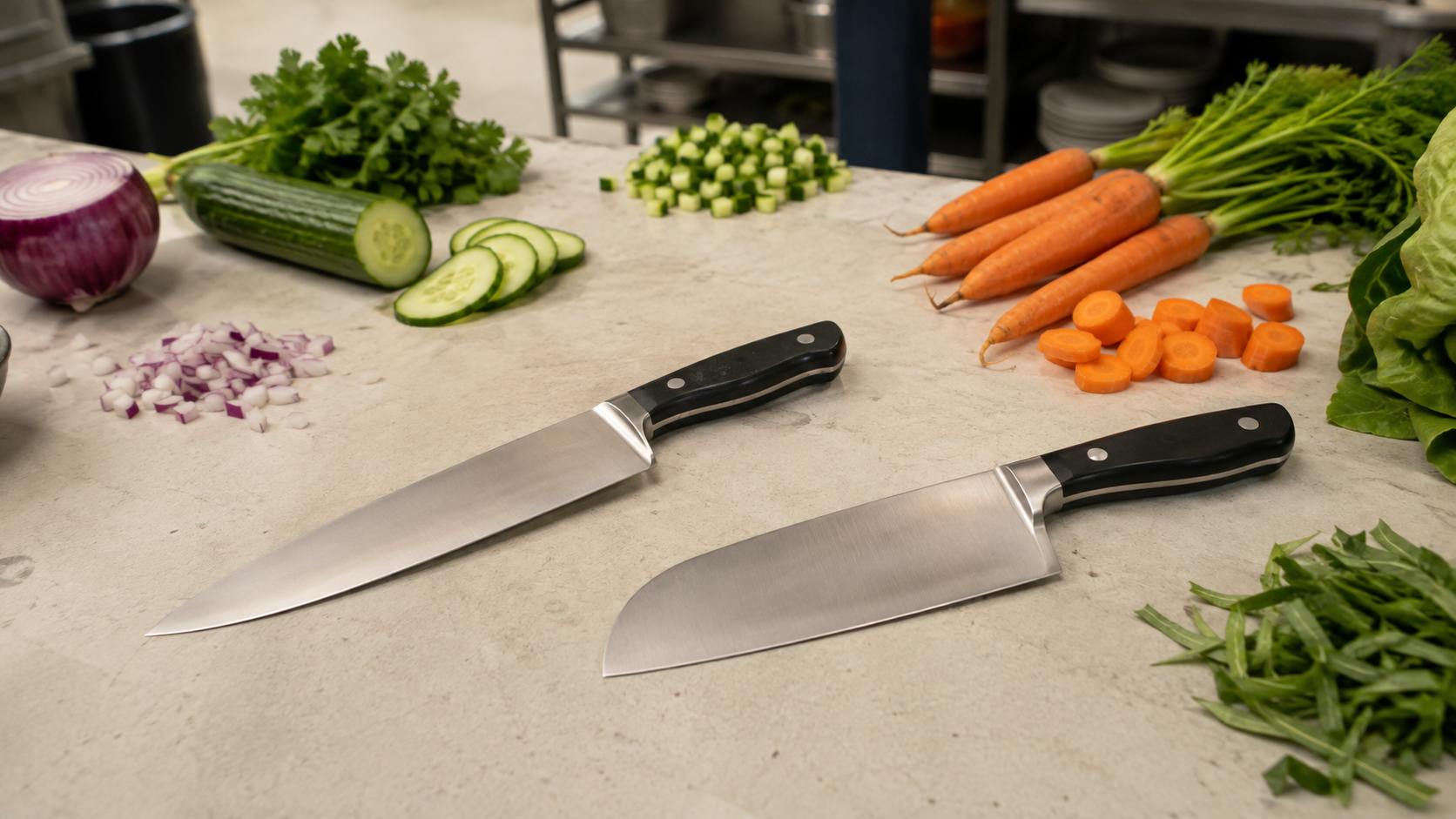
A useful B2B evaluation framework separates kitchen work into several broad task groups:
- general chopping, slicing, dicing, and mincing;
- vegetable and everyday ingredient preparation;
- trimming and separating meat around bones and joints;
- long slicing of roasts, poultry, fish, or other large portions;
- heavy chopping or bone-related work.
The knife category can help identify which group a product is intended to serve, but the actual product specification still needs to support that use.
This principle is consistent with U.S. Occupational Safety and Health Administration guidance for restaurant work, which advises using knives for their intended purpose and selecting the appropriate knife for the cutting job.
For purchasing purposes, this means that intended use should be confirmed explicitly rather than inferred from a familiar knife name.
Chef’s Knife: A General-Purpose Kitchen Format
The chef’s knife is commonly positioned as a general-purpose preparation knife.
Manufacturer guidance typically associates it with tasks such as:
- chopping vegetables;
- dicing ingredients;
- mincing herbs;
- slicing meat and other foods;
- general preparation work.
A typical Western-style chef’s knife may have a pointed tip and a curved section of cutting edge, often called the belly. That curvature can support a rocking cutting motion in which part of the edge remains near the cutting board while the blade moves through the ingredient.
However, “chef’s knife” does not define one exact profile.
Chef’s knives are sold in multiple lengths and with different degrees of curvature, blade height, thickness, weight, and handle construction. A nominal category therefore cannot establish how strongly a particular knife favors rocking, push cutting, or other movements.
It is also risky to interpret “general purpose” as “suitable for every kitchen task.” Manufacturer use guidance for conventional chef’s knives can specifically exclude heavy bone work.
For buyers, the useful question is not simply:
Is this a chef’s knife?
It is:
What blade geometry and intended tasks define this particular chef’s knife?
Santoku: Multipurpose, but Not One Fixed Geometry
The Santoku is also widely positioned as a multipurpose kitchen knife, particularly for meat, fish, vegetables, chopping, slicing, and dicing.
Its market role therefore overlaps substantially with that of a chef’s knife.
The important distinction is that Santoku is not a guarantee of one standardized blade profile or cutting technique.
Some manufacturer descriptions show Santoku blades with relatively straight cutting edges, while others describe slightly curved profiles. There are even products specifically marketed as “rocking Santoku” designs.
This matters because cutting motion is partly a consequence of geometry.
A flatter edge may interact with the cutting board differently from a blade with a pronounced curved belly. Therefore, statements such as “Santoku knives are only for push cutting” are too broad.
When comparing Santoku products, purchasing teams should confirm:
- actual blade length;
- blade height;
- cutting-edge curvature;
- spine thickness at specified locations;
- edge geometry;
- finished knife weight;
- intended cutting tasks.
Likewise, claims that Santoku knives are always shorter, thinner, lighter, or more agile than chef’s knives should not be treated as universal rules. Those characteristics have to be checked at the product level.
Boning Knife: Working Around Bone Is Not the Same as Cutting Through Bone
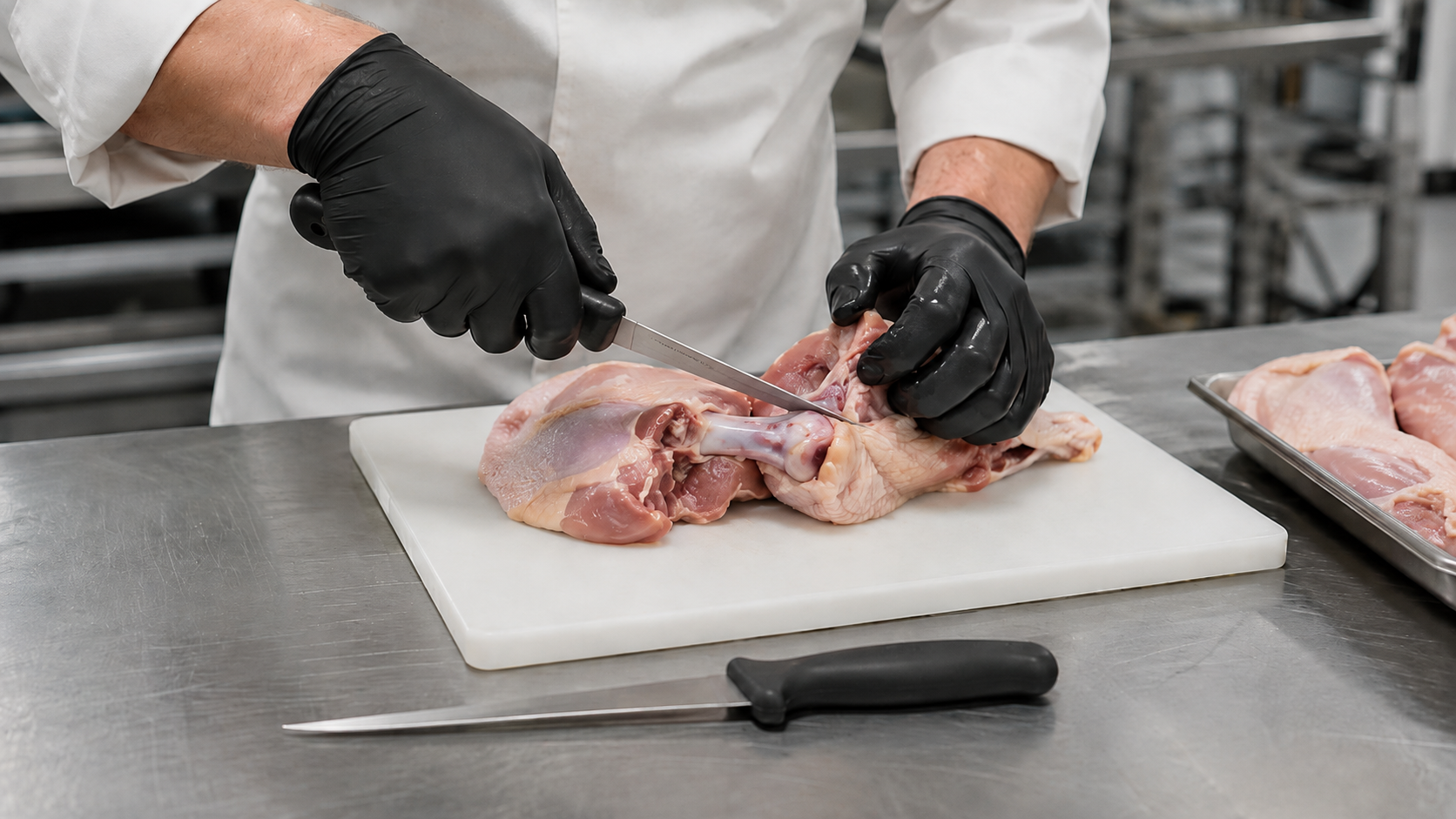
The name boning knife causes one of the more important terminology problems in knife sourcing.
A boning knife is generally designed to help separate meat from bones, joints, tendons, fat, and connective tissue. Typical designs use relatively narrow blades that can work around irregular anatomical structures.
This does not mean the knife is designed to chop through hard bone.
That distinction should be made clear in buyer-facing specifications and product descriptions.
Boning knives also demonstrate why category names cannot define mechanical characteristics. Commercial product ranges include blades described as:
- stiff;
- semi-flexible;
- flexible.
Different levels of stiffness can support different handling requirements, but those marketing categories do not necessarily represent standardized engineering measurements across manufacturers.
A stiff boning knife and a flexible boning knife can therefore belong to the same general knife category while behaving differently in use.
For procurement, “boning knife” should be followed by additional questions:
- Is the blade intended to be stiff or flexible?
- Is it straight or curved?
- What foods and trimming tasks are specified?
- Is the product intended to work around joints, or is any direct bone impact allowed?
- What blade length and thickness are specified?
The word boning should never be used as evidence that a knife is suitable for bone chopping.
Slicing Knife and Carving Knife: Commercial Names Can Overlap
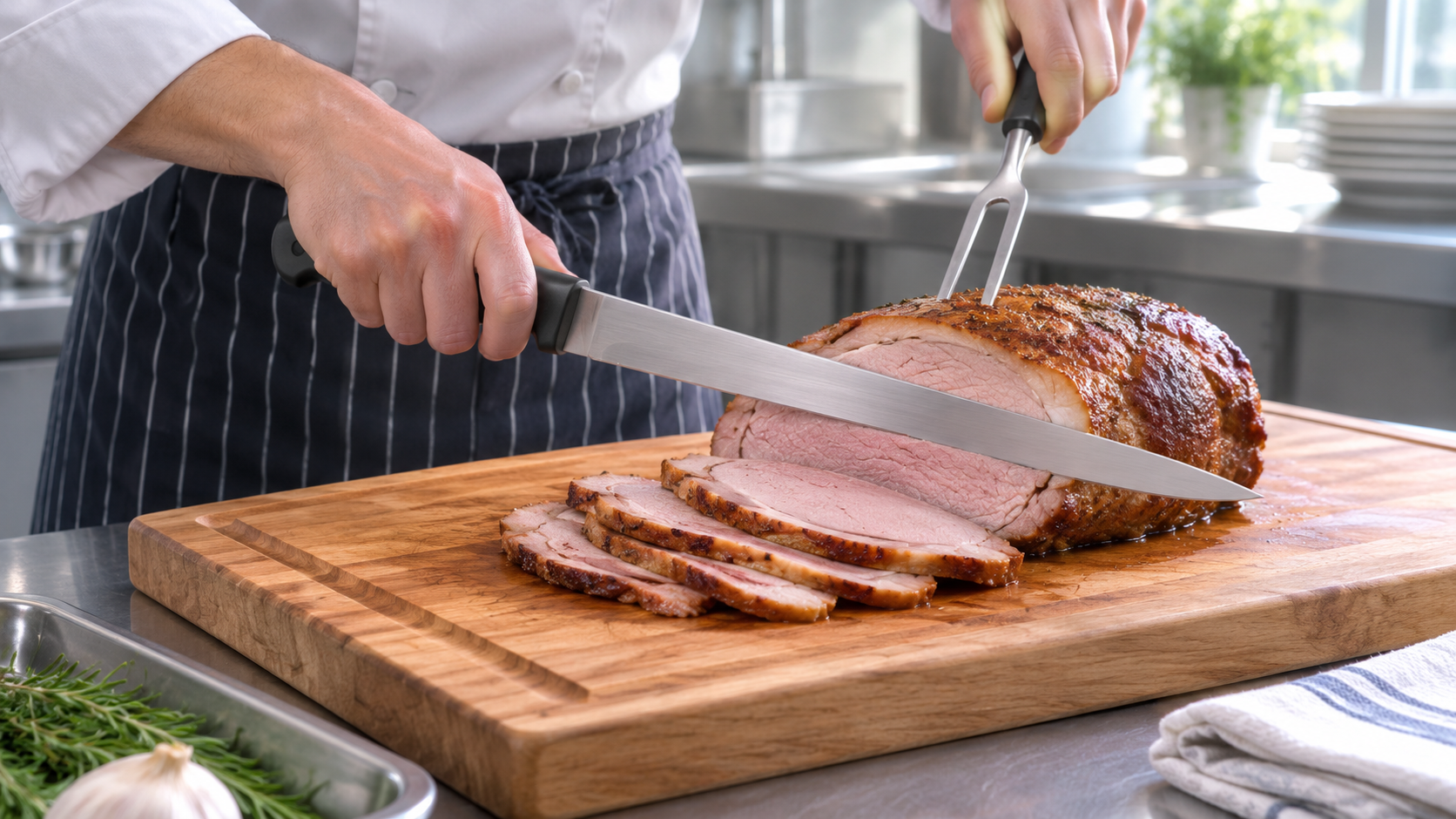
The distinction between slicing knife and carving knife is less standardized than many product descriptions imply.
Both categories commonly include long, relatively narrow blades intended to produce controlled slices through meat, poultry, ham, roasts, and other large food portions.
Some manufacturers maintain separate product names for slicing and carving knives.
Others directly sell products using a combined designation such as:
Slicing/Carving Knife
This makes it difficult to support a universal claim that the two names describe completely separate technical categories.
For a B2B article or specification sheet, it is safer to explain the overlap and then compare measurable features.
Useful variables include:
Blade length
A longer cutting edge can support longer slicing strokes across large food portions, but the appropriate dimension depends on the intended food and working environment.
Blade width
Slicing and carving knives are often narrower than general-purpose chef’s knives, but the actual width should still be measured rather than assumed.
Stiffness or flexibility
Some slicing applications may benefit from different levels of flexibility, depending on the ingredient and desired control.
Edge design
Plain and other edge configurations should be specified directly.
Intended food
A knife intended for roast carving does not automatically have the same requirements as a knife intended for large fish, ham, or production slicing.
In other words, slicing and carving are useful market terms, but the product specification should decide the comparison.
Chinese-Style Cleaver and Meat Cleaver: Similar Shape, Different Job
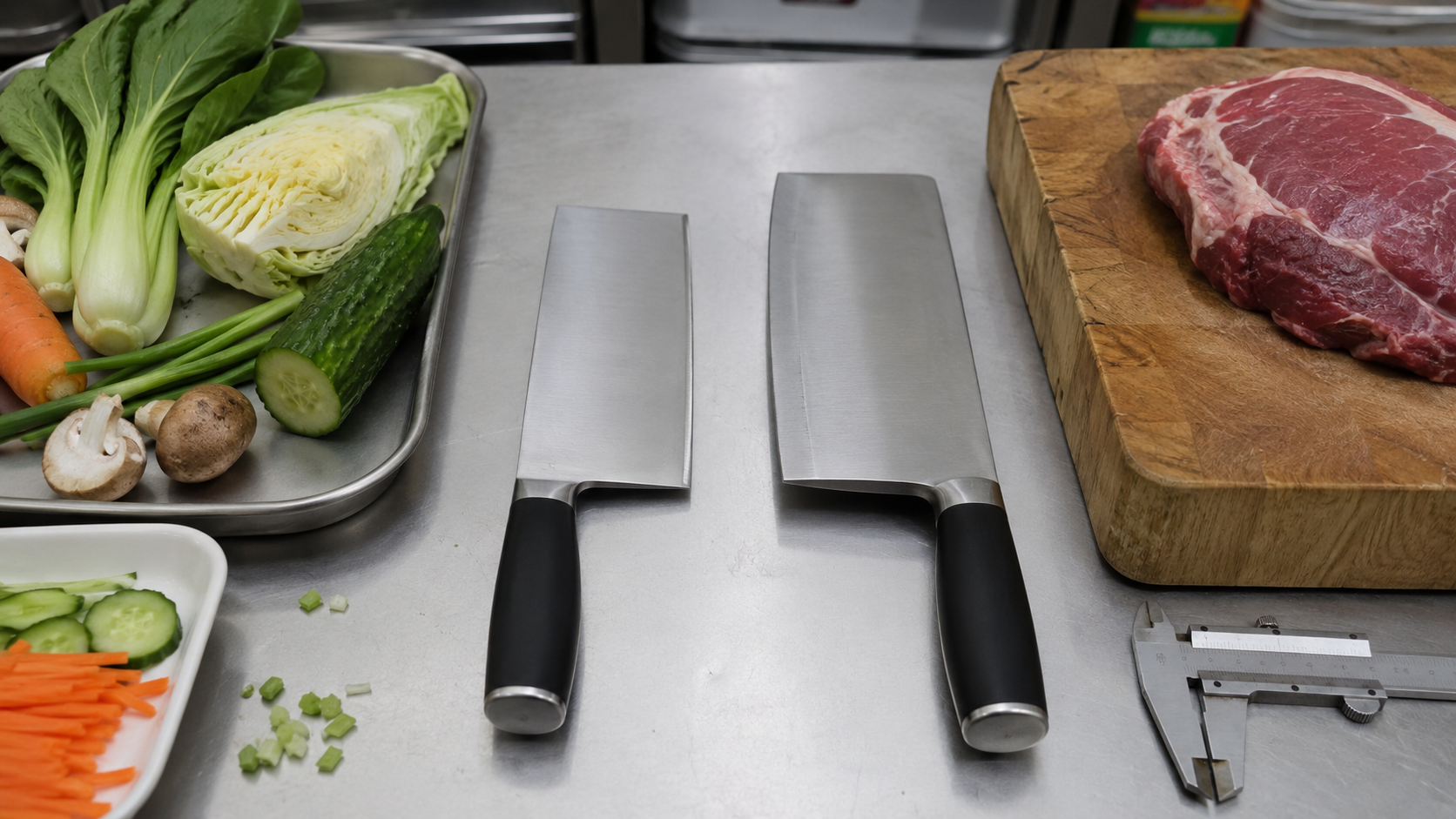
Cleaver terminology deserves particular attention because very different products can share a wide, rectangular blade silhouette.
In U.S. commercial catalogs, terms such as:
- Chinese chef’s knife;
- Chinese-style cleaver;
- vegetable cleaver;
- meat cleaver
may appear within the same broad product family.
That does not mean they are interchangeable.
Chinese Chef’s Knife or Vegetable Cleaver
Some wide rectangular Chinese-style knives are intended primarily for tasks such as:
- vegetable slicing;
- dicing;
- chopping;
- general food preparation.
Their broad blade surface may also be convenient for handling prepared ingredients, depending on the product and user technique.
Despite the visual resemblance to a heavy cleaver, these knives may use substantially different blade construction.
A product can even carry a name associated with a Chinese chopping-knife shape while its manufacturer specifically advises against using it to chop bones.
This is strong evidence that shape and category name are insufficient to determine bone-cutting capability.
Meat Cleaver
A meat cleaver can instead be designed as a heavier-duty knife for large meat preparation, and some specific products are explicitly described by their manufacturers as suitable for cutting through bone.
That capability must still be confirmed for the individual product.
“Meat cleaver” should not be converted into an unlimited claim about:
- every type of bone;
- every bone diameter;
- frozen material;
- repeated industrial impact;
- joints or other hard materials.
Those are separate use conditions.
Why Thickness and Weight Matter — but Do Not Define the Category
An instructive example can be found within one manufacturer's product range.
Two knives from the same series may have similarly broad rectangular blade outlines but significantly different specifications. One Chinese chef’s knife/vegetable cleaver is listed with a substantially thinner blade and lower finished weight than a meat cleaver from the same range.
Their intended tasks also differ.
This is useful as a product-level example because it demonstrates how similar-looking knives can be engineered differently.
It should not, however, be converted into statements such as:
Chinese cleavers have a standard thin blade.
or:
Meat cleavers must have a specific minimum thickness.
No universal thickness threshold has been established by the category names themselves.
Weight has the same limitation.
A heavier knife may create greater momentum during a downward movement, but weight alone cannot prove that the blade, edge, steel condition, handle construction, or complete knife is suitable for bone impact.
Blade Stiffness Should Be Treated as a Separate Specification
Blade stiffness is another characteristic that is often assumed from knife type.
That assumption is particularly problematic for boning and slicing knives.
Commercial catalogs clearly demonstrate that multiple stiffness descriptions can exist within one knife category. However, unless the supplier provides a defined test method, terms such as “flexible,” “semi-flexible,” and “stiff” may remain product descriptors rather than directly comparable engineering values.
A meaningful cross-supplier comparison would require more information, potentially including:
- blade geometry;
- thickness distribution;
- unsupported blade length;
- material condition;
- load and deflection measurement method.
Without a common test method, two manufacturers' “semi-flexible” blades cannot automatically be assumed to have equivalent stiffness.
Seven Items Buyers Should Confirm

Instead of approving a knife from the category name alone, a sourcing specification can confirm at least seven areas.
1. Intended cutting task
Specify whether the knife is intended for general prep, trimming, slicing, vegetable work, heavy chopping, or another task.
2. Intended food type
Clarify whether the expected use involves vegetables, boneless meat, poultry, fish, cooked roasts, joints, or bone.
3. Blade profile
Confirm tip geometry, blade height, cutting-edge curvature, and the general side profile.
4. Blade stiffness or flexibility
Do not assume this from terms such as boning knife or slicing knife.
5. Length
Define whether the quoted dimension means cutting-edge length, blade length, or overall knife length.
6. Thickness, edge geometry, and weight
Thickness should be tied to a defined measurement position. Finished weight should also be specified separately from blade thickness.
7. Use limitations
If bone, frozen food, joints, hard shells, or other demanding materials are relevant, they should be confirmed specifically rather than inferred from the knife category.
A Better Way to Compare Kitchen Knife Types
For B2B product evaluation, the most useful sequence is:
Task → food → blade profile → stiffness → length → thickness and edge geometry → weight → use limitations
The category name remains useful, but it should not be the final specification.
A chef’s knife and a Santoku can both cover broad everyday preparation while using different profiles.
A boning knife works around bone but should not automatically be treated as a bone-chopping tool.
Slicing and carving knife terminology may overlap between manufacturers.
And perhaps most importantly, a Chinese-style cleaver and a meat cleaver can look similar while being intended for very different work.
For importers and product teams, the safest conclusion is simple:
Use the knife name to identify the product family. Use measurable specifications and explicit intended-use documentation to determine whether the knife actually fits the task.
References
- Virginia Cooperative Extension. The Basics of Knife Skills.
- Illinois Extension. Know Your Knives.
Scope note: These sources support the general principles discussed here; they do not prove the material, performance, compliance, or production history of any specific Tastiva product. Links last checked August 24, 2026.