
Knife Knowledge · Edge Maintenance
How Cutting Board Materials Affect Kitchen Knife Edge Maintenance
A buyer-focused guide to how board material, surface condition, and test method interact with kitchen-knife edge maintenance.
Quick answer
Cutting-board material alone does not predict edge wear. Buyers should evaluate surface formulation, hardness, stiffness, condition, maintenance, cutting load, and the defined test method together.

A cutting board is part of the cutting system. During many kitchen tasks, the edge passes through the ingredient and reaches the supporting surface. Repeated contact can change the microscopic shape of the apex and eventually alter cutting performance.
That does not justify a universal “best to worst” material ranking. Public evidence is uneven, broad board categories contain very different formulations, and edge wear also depends on the knife, cutting action, load, and condition of the surface. The useful procurement question is therefore not simply, “Which material is best?” It is, “What exactly is the contact surface, in what condition, and how was its effect on a defined knife edge tested?”
Board Contact Can Change an Edge, but One Test Cannot Rank Every Material
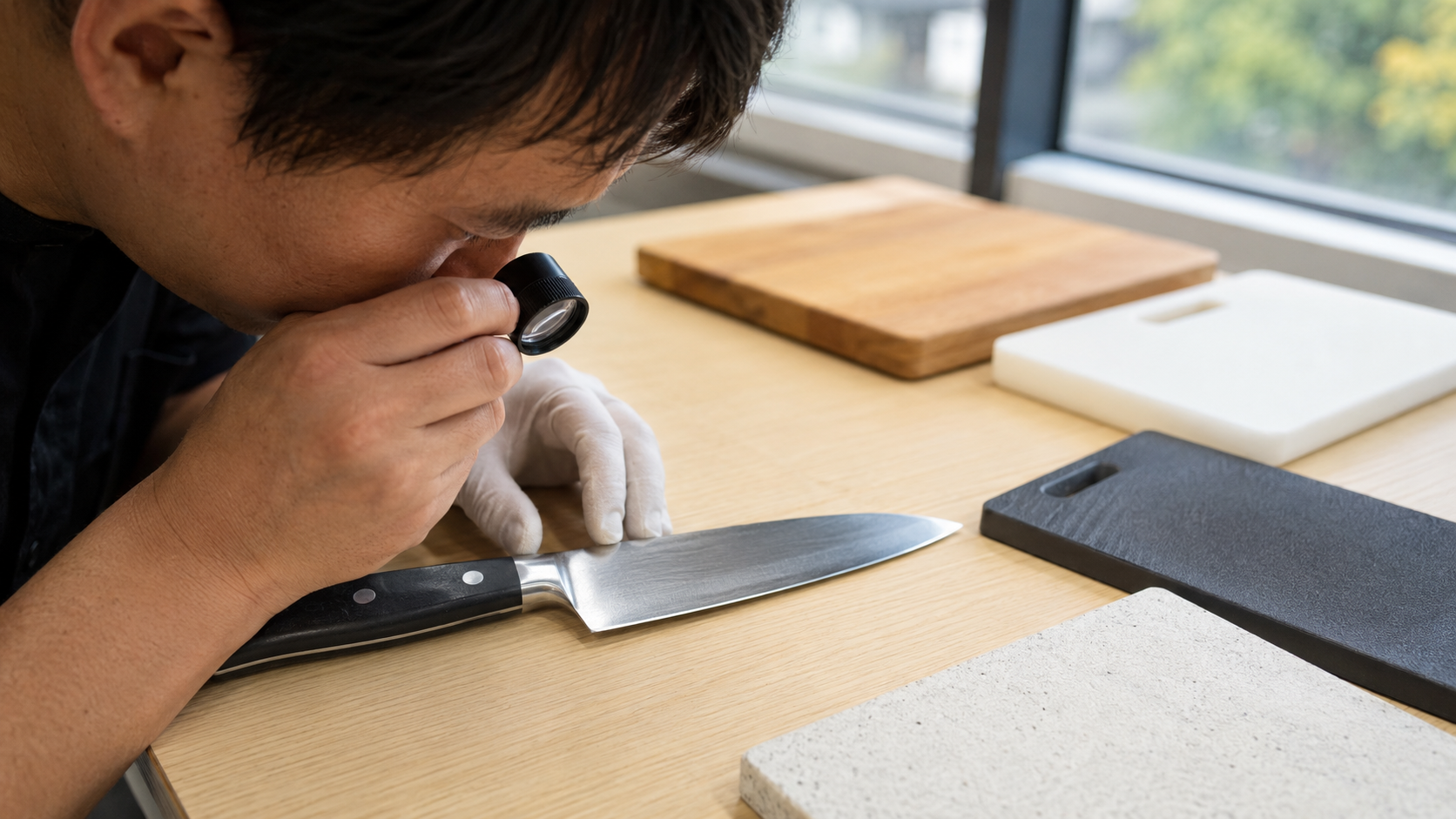
A peer-reviewed study published in 2003 repeatedly rubbed knife edges perpendicular to a Japanese cypress wood block. Scanning electron microscopy showed abrasion, crushing, and changes in microscopic grooves at the edge tip. The study mainly examined SUS420J2 stainless steel and also reported observations for SUS410 and SUP10 blades. It confirms that repeated contact with a board-like support can alter edge microgeometry and cutting behavior. It does not compare wood with plastic, rubber, composite, glass, ceramic, or stone.
A knife may lose cutting performance through gradual material removal, local deformation, crushing, or small fractures. A sharpness reading or a user’s impression of “dullness” does not identify the mechanism by itself. Blade steel, heat treatment, edge angle, apex width, grinding finish, and test medium can all influence the result. A 2023 peer-reviewed study likewise treated cutting performance as a combined problem involving contact mechanics, edge geometry and roughness, steel hardness, and wear resistance.
Why Surface Hardness Is Not a Complete Answer
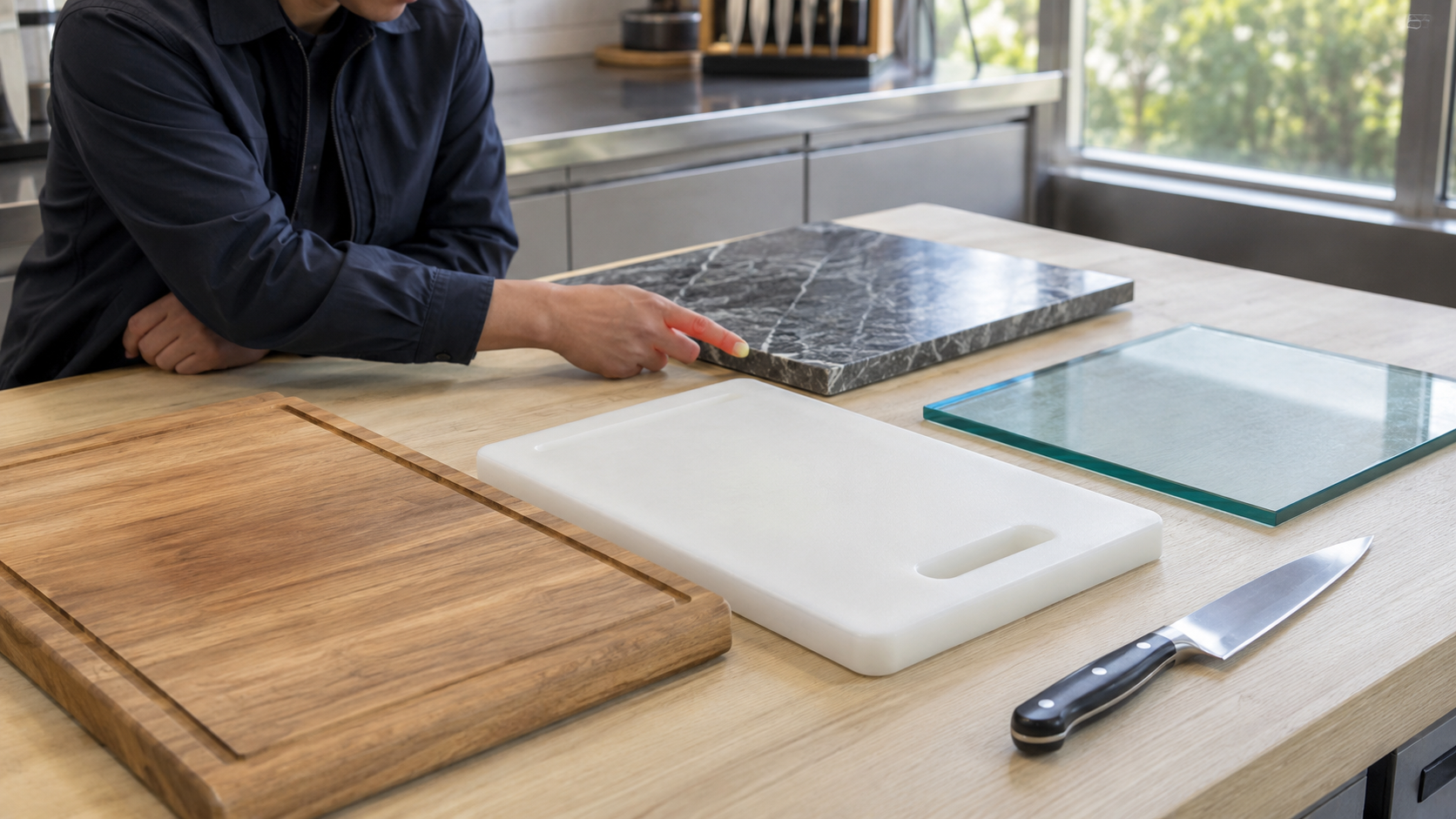
“Hard surface” is common commercial language, but hardness is not one universal number. NIST notes that indentation-hardness results depend on indenter size and geometry and on applied load. ASTM D2240 similarly explains that durometer readings for rubbers, thermoplastic elastomers, and some plastics depend on elastic modulus, viscoelastic behavior, indenter geometry, and force; different durometer types do not have a simple relationship.
A wood Janka value, a rubber Shore A value, a plastic Shore D value, and a knife-blade Rockwell C value therefore cannot form a direct “edge friendliness” scale. They describe different test systems.
Hardness must also be separated from stiffness, compliance, and resilience. A board may have a soft surface layer supported by a rigid core. A thin mat may behave differently on different counters. Board thickness, backing, nonslip layers, and the worktop beneath the board can change the contact system even when the nominal surface material is unchanged.
What the Main Material Categories Can—and Cannot—Tell Buyers
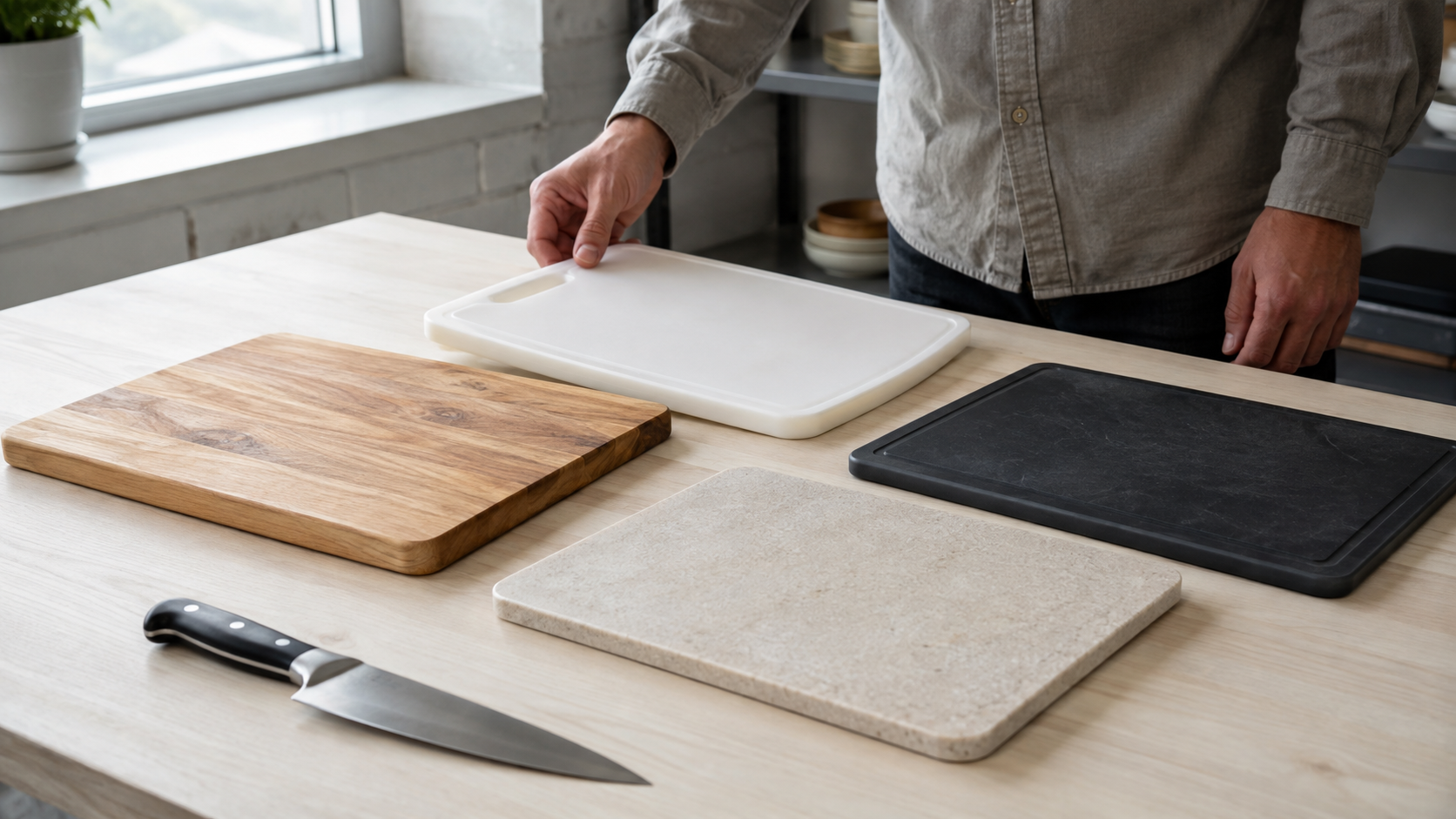
Wood
“Wood cutting board” is an incomplete specification. Species, grain orientation, moisture condition, adhesive lines, surface finish, thickness, and maintenance history may affect the contact surface.
The Japanese cypress study does not establish that wood is better or worse than another category. Nor does it prove a universal advantage for end-grain construction. That claim would require controlled comparisons using the same species, moisture condition, board thickness, knife batch, edge preparation, load, movement, and endpoint.
For U.S. commercial food-service readers, the FDA Food Code should not be used as an edge-performance source. The 2022 model Food Code permits hard maple or equivalently hard, close-grained wood for specified cutting boards and blocks. This is a food-equipment and sanitation provision, not a finding of superior edge retention. The Food Code is also a model offered for jurisdictional adoption, not automatically applicable federal law.
Plastic
Plastic boards are not one material. Polyethylene, polypropylene, thermoplastic polyurethane, thermoplastic elastomers, and other formulations may differ in hardness, viscoelastic response, fillers, pigments, texture, and aging behavior.
One wood-core board manufacturer, for example, offers both a softer surface product and a harder polyethylene-surface product for different tasks. This does not establish a general ranking, but it shows why “plastic board” or “wood-core board” does not fully identify the knife-contact surface.
Buyers should request the surface polymer, grade or formulation, surface thickness, hardness method, conditioning state, filler declaration, and data for both new and worn surfaces. A polymer abbreviation alone cannot predict maintenance frequency.
Rubber and Elastomeric Boards
Rubber and elastomer boards are often marketed as resilient or blade-friendly, but those terms are not universal technical grades.
A U.S. supplier describes one high-density rubber board as resilient, resurfacing-capable, and intended to preserve knife edges. That is a product-specific manufacturer statement, not independent proof that every natural rubber, synthetic rubber, or thermoplastic elastomer board will outperform wood or plastic.
Relevant purchasing information includes the exact compound, Shore scale and conditions, thickness, layer construction, support conditions, resurfacing instructions, and comparative test protocol.
Composite Materials
“Composite cutting board” may describe compressed paper fibers with thermosetting resin, a wood core covered by polymer layers, or a resin system containing fibers, minerals, pigments, or other additives. Official manufacturer descriptions confirm that materially different constructions are sold under the same broad label.
The key question is what material forms the exposed surface throughout service life—and whether sanding, wear, or deep scoring can expose another layer or particle phase.
Glass, Ceramic, Stone, Metal, and Other Hard Surfaces
Several knife manufacturers advise users to avoid glass, ceramic, tile, marble, granite, stone, or metal cutting surfaces. These are useful maintenance cautions within the scope of the manufacturers’ own knives and are consistent with concern about hard, minimally yielding contact surfaces.
They should not be converted into unsupported numbers. Public care guidance does not show that every hard surface creates the same damage mechanism or dulls every knife at a fixed rate. Surface finish, blade geometry, steel condition, force, and motion still matter. The evidence supports caution, not a universal wear multiplier.
Fillers and Contamination Need Separate Review
A board’s base material may not be the only phase touching the knife. Hard fillers, reinforcement, exposed particles, or foreign grit can change the interface.
General tribology distinguishes two-body abrasion, where a hard feature is fixed in one surface, from three-body abrasion, where loose particles become trapped between contacting surfaces. NIST technical literature describes abrasive wear through cutting and ploughing and emphasizes particle size, shape, relative hardness, load, and material behavior.
This supports a conditional statement: exposed hard particles or trapped grit may contribute to edge wear under suitable conditions. It does not prove that every filled composite board is abrasive. Product-level evidence would require filler identity, particle size and concentration, surface-exposure evidence, and a controlled edge test.
Cleaning before testing also matters. Sand, metal fragments, ceramic debris, or other foreign particles can confound a board-material comparison. A used-versus-new demonstration is not controlled unless contamination and surface condition are documented.
Cut Grooves, Warping, and Maintenance Are Different Variables
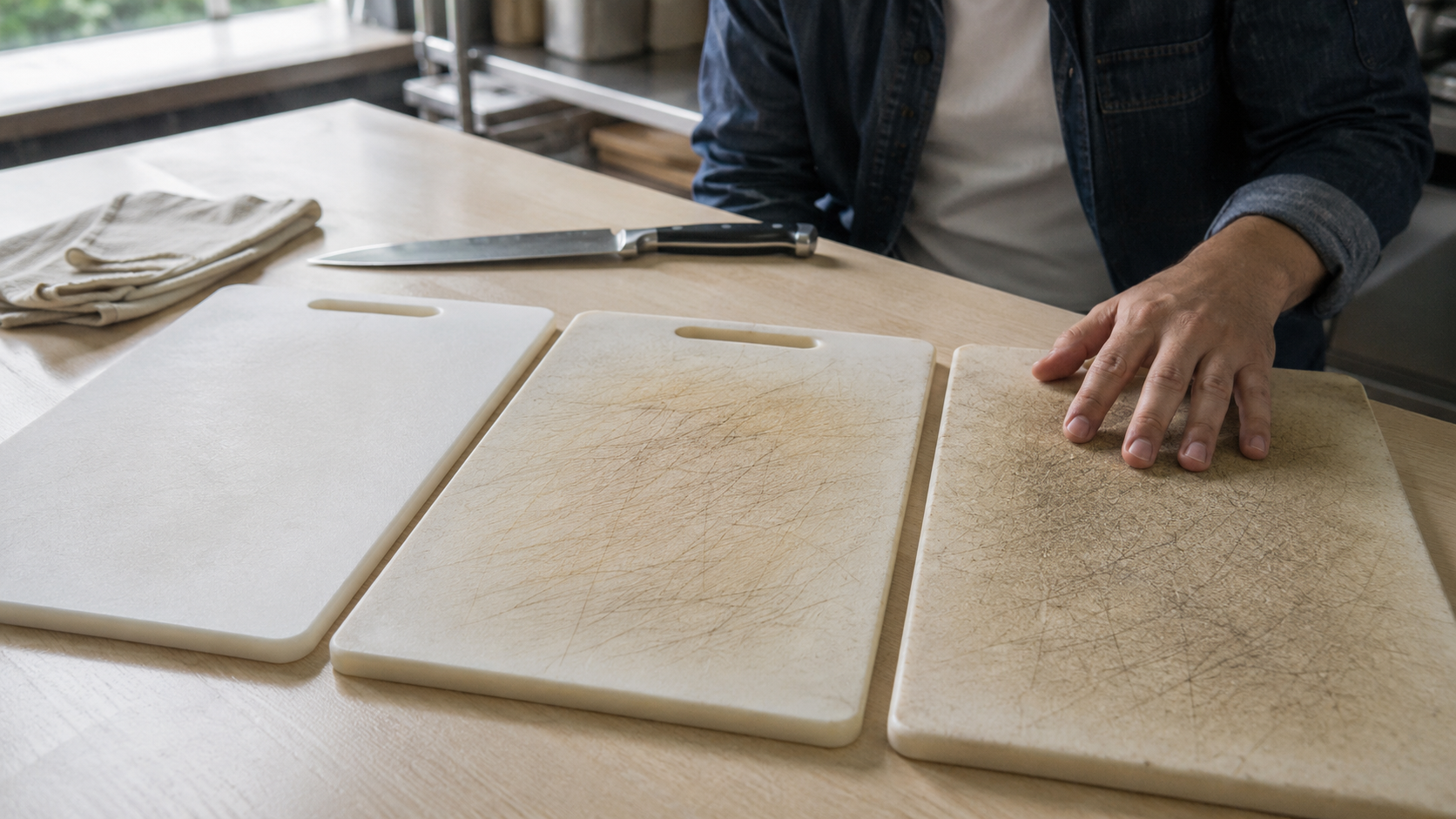
Deep cut marks are often discussed as though they prove both edge damage and microbial risk. They do not.
The FDA Food Code states that scratched and scored cutting blocks and boards should be resurfaced when they can no longer be effectively cleaned and sanitized, or discarded when resurfacing is not possible. Its public-health explanation is that these surfaces may allow pathogenic microorganisms to accumulate and transfer to food. This is a sanitation rationale; it does not state that grooves accelerate or reduce knife-edge wear.
An edge-wear claim needs an edge-wear experiment. A microbial-cleanability claim needs a microbiological and sanitation study. One should not be used as proof of the other.
Warping also requires discipline. A bowed, cupped, or twisted board can affect stability, local support, and user control. Those are valid inspection concerns. However, the public evidence reviewed for this article does not establish a repeatable quantitative relationship between a specified amount of warpage and a specified edge-wear rate. Warping should therefore be treated as a stability and condition variable, not a proven edge-damage mechanism.
Sanding, planing, repeated high-temperature washing, drying cycles, and normal scoring may alter surface roughness or expose new material. A credible evaluation should distinguish among new, conditioned, worn, contaminated, and resurfaced boards.
Standard Knife Tests Are Not Automatically Board Tests
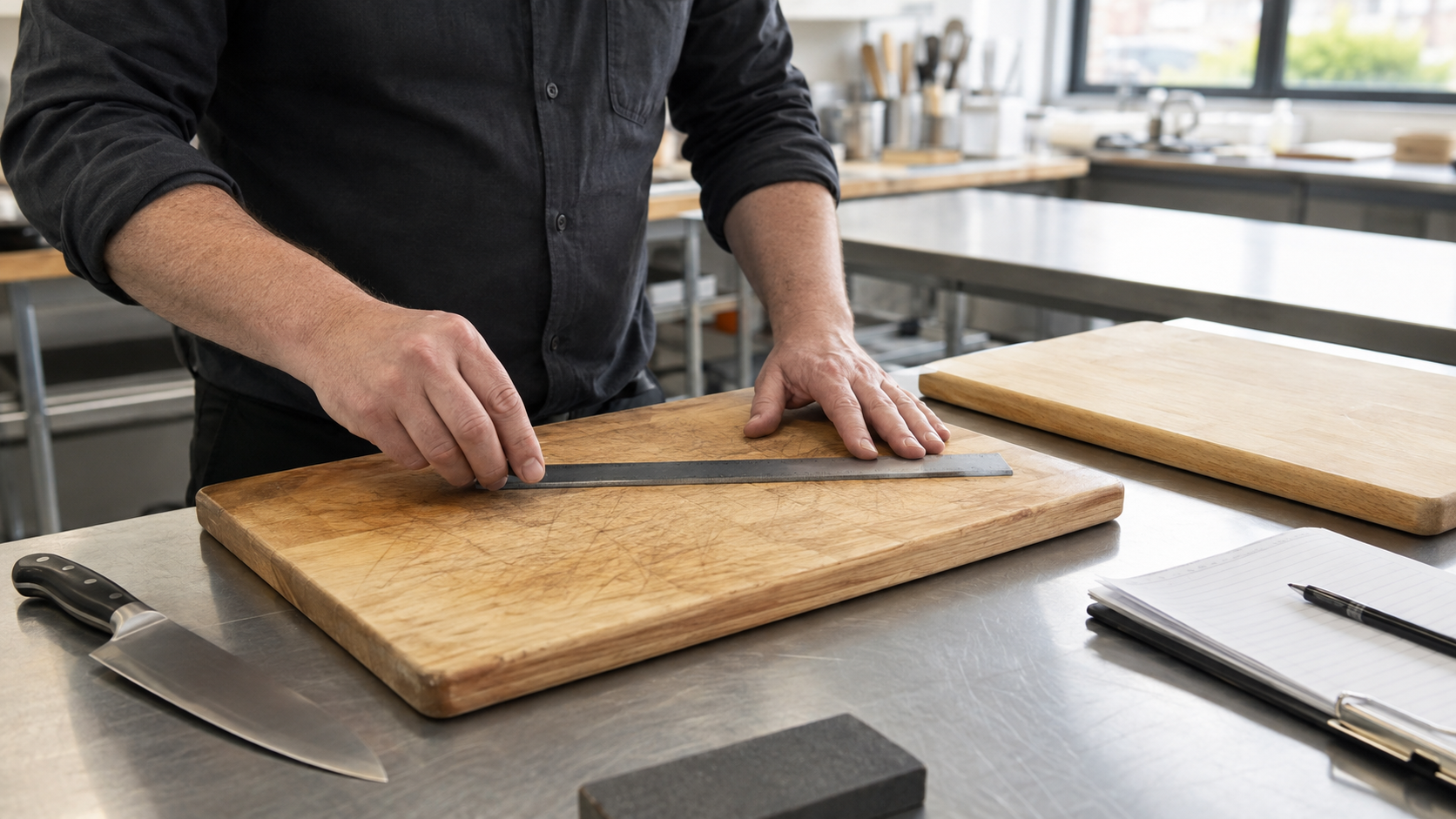
ISO 8442-5:2004 specifies a sharpness and edge-retention test for hand-used food-preparation knives. Its principle is a controlled forward-and-reverse cutting action against a synthetic test medium. At the time of review, ISO listed the 2004 edition as current and under revision.
CATRA’s corresponding equipment uses synthetic card containing 5% silica and records cutting depth over repeated strokes. This provides a controlled relative comparison under that method. It does not reproduce contact with a wood, plastic, rubber, composite, glass, or stone board.
An ISO/CATRA result alone therefore cannot substantiate a statement that a particular board extends edge life. A board-specific claim requires a board-specific protocol.
A Buyer and QC Checklist

For the board specification, request:
- the exact surface material and grade;
- layer construction and surface thickness;
- hardness method, scale, specimen thickness, and conditioning;
- filler, reinforcement, and pigment information;
- surface finish or roughness data;
- board thickness, backing, and intended support;
- warp or flatness tolerance;
- cleaning, resurfacing, and replacement instructions.
For an edge-wear comparison, require:
- knives from a defined batch;
- documented steel, heat treatment, hardness, edge angle, and initial edge condition;
- controlled motion, load, speed, path, and cycle count;
- multiple independent knife and board specimens;
- defined new, worn, contaminated, and resurfaced board conditions;
- a stated sharpness or wear endpoint;
- microscopic edge examination where a damage mechanism is claimed;
- raw data, variability, and treatment of anomalous results.
The Practical Conclusion
Cutting-board material can influence knife-edge maintenance, but the category name does not determine the result. Wood, plastic, rubber, and composite products contain substantial internal variation, while glass, ceramic, stone, metal, and other hard surfaces warrant caution without supporting an absolute wear-rate claim.
For professional sourcing, compare complete surface specifications and controlled product-level evidence. Keep edge wear separate from microbial hygiene, keep each test method within its stated scope, and do not convert a product claim, maintenance guide, or single demonstration into a universal material ranking. Sanitation and food-contact requirements should be checked against the specific product, intended use, and applicable U.S. jurisdiction.
References
- Illinois Extension. Cutting Boards — selection, separation and replacement.
- U.S. Food and Drug Administration. Safe Food Handling — clean and separate guidance.
Scope note: These sources support the general principles discussed here; they do not prove the material, performance, compliance, or production history of any specific Tastiva product. Links last checked August 24, 2026.