
Knife Knowledge · Materials & Heat Treatment
3Cr, 5Cr, and X50CrMoV15: What Kitchen Knife Buyers Should Actually Compare
A kitchen knife quotation may describe the blade material as “3Cr,” “5Cr,” or “German X50CrMoV15 steel.” These names can appear specific, but they do not necessarily provide enough information for material approval, supplier comparison, or batch verification.
Quick answer
3Cr and 5Cr are broad commercial shorthand, while X50CrMoV15 is a standardized steel designation. None of these labels proves finished-knife performance. Buyers should request the applicable standard, exact grade, material certificate, heat-treatment target, finished hardness range, geometry, and product-specific test results.
A kitchen knife quotation may describe the blade material as “3Cr,” “5Cr,” or “German X50CrMoV15 steel.” These names can appear specific, but they do not necessarily provide enough information for material approval, supplier comparison, or batch verification.
A complete material specification should identify more than a familiar steel name. It should connect the quoted material to a formal grade, an applicable standard, a standard edition, a product form, defined chemical limits, and traceable lot documentation. Finished-blade variables—including heat treatment, hardness, blade geometry, surface condition, and test method—must then be evaluated separately.
The central purchasing question is therefore not simply:
Which steel name is better?
A more useful question is:
What evidence connects the quoted steel name to the material and finished blade being supplied?
Why “3Cr” and “5Cr” Are Incomplete Specifications
The labels “3Cr” and “5Cr” omit important parts of a steel designation. They do not state the complete chromium designation, whether molybdenum or vanadium is included, which standard system applies, or which edition of that standard the supplier is using.
China’s current general standard for stainless-steel designations and chemical composition is GB/T 20878-2024. It was published in July 2024, became effective on February 1, 2025, and replaced GB/T 20878-2007 in full.
Within the current Chinese grade system, relevant formal designations include 30Cr13 and 50Cr15MoV. Commercial and older documentation may still use forms such as “3Cr13,” while the shortened label “3Cr” removes even more identifying information. Chinese steel producers also list 30Cr13 and 50Cr15MoV as separate martensitic stainless-steel grades rather than as general “3Cr” or “5Cr” categories.
The same caution applies to “5Cr15MoV.” That name appears in commercial documents and peer-reviewed materials research, so it is not an invented market term. However, its appearance in a quotation does not by itself prove that the supplier intends to deliver 50Cr15MoV according to GB/T 20878-2024.
A buyer receiving a quotation for “5Cr15MoV” should request a written clarification such as:
Does this designation refer to 50Cr15MoV supplied according to GB/T 20878-2024 and the applicable flat-product delivery standard?
Without that confirmation, the buyer cannot reliably determine the governing chemistry, material condition, product-analysis tolerances, or inspection-document requirements.
A Practical Mapping of Common Knife-Steel Names
| Name shown in a quotation | Defensible interpretation | What remains unconfirmed |
|---|---|---|
| 3Cr | An incomplete commercial shorthand | Full grade, chromium range, alloy additions, standard, edition, and lot chemistry |
| 3Cr13 | An older or commercial designation commonly associated with current 30Cr13 | Whether the supplied material meets the current standard and applicable product specification |
| 30Cr13 | A formal grade in the current Chinese system | Product form, delivery condition, heat or lot analysis, heat treatment, and finished-blade properties |
| 5Cr | An incomplete commercial shorthand | Whether the supplier means 5Cr15MoV, 50Cr15MoV, another grade, or an internal specification |
| 5Cr15MoV | A name used in commercial and technical contexts | Its exact governing standard, edition, chemistry limits, and relationship to 50Cr15MoV |
| 50Cr15MoV | A formal Chinese grade designation | Product standard, actual batch chemistry, delivery condition, and finished-blade processing |
| X50CrMoV15 / 1.4116 | An EN steel name and corresponding steel number | Applicable EN part, edition, product form, manufacturing origin, lot chemistry, and final heat treatment |
This mapping is not a performance ranking. It is a way to separate names that can be connected to a formal standard from names that remain commercially ambiguous.
What X50CrMoV15 and 1.4116 Actually Identify
In the EN designation system, X50CrMoV15 is a steel name, while 1.4116 is its numerical steel designation.
EN 10027-1 establishes rules for steel names based on symbolic letters and numbers. EN 10027-2 establishes the numerical system and states that each steel number should refer to only one steel grade. The steel number complements the steel name; it does not replace the need to identify the applicable product standard and delivery condition.
The current EN 10088 series separates the general stainless-steel list from product-specific delivery standards:
EN 10088-1:2023 lists stainless steels and specifies chemical compositions.
EN 10088-2:2024 covers hot- or cold-rolled sheet, plate, and strip.
EN 10088-3:2023 covers semi-finished products, bars, rods, wire, sections, and bright products.
These standards are current, but they serve different purposes and cover different product forms.
That distinction matters in kitchen knife sourcing. Where the blade stock is purchased as sheet or strip, data from the flat-product standard should not automatically be replaced with data taken from a long-product standard. Product form can affect the applicable chemical table, delivery condition, tolerances, inspection requirements, and mechanical-property provisions.
A 2023 Acerinox data sheet for its ACX 380 flat product identifies the material as X50CrMoV15 / 1.4116 and lists the following composition for that specific product:
Carbon: 0.45–0.55%
Chromium: 14.00–15.00%
Molybdenum: 0.50–0.80%
Vanadium: 0.10–0.20%
Silicon and manganese: no more than 1.00% each
Phosphorus: no more than 0.040%
Sulfur: no more than 0.015%
The same data sheet states that the material can be delivered according to EN 10088-2 requirements. These values are useful for understanding a specific mill product, but they should not be expanded into a universal statement about every document, product form, or finished knife labeled 1.4116.
Does Similar Chemistry Mean the Grades Are Equivalent?
50Cr15MoV and X50CrMoV15/1.4116 can have closely overlapping published chemistry ranges. This is why cross-reference tables and supplier documents sometimes place them together.
However, similar chemistry does not automatically establish complete equivalence.
Two grades should not be treated as interchangeable until the buyer has compared:
The standards organization
The exact standard number
The standard edition
The applicable product form
Every specified chemical element
Heat-analysis and product-analysis requirements
Permitted analysis deviations
Delivery condition
Inspection-document requirements
Mechanical or hardness requirements
Any order-specific restrictions
Even where the main carbon, chromium, molybdenum, and vanadium ranges appear similar, differences may remain in sulfur, nitrogen, residual elements, footnotes, analysis rules, or product-specific requirements.
The safer purchasing language is therefore:
The grades may be cross-referenced or compositionally overlapping under specified standards, but interchangeability must be verified against the applicable editions, product forms, ordered chemistry, and lot documents.
Terms such as equivalent, identical, and interchangeable should not be used casually. “Comparable grade,” “cross-reference grade,” or “overlapping composition range” is generally more accurate unless a full technical comparison has been completed.
The Steel Name Does Not Prove Manufacturing Origin
X50CrMoV15 and 1.4116 are EN material identifiers. They do not prove that the steel was melted, rolled, or processed in Germany.
A statement such as “German steel” may refer to several different things:
An EN or historically DIN-associated grade designation
A German steel producer
Steel melted in Germany
Material rolled or distributed in Germany
A German-origin finished knife
A general marketing description
These are not interchangeable claims.
A buyer seeking origin verification should request separate supply-chain evidence, such as the steel producer’s identity, mill location, heat number, country-of-melt documentation, inspection certificate, and chain of custody. The material name alone cannot provide this information.
What Buyers Should Compare in an RFQ or Purchase Order
1. Formal Grade, Standard, Edition, and Product Form
The material line should identify:
Complete formal grade
Steel name and steel number where applicable
Standards organization
Standard number
Standard edition
Sheet, strip, plate, bar, or another product form
Required delivery condition
Whether substitutions require written approval
A specification such as “Material: 1.4116” remains incomplete.
A more controlled format would be:
X50CrMoV15 / 1.4116, sheet or strip, supplied to EN 10088-2:2024, with ordered chemistry, inspection documentation, and no grade substitution without written buyer approval.
The exact wording should be adapted to the actual product and supply arrangement.
2. Standard Limits, Ordered Limits, and Actual Lot Chemistry
Three different types of chemistry information should be kept separate:
Standard limits define the permitted range under the cited standard.
Ordered limits are any narrower ranges agreed between buyer and supplier.
Actual lot values are the measured results associated with a specific heat or material batch.
The material certificate should also state whether the results are based on heat analysis, cast analysis, or product analysis. These terms should not be treated as interchangeable because they can involve different sampling points and allowable deviations.
For U.S.-market technical documentation, ASTM A751-25 provides terminology and practices for chemical analysis of steel products. However, ASTM states that A751 applies only when it is invoked by the relevant product standard, and the product specification takes precedence in the event of a conflict.
3. Inspection Documents and Traceability
A material certificate is useful only when it can be linked to the material and finished-product batch under review.
The traceability chain may include:
Purchase order → inspection document → heat number → coil or plate number → incoming-material lot → blade-production batch → finished-product inspection → shipment lot
ISO 10474:2013 defines types of inspection documents supplied to purchasers in accordance with order requirements. EN 10204:2004 provides a corresponding European framework for metallic-product inspection documents. Neither standard automatically applies merely because a supplier mentions it; the required document type should be stated in the order.
A useful document review should confirm:
Certificate issuer
Material producer
Formal grade
Standard and edition
Product form
Heat number
Coil, plate, or material lot
Actual chemistry results
Delivery condition
Relationship to the finished-knife batch
Document validation method
4. Heat-Treatment Condition
The steel grade identifies a chemical-composition framework. It does not define the final microstructure or performance of a finished blade.
Buyers should therefore confirm:
Whether the reported condition applies to raw material or the finished blade
The required final hardness range
The heat-treatment batch identifier
Whether the process location or subcontractor may be changed
How nonconforming heat-treatment batches are controlled
Whether the supplier maintains records linking the result to the production lot
The buyer may not need access to a supplier’s proprietary heat-treatment recipe. However, the agreed finished condition, test method, batch traceability, and change-control requirements should be clear.
5. Hardness Test Conditions
A statement such as “56–58 HRC” is not fully comparable unless the testing conditions are defined.
ASTM E18-25 describes Rockwell hardness as an empirical indentation test and warns that a result taken at one location may not represent the characteristics of the entire part or finished product. ISO 6508-1:2023 is the current ISO method covering regular and superficial Rockwell hardness scales for metallic materials.
A hardness requirement should identify:
Rockwell scale, such as HRC
Test standard and edition
Finished blade, test coupon, or raw-material sample
Test location
Surface preparation
Blade support during testing
Minimum specimen thickness considerations
Number of readings
Number of samples per batch
Reporting and acceptance rules
Two knives carrying the same HRC value should not be assumed to have the same toughness, edge stability, or edge retention.
6. Blade and Edge Geometry
The steel name does not define how the knife will cut.
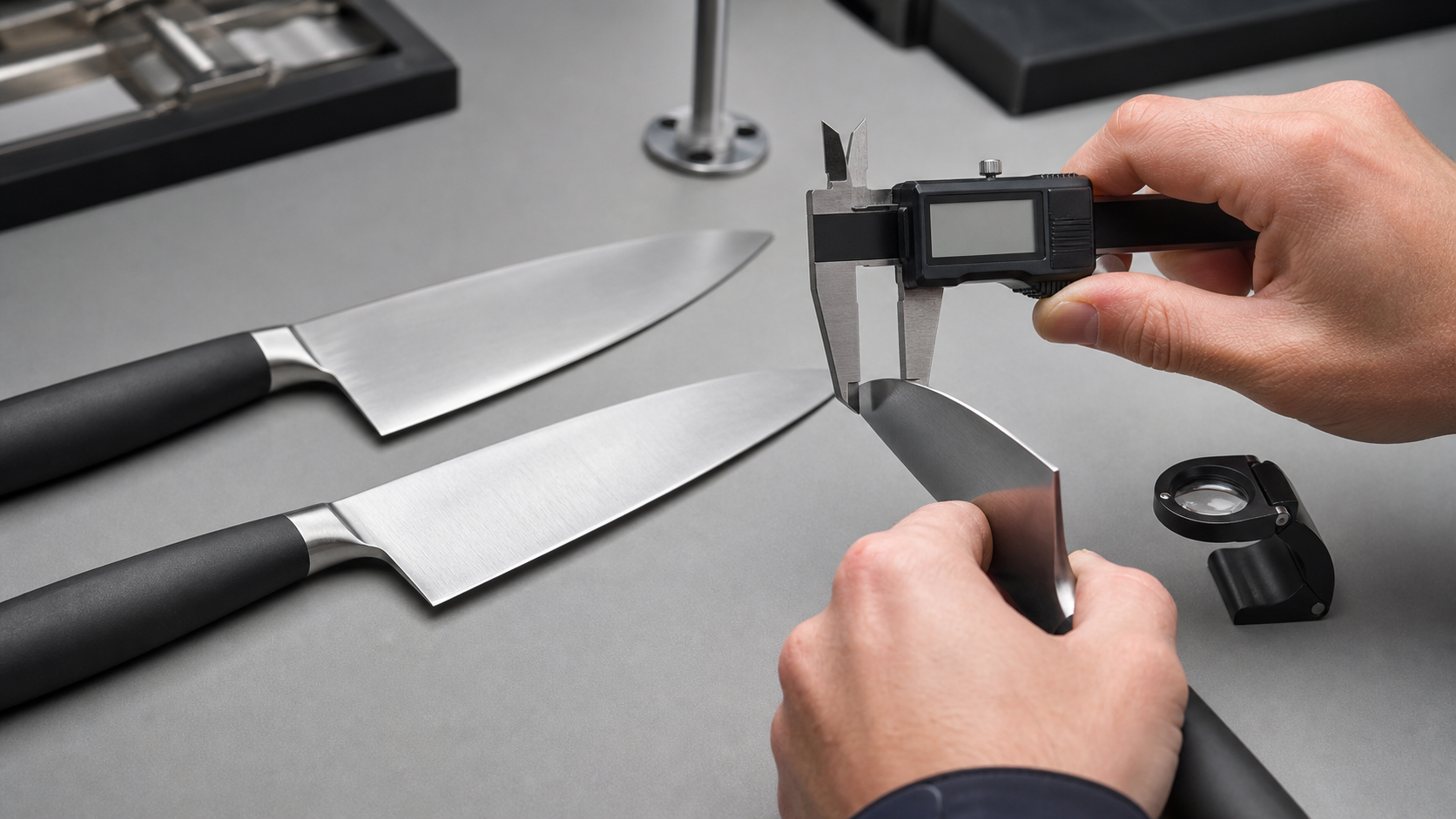
Buyers should separately specify or measure:
Blade thickness at defined locations
Thickness behind the edge
Distance from the edge at which thickness is measured
Primary grind
Secondary bevel or microbevel
Angle per side
Total included angle
Edge symmetry
Edge radius or micro-geometry
Surface finish
Distal taper where relevant
A knife with thinner behind-the-edge geometry may behave differently from a more robust knife made from the same steel and tested at the same nominal hardness. That difference should not be attributed to the steel name alone.
7. Corrosion and Cutting-Test Conditions
“Corrosion resistant” is a conditional description, not a promise that a blade cannot stain or corrode.
ASTM G31 notes that immersion-corrosion results can be affected by the solution, temperature, specimen preparation, fluid movement, exposure duration, cleaning procedure, and other test variables. ASTM G48-25 applies specifically to pitting and crevice-corrosion initiation in ferric-chloride environments and does not support conclusions about environments that contain no chlorides.
Corrosion comparisons should therefore identify:
Test method
Medium and concentration
pH
Temperature
Exposure time
Surface condition
Heat-treatment condition
Cleaning procedure
Evaluation criteria
Sharpness and edge-retention data require similar control. ISO 8442-5:2004 remains the current published ISO standard for sharpness and edge-retention testing of hand-used knives intended for professional or domestic food preparation. A meaningful comparison still requires matched edge type, sharpening condition, test medium, sample number, and reporting method.
A Buyer’s Comparison Sequence
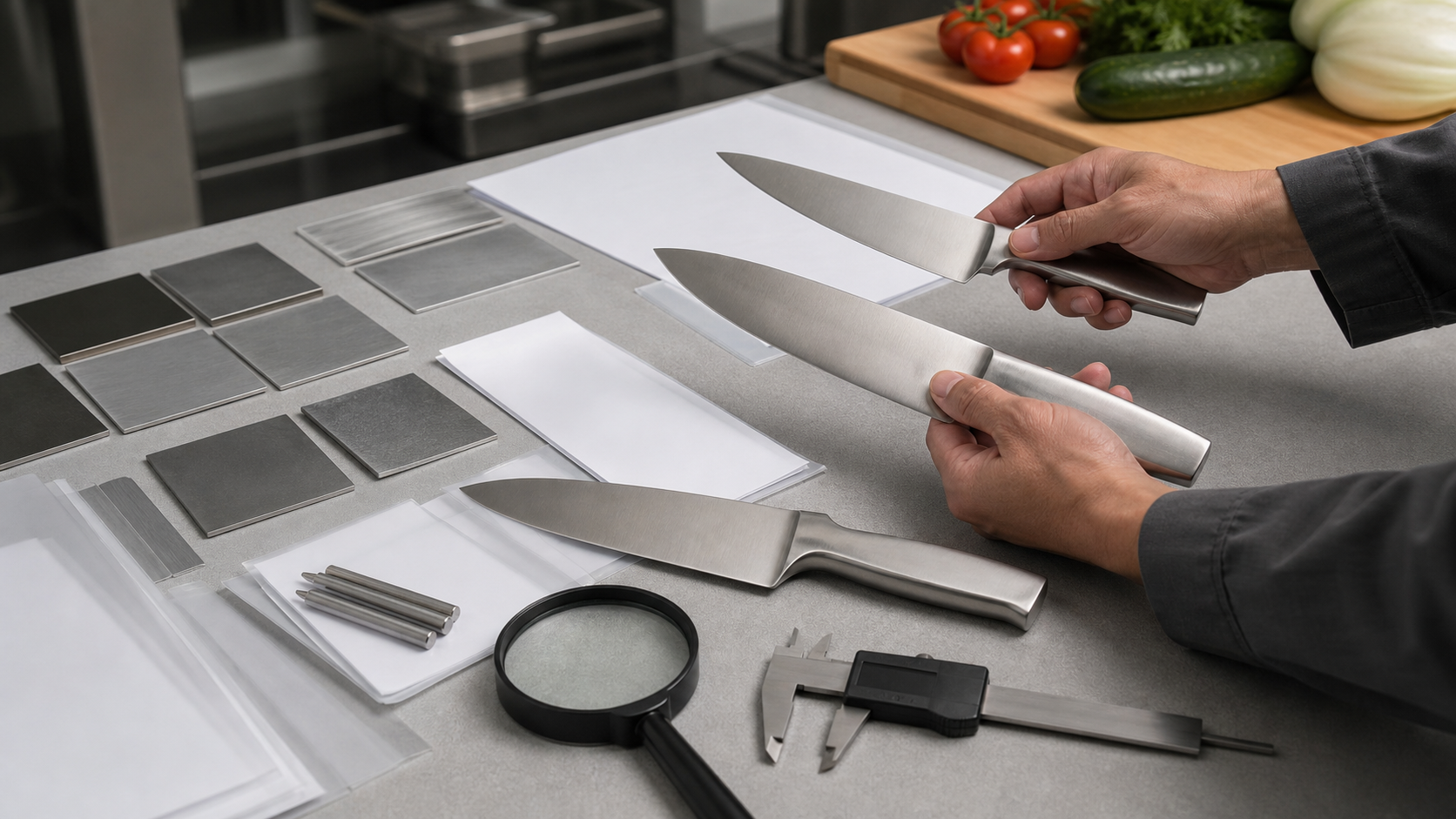
A practical sourcing review can follow this order:
Resolve the full formal grade.
Confirm the standards system and edition.
Confirm the raw-material product form.
Compare the complete ordered chemistry.
Review the heat or lot analysis.
Verify inspection documents and batch traceability.
Confirm the finished heat-treatment condition.
Review hardness method, location, and sampling.
Compare blade and edge geometry.
Review corrosion, sharpness, or edge-retention tests only under matched conditions.
Establish written approval requirements for material and process changes.
This sequence helps prevent a commercial shorthand from being treated as a complete product specification.
Conclusions Buyers Should Avoid
The available evidence does not support broad statements such as:
“5Cr is better than 3Cr.”
“A larger number means a higher-quality steel.”
“5Cr15MoV is always identical to 50Cr15MoV.”
“50Cr15MoV and X50CrMoV15 are automatically interchangeable.”
“1.4116 proves that the steel was made in Germany.”
“The same steel grade produces the same knife performance.”
“A higher HRC number guarantees better edge retention.”
“Stainless knife steel is rust-proof.”
Each statement removes conditions that materially affect the conclusion.
Compare the Evidence Package, Not the Nickname
Steel names are useful starting points, but they are not complete sourcing decisions.
For importers, brands, product managers, purchasing teams, and quality personnel, the most reliable comparison is an evidence package connecting:
The formal material designation
The applicable standard and edition
The raw-material product form
Ordered and actual chemistry
Inspection documents
Heat and production batches
Finished heat-treatment condition
Hardness-test conditions
Blade and edge geometry
Test conditions
Change-control records
This approach does not establish that one grade is universally better than another. It establishes whether the material and finished blade being supplied can be clearly identified, compared, and traced.
Specific product suitability or compliance still requires review of the actual material, intended use, destination market, supplier documentation, production records, and any necessary laboratory or professional evaluation.
References
- GB/T 20878-2024 — Stainless steels—Designation and chemical composition (SAMR)
- Baosteel special-steel grade cross-reference (30Cr13 / 3Cr13)
- Effect of Tempering Time on the Microstructure and Properties of Martensitic Stainless Steel (Metals, 2024)
- BS EN 10027-1:2016 — Designation systems for steels — Steel names
- BS EN 10027-2:2015 — Designation systems for steels — Numerical system
- BS EN 10088-1:2023 — Stainless steels — List of stainless steels
- BS EN 10088-2:2024 — Technical delivery conditions for sheet, plate and strip
- BS EN 10088-3:2023 — Technical delivery conditions for semi-finished and long products
- Acerinox ACX 380 / X50CrMoV15 / 1.4116 product data sheet
- ASTM A751-25 — Standard Test Methods and Practices for Chemical Analysis of Steel Products
- ISO 10474:2013 — Steel and steel products — Inspection documents
- BS EN 10204:2004 — Metallic products — Types of inspection documents
- ASTM E18-25 — Standard Test Methods for Rockwell Hardness of Metallic Materials
- ISO 6508-1:2023 — Metallic materials — Rockwell hardness test — Part 1: Test method
- ASTM G31-21(2025) — Standard Guide for Laboratory Immersion Corrosion Testing of Metals
- ASTM G48-25 — Pitting and crevice corrosion resistance by use of ferric chloride solution
- ISO 8442-5:2004 — Specification for sharpness and edge retention test of cutlery