
Knife Knowledge · Materials & Hardness
Why Higher HRC Does Not Always Mean a Better Kitchen Knife
HRC reports indentation hardness at a defined test point. It can help control a specification, but it cannot rank finished knives without the steel, heat treatment, geometry, test method, and intended task.
Quick answer
A higher HRC is not a universal quality score. It may affect deformation or wear behavior within a controlled material system, but it does not by itself establish edge retention, toughness, cutting efficiency, sharpenability, or suitability for a task. Buyers should compare the steel designation, heat treatment, Rockwell scale and test location, blade geometry, sampling method, and intended use together.
Two kitchen knives can carry different HRC values without the higher number being the better purchase. The number describes an indentation-hardness result at a particular test location under a defined method; it does not summarize the finished knife.
HRC is useful, but it measures only one aspect of a knife material under defined test conditions. It does not directly measure sharpness, toughness, wear resistance, cutting efficiency, resistance to chipping, or suitability for a particular kitchen task.
For importers, distributors, private-label brands, product managers, and quality teams, the more useful question is not simply:
“How high is the HRC?”
It is:
“What does this hardness result represent, how was it measured, and how does it fit with the steel, heat treatment, edge geometry, and intended use of the knife?”
What Rockwell C Hardness Actually Measures
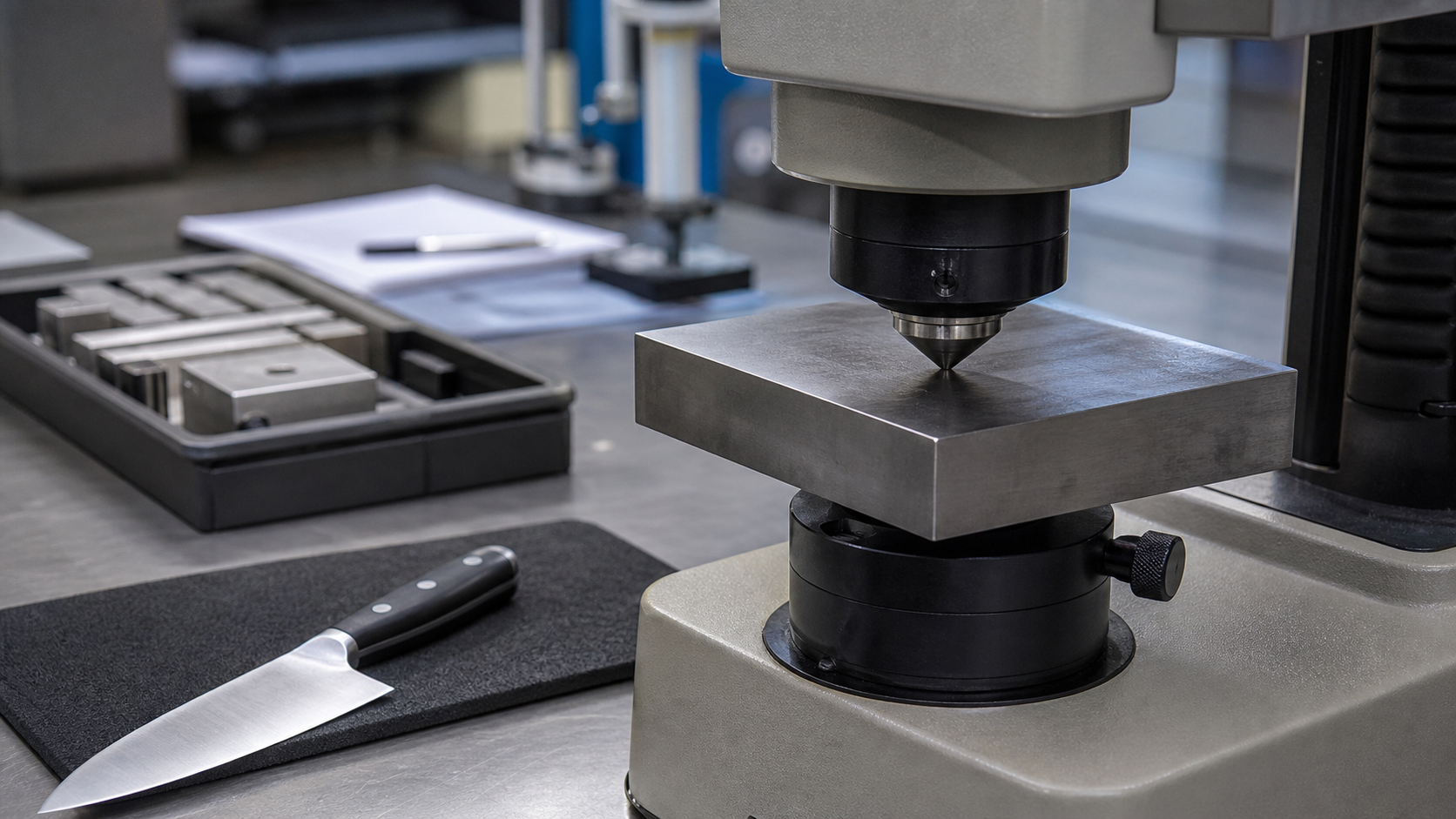
Rockwell hardness is an indentation hardness method. Under a defined test procedure, an indenter is pressed into a material and the resulting depth response is used to determine a hardness value.
ASTM E18, the principal ASTM standard for Rockwell hardness testing of metallic materials, describes Rockwell hardness as an empirical indentation test. This distinction matters because an HRC number should not be treated as a complete description of a material’s mechanical behavior.
A hardness measurement does not directly tell a buyer:
how tough the blade is,
how resistant the edge is to chipping,
how long the knife will remain sharp in a kitchen,
how easily it can be sharpened,
how corrosion resistant the steel is,
or how efficiently the finished blade will cut food.
These properties may be influenced by material condition, but they require their own definitions, test methods, and operating conditions.
In other words, HRC is a specification variable, not an overall knife-performance score.
Why the Test Location Matters
A kitchen knife is not a simple laboratory block with identical geometry at every location.
The blade may become progressively thinner toward the edge. Surface condition may vary between the blade face, bevel, spine, and other areas. Local material condition may also differ depending on manufacturing and heat-treatment history.
ASTM E18 specifically warns that a hardness result obtained at a particular location may not represent the physical characteristics of the entire part or finished product.
For knife buyers, this raises an important specification question:
Where was the hardness measured?
A statement such as “60 HRC” without a defined test location provides less information than a hardness specification tied to a controlled measurement position.
It should not automatically be assumed that one reading represents identical hardness across every part of the blade.
For supplier qualification or incoming QC, test-location information can therefore be as important as the nominal number itself.
Blade Thickness Can Affect Rockwell Testing
Rockwell testing produces a deformation zone beneath the indentation. If the material at the measurement point is too thin for the selected testing conditions, the support beneath the specimen may influence the result.
This issue is particularly relevant to kitchen knives because finished blades can become very thin near the cutting edge.
ASTM E18 includes guidance for determining minimum test-piece thickness, and ISO 6508 provides a separate international framework for Rockwell hardness testing.
The practical procurement lesson is straightforward:
A hardness value should only be compared when the test method is appropriate for the local thickness being measured.
This does not mean that buyers should apply a universal minimum blade thickness from memory. Minimum thickness requirements depend on the applicable standard, Rockwell scale, hardness level, and test conditions.
When a precise acceptance criterion is required, the current version of the relevant test standard should be consulted.
Surface Condition Also Matters
The condition of the test surface can influence the reliability of a hardness measurement.
Rockwell hardness guidance from the U.S. National Institute of Standards and Technology discusses the importance of clean, properly prepared surfaces and appropriate specimen support. Surface preparation should also avoid altering the material being measured through excessive heating or cold working.
For a finished knife, relevant questions can include whether the measurement was performed on:
a ground surface,
a polished surface,
an oxidized surface,
a coated region,
or a specially prepared test area.
The purpose is not to prescribe one universal preparation method for every kitchen knife. It is to make sure results being compared were obtained under suitable and sufficiently comparable conditions.
A One-Point HRC Difference Is Not Automatically a Meaningful Performance Difference
Specification sheets often encourage very fine comparisons: 58 HRC versus 59 HRC, or 59 HRC versus 60 HRC.
But any hardness measurement exists within a measurement system.
Instrument performance, calibration, surface condition, specimen positioning, local material variation, test cycle, and other factors can contribute to measurement variation and uncertainty. ASTM E18 includes guidance relating to Rockwell hardness uncertainty, while ISO 6508-2 addresses verification and calibration of Rockwell testing machines and indenters.
This means a small difference between two reported values should not automatically be interpreted as a confirmed difference in finished-knife performance.
Before treating a one-point HRC difference as commercially significant, buyers should ask whether the measurements were:
made to the same standard,
made on the same Rockwell scale,
taken at comparable blade locations,
made on suitable local thicknesses,
produced with appropriately verified equipment,
and based on comparable sampling procedures.
Without that context, the numbers may appear more precise than the comparison actually is.
Similar HRC Does Not Mean Similar Edge Retention
One of the clearest reasons not to rank knives by HRC alone is that different steels can show similar hardness while behaving differently during cutting and wear tests.
A 2022 peer-reviewed knife study compared blades made from 154CM, 440C, and N690 steels. Their measured hardness values were very close—approximately 57 HRC—but their sharpness-retention behavior in a controlled abrasive cutting test was not the same.
This is important because it demonstrates something that a specification sheet cannot show with HRC alone:
similar indentation hardness does not mean identical edge-retention behavior.
The explanation can involve differences in steel composition, matrix condition, carbides, heat treatment, and wear mechanisms.
The opposite mistake should also be avoided. This evidence does not mean hardness is irrelevant.
It means hardness must be interpreted as one variable within a larger material system.
Higher Hardness Can Help Under Some Conditions
Within the same steel and a controlled test system, increasing hardness may be associated with better resistance to certain forms of edge wear.
A 2023 knife-cutting study provides useful examples. In specific heat-treatment comparisons involving 5Cr15MoV and 9Cr18MoV, higher-hardness conditions were associated with larger accumulated cutting values in the study’s controlled abrasive cutting test.
That is a legitimate observation.
However, when different steels in the same study were compared together, hardness alone did not produce a simple universal ranking of cutting performance.
This distinction is essential.
A relationship observed:
within one steel, under one heat treatment comparison, with controlled geometry and testing
should not automatically become:
“higher HRC always means better edge retention.”
For B2B specifications, conditional language is more technically accurate.
Edge Geometry Can Change the Result
Steel and hardness are only part of the finished knife.
The geometry of the cutting edge can substantially influence cutting behavior.
The same 2023 study found that blade angle affected controlled cutting performance. It also found differences when edge-related geometry was changed even within the same steel and nominal angle conditions.
For buyers, this has a direct implication:
Two knives can have the same steel grade and similar HRC while still cutting differently because their edges are not geometrically equivalent.
Relevant variables can include:
edge angle,
whether the quoted angle is per side or included angle,
thickness behind the edge,
primary bevel geometry,
micro-bevel configuration,
and the geometry immediately at the apex.
This is why an HRC number cannot substitute for a complete blade specification.
A harder but substantially thicker edge may behave differently from a slightly softer but thinner edge, depending on the food being cut, the cutting motion, and the loads applied.
There is no useful universal answer without defining the geometry and the task.
Does Higher HRC Mean a Knife Is Harder to Sharpen?
This claim is common, but it should be treated carefully.
Hardness can influence material removal, but sharpening behavior is not determined by HRC alone.
Other variables can include:
steel microstructure,
carbide type,
carbide size and distribution,
abrasive material,
abrasive size,
sharpening pressure,
edge angle,
edge condition,
and the amount of metal that must be removed.
As a result, a simple statement such as:
“60 HRC is harder to sharpen than 58 HRC”
is not reliable unless the steels, microstructures, geometries, abrasives, and sharpening conditions are sufficiently controlled.
For purchasing communication, a better approach is to treat sharpenability as a separate performance question, rather than deriving it directly from the HRC value.
Does Higher Hardness Mean Greater Chipping Risk?
Another common shortcut is:
“Harder means more brittle.”
Again, the underlying engineering issue is more complicated.
Rockwell C hardness does not directly measure impact toughness, fracture toughness, or resistance to edge chipping. These are separate mechanical behaviors.
Whether an actual knife edge chips depends on a combination of factors that can include:
steel composition,
heat-treatment condition,
microstructure,
edge thickness,
edge angle,
defects or damage,
impact loading,
lateral loading,
contact with hard materials,
and the way the knife is used.
A very thin edge and a more robust edge made from the same material may behave differently under the same accidental load.
Similarly, two different steels at the same HRC should not be assumed to have the same impact response.
For that reason, chipping resistance should not be calculated from HRC alone.
If a product is being marketed for demanding impact or chopping applications, relevant material, geometry, and performance evidence is more useful than a hardness number by itself.
There Is No Universal “Best HRC” for Every Knife Type
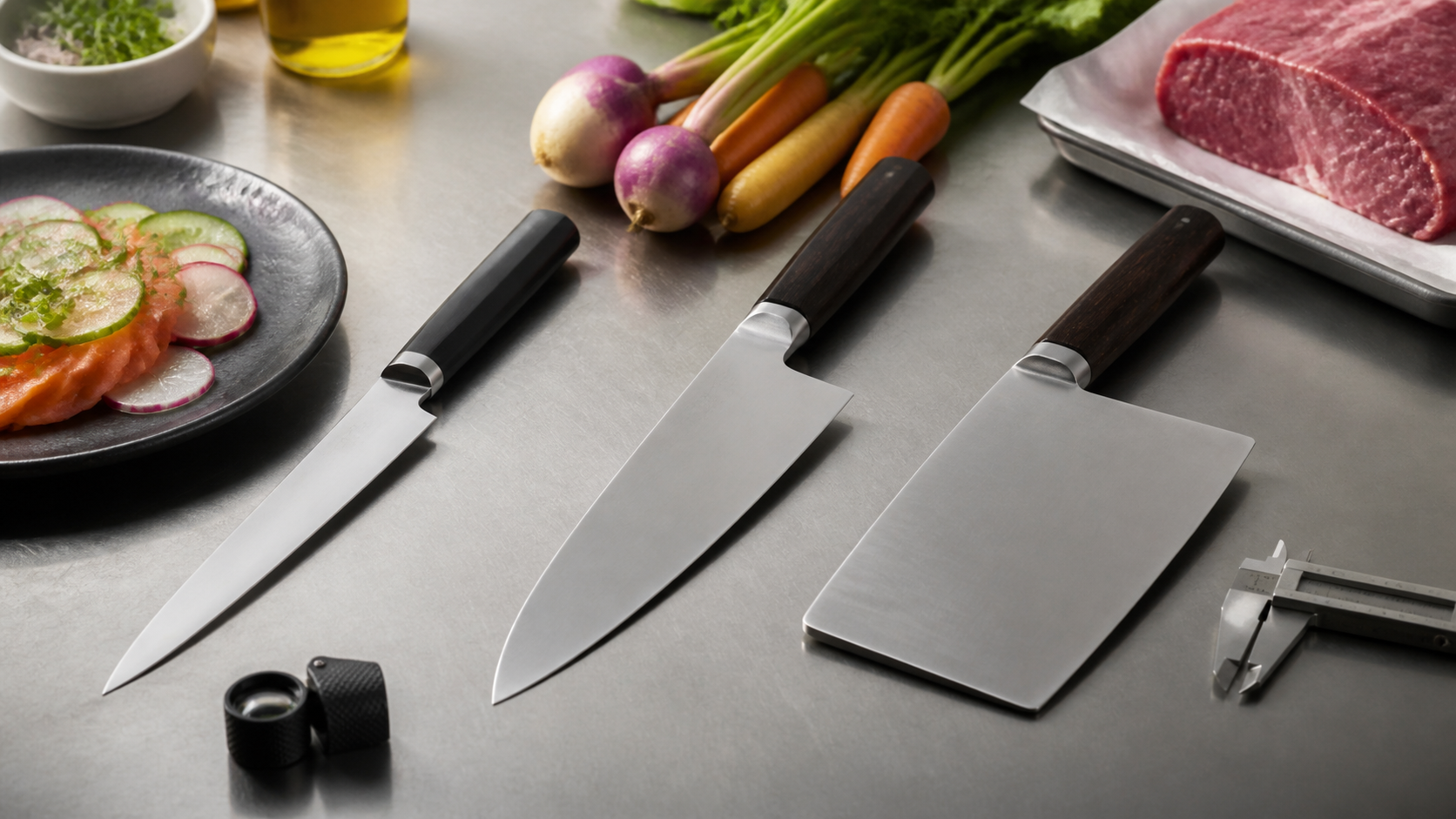
Buyers sometimes encounter charts assigning a supposedly ideal hardness range to chef knives, santoku knives, boning knives, cleavers, or other categories.
Such charts can look precise while hiding important design differences.
Two knives within the same category can differ substantially in:
steel,
heat treatment,
blade thickness,
edge angle,
edge thickness,
flexibility,
mass,
intended food materials,
cutting motion,
and expected misuse or impact.
A heavy chopping tool and a thin slicing knife do not experience identical loads. But that does not justify assigning one universal HRC value to each knife category either.
The better purchasing question is:
What combination of material condition and geometry is appropriate for the intended task?
That question cannot be answered from HRC alone.
HRC and Edge-Retention Tests Measure Different Things
It is also important to distinguish hardness testing from knife cutting tests.
Rockwell hardness measures indentation hardness.
By contrast, ISO 8442-5 addresses controlled testing of sharpness and edge retention for cutlery using a defined synthetic test medium.
These methods answer different questions.
A hardness test can confirm that a material at a defined test location falls within a hardness requirement.
A controlled cutting test can provide information about cutting behavior under the conditions of that test.
Neither should be presented as automatically proving real-world kitchen lifetime.
Statements such as:
“stays sharp for six months,”
“cuts twice as long,”
or “requires half as much sharpening”
would require evidence specifically designed to support those claims under defined conditions.
What Buyers Should Ask When Reviewing an HRC Specification
Instead of using HRC as a ranking number, purchasing and QC teams can treat it as part of a larger specification package.
When reviewing a hardness specification, useful questions include:
Hardness-test information
Which test standard and edition were used?
Which Rockwell scale was used?
Where on the blade was the measurement taken?
Was the local blade thickness appropriate for the selected method?
What was the surface condition at the test location?
How many measurements were taken?
How were the measurements distributed across the sample?
What range or variation was observed?
Was the equipment appropriately verified or calibrated?
Product information that should accompany HRC
What is the exact steel designation?
Which material specification or grade definition applies?
What is the heat-treatment condition?
What is the blade thickness and cross-sectional geometry?
What is the edge angle?
What is the thickness behind the edge?
What task is the knife intended to perform?
What cutting, wear, impact, or sharpening evidence exists if those properties are being claimed?
This approach provides much more useful information than asking only whether one knife is “58 HRC” and another is “60 HRC.”
HRC Should Be Treated as One Controlled Input
Rockwell C hardness is valuable because it gives buyers and quality teams a standardized way to evaluate one aspect of material condition.
Its value decreases when the number is removed from its measurement context.
A higher HRC may contribute to desirable wear or edge-retention behavior in some material systems. In other designs, toughness requirements, edge geometry, sharpening requirements, or expected loading may change the preferred balance.
Similarly, two knives with almost identical HRC values can still differ in steel composition, microstructure, edge geometry, and cutting behavior.
For kitchen knife sourcing, the practical conclusion is therefore not that hardness is unimportant.
It is that hardness should be interpreted together with steel identity, heat treatment, test conditions, blade and edge geometry, and intended use.
The most useful procurement question is not:
“Which knife has the higher HRC?”
It is:
“Is this hardness result valid, representative, comparable, and appropriate for the steel, geometry, and task we are specifying?”
That distinction turns HRC from a marketing number into a meaningful engineering specification.
References
- ASTM International. ASTM E18-25 — Standard Test Methods for Rockwell Hardness of Metallic Materials.
- ISO. ISO 6508-1:2023 — Metallic materials — Rockwell hardness test — Part 1: Test method.
- ISO. ISO 6508-2:2023 — Metallic materials — Rockwell hardness test — Part 2: Verification and calibration of testing machines and indenters.
- ISO. ISO 8442-5:2004 — Materials and articles in contact with foodstuffs — Cutlery and table holloware — Part 5: Specification for sharpness and edge retention test of cutlery.
- National Institute of Standards and Technology. NIST Recommended Practice Guide: Rockwell Hardness Measurement of Metallic Materials.
- Effect of Alloying Elements on the Sharpness Retention of Kitchen Knife Blades. Metals, 2022.
- A Comprehensive Understanding of Knife Cutting Performance: The Effect of Different Steels, Heat Treatments and Edge Geometries. Materials, 2023.