
Knife Knowledge · Materials & Heat Treatment
Why Heat Treatment Changes Kitchen Knife Performance
Heat treatment affects far more than HRC. Buyers should connect material identity, documented process history, measured steel condition, and finished-knife testing instead of treating one hardness value or process label as proof.
Quick answer
Heat treatment changes the microstructure and can affect hardness, toughness, retained austenite, distortion, corrosion behavior, and consistency. Buyers should verify the steel, process window, hardness method and sampling plan, dimensional controls, and finished-knife performance tests together.
For kitchen knife buyers, heat treatment is often reduced to a single number: HRC. That number matters, but it does not explain the whole condition of the steel.
Two knives made from the same nominal steel grade can show similar Rockwell hardness values and still behave differently in cutting, edge damage, sharpening, corrosion exposure, or long-term use. One reason is that heat treatment affects much more than hardness. It changes the steel’s microstructure, including martensite, retained austenite, carbides, grain condition, residual stress, and in some cases the condition of the surface layer.
For importers, brands, product managers, and quality teams, the more useful question is therefore not simply:
“What HRC is this knife?”
It is:
“What material was heat treated, what process did it actually experience, and how was the resulting condition verified?”
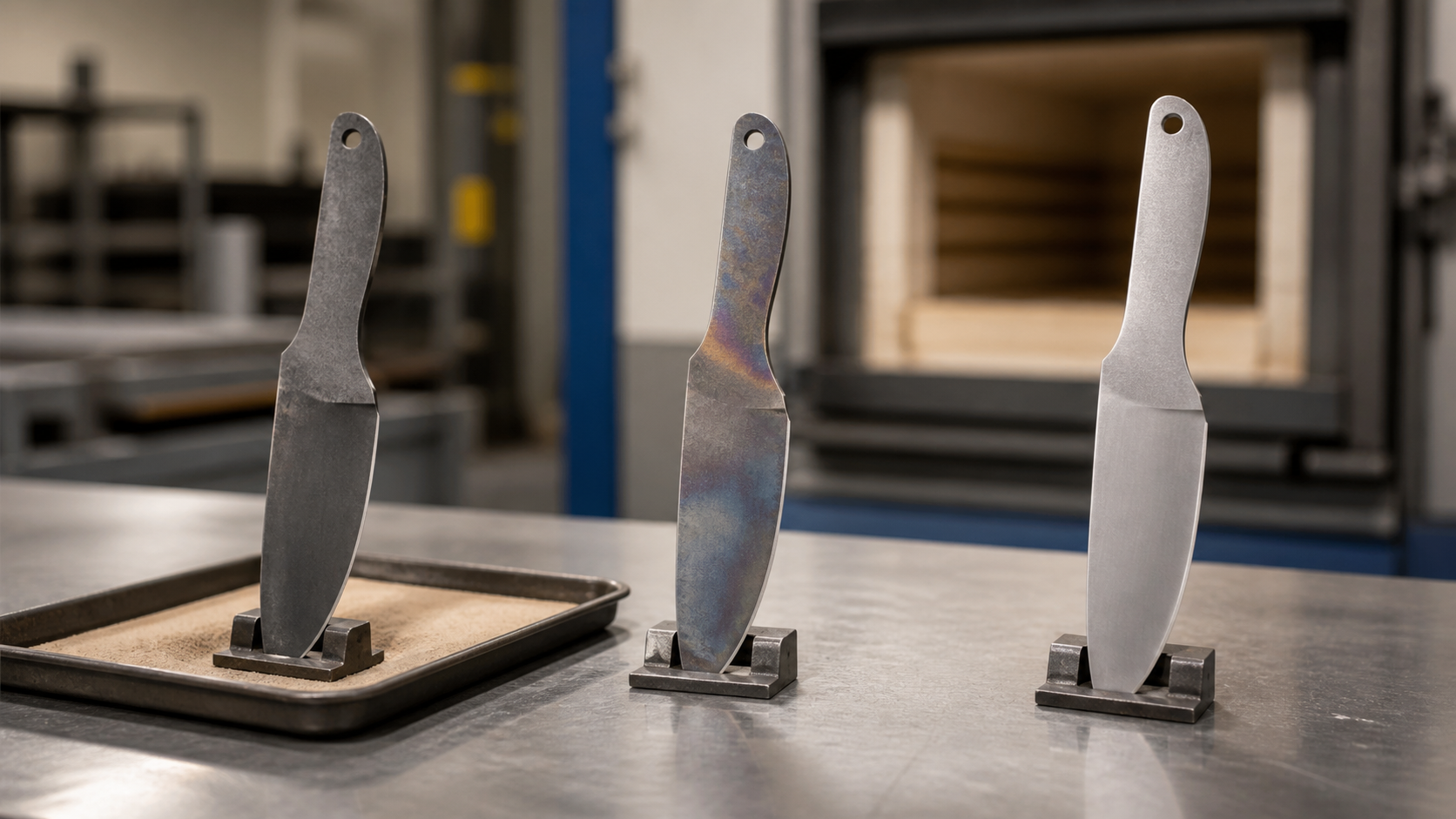
Heat Treatment Is a Sequence, Not a Single Step
Heat treatment is a controlled sequence of heating and cooling operations used to change the structure and properties of steel.
For many hardenable knife steels, the sequence may include:
- heating and temperature equalization;
- austenitizing;
- quenching;
- tempering;
- and, for some steel grades, sub-zero or cryogenic treatment.
These stages should not be treated as a universal recipe.
Different steels contain different amounts of carbon, chromium, molybdenum, vanadium, nitrogen, and other alloying elements. They can also contain different types and amounts of carbides. Those differences affect how the steel responds to temperature, how much carbide dissolves during austenitizing, how easily martensite forms during cooling, how much retained austenite remains, and how the steel responds to tempering.
This is why one set of temperatures, holding times, and cooling conditions should not be assumed to work equally well for every kitchen knife steel.
What Happens During Austenitizing?
Austenitizing is more than simply heating the blade until it becomes “hot enough.”
During this stage, the steel develops an austenitic matrix that will later transform during quenching. At the same time, some carbides may dissolve and release carbon and alloying elements into the austenite.
The resulting balance matters.
If the treatment conditions are insufficient for a particular steel, the desired amount of alloying elements may not enter solution and the steel may not reach the intended hardened condition.
If conditions are too aggressive for that same steel, other problems may appear. Depending on the alloy, excessive carbide dissolution, increased retained austenite, grain growth, or changes in corrosion behavior can occur.
This is also why the idea that “all carbides should be completely dissolved” is not a reliable general rule for knife steels. In some alloys, the intended microstructure includes a controlled amount of retained carbide.
The correct target is therefore grade-specific.
Quenching Controls More Than Final Hardness
After austenitizing, the steel is cooled through the transformation range. In hardenable steels, the objective is generally to produce the required martensitic structure while controlling undesirable transformations.
The cooling path must be fast enough for the particular steel, section thickness, and process.
But “faster is always better” is not a sound quality rule.
During quenching, the blade does not cool uniformly at every point. Thin sections, thick sections, the spine, the tip, holes, transitions, and other geometric features can experience different cooling rates.
At the same time, martensitic transformation involves dimensional changes within the steel. Thermal gradients and transformation stresses can contribute to:
- distortion;
- residual stress;
- cracking risk;
- dimensional instability.
For a kitchen knife, this matters because a blade is not a simple laboratory coupon. It can contain major differences in thickness between the spine, primary grind, edge region, tang, and tip.
The suitable cooling method therefore depends on the steel grade, blade geometry, equipment, loading arrangement, and target condition.
Why Tempering Is Necessary
Freshly quenched martensitic steel is usually not the final condition wanted for a finished knife.
As-quenched martensite can contain substantial internal stress and may be too brittle for the intended application. Tempering changes this condition by allowing further microstructural changes to occur.
Depending on the alloy and tempering conditions, tempering can affect:
- hardness;
- stress state;
- carbide precipitation;
- dimensional stability;
- retained-austenite transformation;
- toughness-related behavior;
- and, for some stainless steels, corrosion response.
It is therefore misleading to describe tempering simply as “softening the steel.”
For simple steels, hardness often decreases as tempering becomes more severe. High-alloy steels can show more complicated behavior because alloy carbide precipitation and secondary hardening mechanisms may become important.
The practical implication for buyers is straightforward: a generic statement such as “double tempered” or “high-temperature tempered” does not, by itself, prove that the steel reached the correct final condition.
The steel grade and the complete processing sequence still matter.
What About Sub-Zero or Cryogenic Treatment?
Some knife steels may retain a meaningful amount of austenite after conventional quenching.
In certain grades, cooling the steel below room temperature can promote additional transformation of retained austenite to martensite. This may be described as sub-zero treatment, deep freezing, or cryogenic treatment.
These terms should be used carefully.
They do not always refer to the same temperature range or process sequence, and the effect depends heavily on the steel.
A treatment may be performed:
- before tempering;
- between tempering operations;
- after an initial temper;
- or as part of a more complex cycle.
New martensite produced during low-temperature treatment may also require subsequent tempering.
For this reason, the phrase “cryogenically treated” is not enough to evaluate quality. Buyers would need to know the steel grade, the actual treatment sequence, and the resulting measurements.
Cryogenic treatment should also not be presented as a mandatory step for every kitchen knife steel or as a universal method for improving hardness, toughness, wear resistance, and edge retention at the same time.
Those claims require steel-specific evidence.
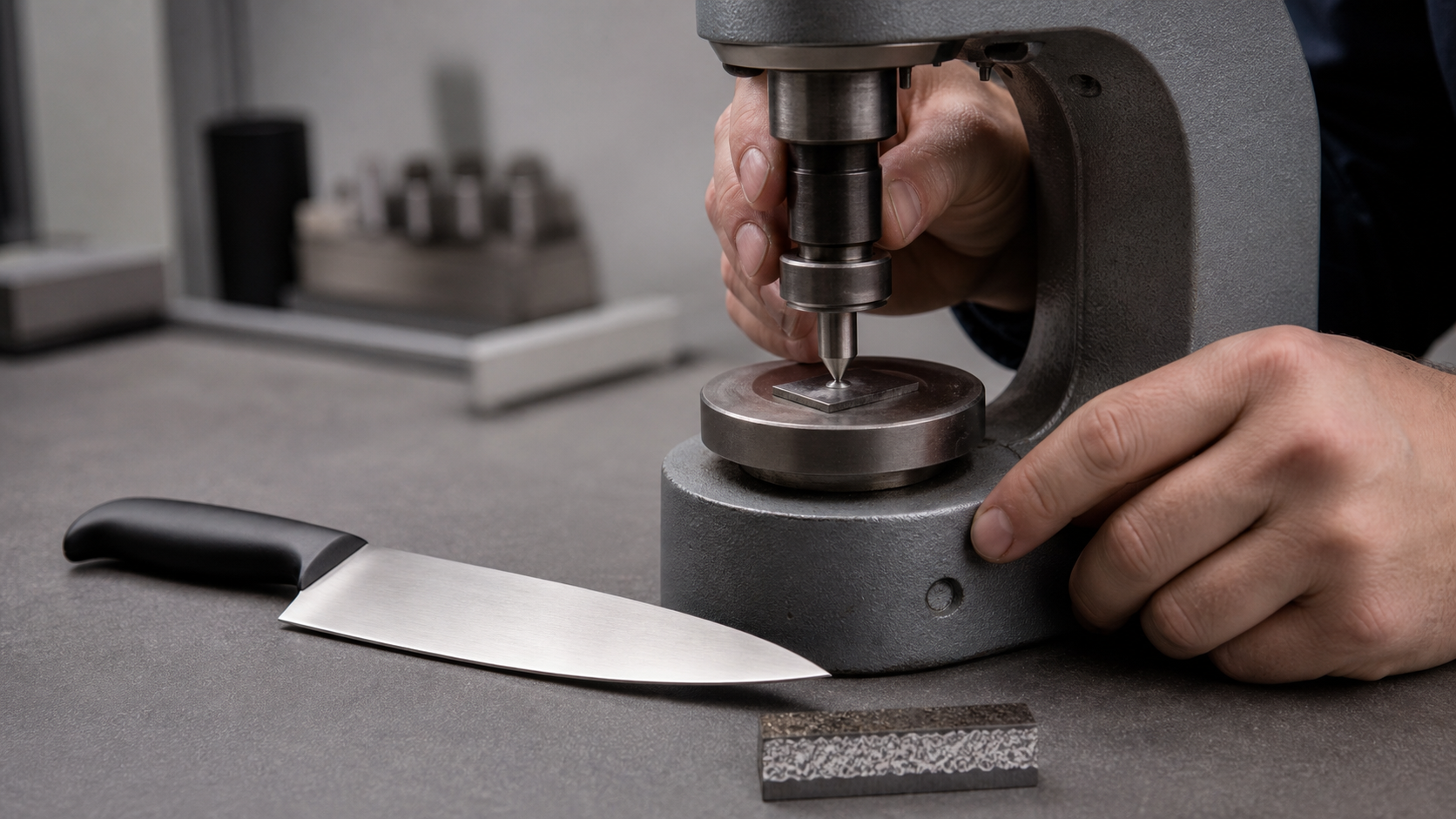
Why One HRC Number Does Not Tell the Whole Story
Rockwell C hardness is widely used in knife specifications because it is useful, repeatable when correctly performed, and practical for quality control.
However, hardness is still only one measured response.
A Rockwell result does not directly measure:
- fracture toughness;
- impact resistance;
- wear resistance;
- corrosion resistance;
- edge retention;
- resistance to rolling;
- resistance to microchipping;
- cutting force.
It also matters where the hardness test is performed.
A measurement on a flat area of the blade may not represent every part of the knife. The edge region may have a different thermal and grinding history from the center of the blade. Thin sections can also create testing limitations that make conventional Rockwell measurements inappropriate.
For some investigations, microhardness testing on a prepared cross-section can provide more information about local gradients.
This does not mean HRC is unimportant.
It means that HRC should be interpreted as one part of a larger verification system.
Hardness and Hardenability Are Not the Same Thing
Another common source of confusion is the difference between hardness and hardenability.
Hardness describes the material’s response to a specified indentation test.
Hardenability refers to the ability of a steel to develop a particular depth and distribution of hardness under defined quenching conditions.
A steel can be capable of high hardness but still behave differently from another steel in terms of how that hardness develops through different section sizes.
For kitchen knife buyers, the distinction matters because a single surface hardness reading cannot establish how uniformly the required condition has developed through the relevant part of the blade.
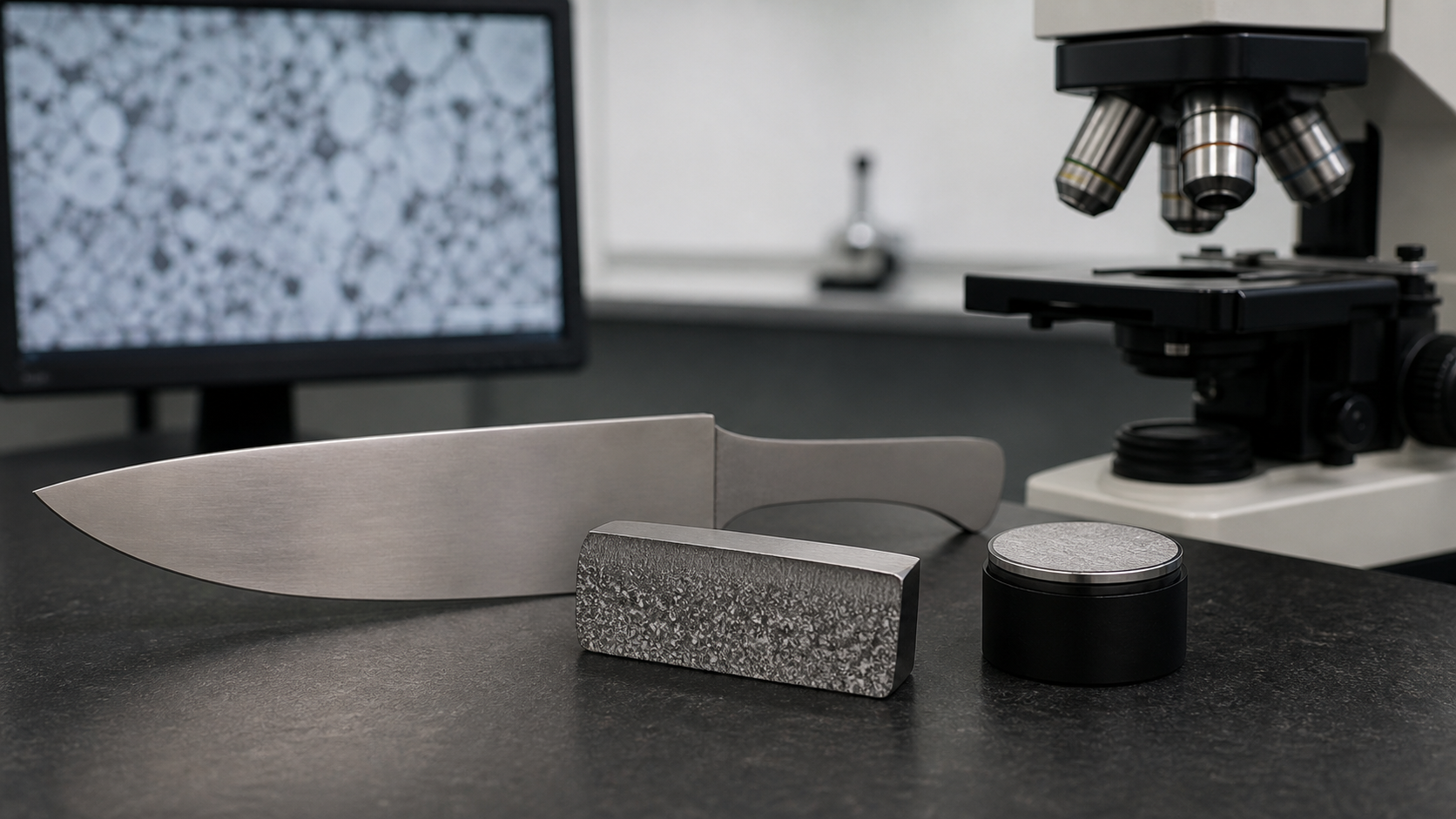
Microstructure May Require Separate Verification
When a performance claim depends on a particular structural feature, hardness testing alone may not be enough.
Additional evaluation may include:
Retained Austenite Measurement
X-ray diffraction can be used for retained-austenite measurement under appropriate conditions.
However, the method itself has limitations, including detection limits, crystallographic orientation effects, and interference from other phases. A report should therefore identify the method, test location, and relevant reporting limits.
Metallography
Prepared cross-sections can be used to examine features such as:
- carbide distribution;
- microstructural uniformity;
- grain condition;
- surface decarburization.
Metallographic images should not be compared casually. Sampling direction, polishing, etching method, magnification, and interpretation criteria all affect what is visible.
Decarburization Evaluation
During high-temperature processing, carbon can be lost from the surface under certain atmospheric conditions.
This may affect the near-surface condition and cannot necessarily be ruled out by a hardness measurement taken farther inside the blade.
If decarburization is relevant to the specification, it requires an appropriate test method and defined acceptance criteria.
Heat Treatment Can Also Affect Corrosion Behavior
For martensitic stainless steels, corrosion performance is not determined by chromium content alone.
Heat treatment can change how chromium and other alloying elements are distributed between the steel matrix and carbides. In some alloy systems, particular heat-treatment conditions can create chromium-depleted regions or otherwise change corrosion response.
This does not mean that one tempering temperature can be labeled “corrosion resistant” and another “corrosion prone” across all knife steels.
Different alloys respond differently.
Corrosion results also depend on:
- surface finish;
- test solution;
- temperature;
- exposure time;
- chloride concentration;
- specimen preparation;
- cleaning and use conditions.
Any corrosion statement should therefore be tied to a specific steel and defined test environment.
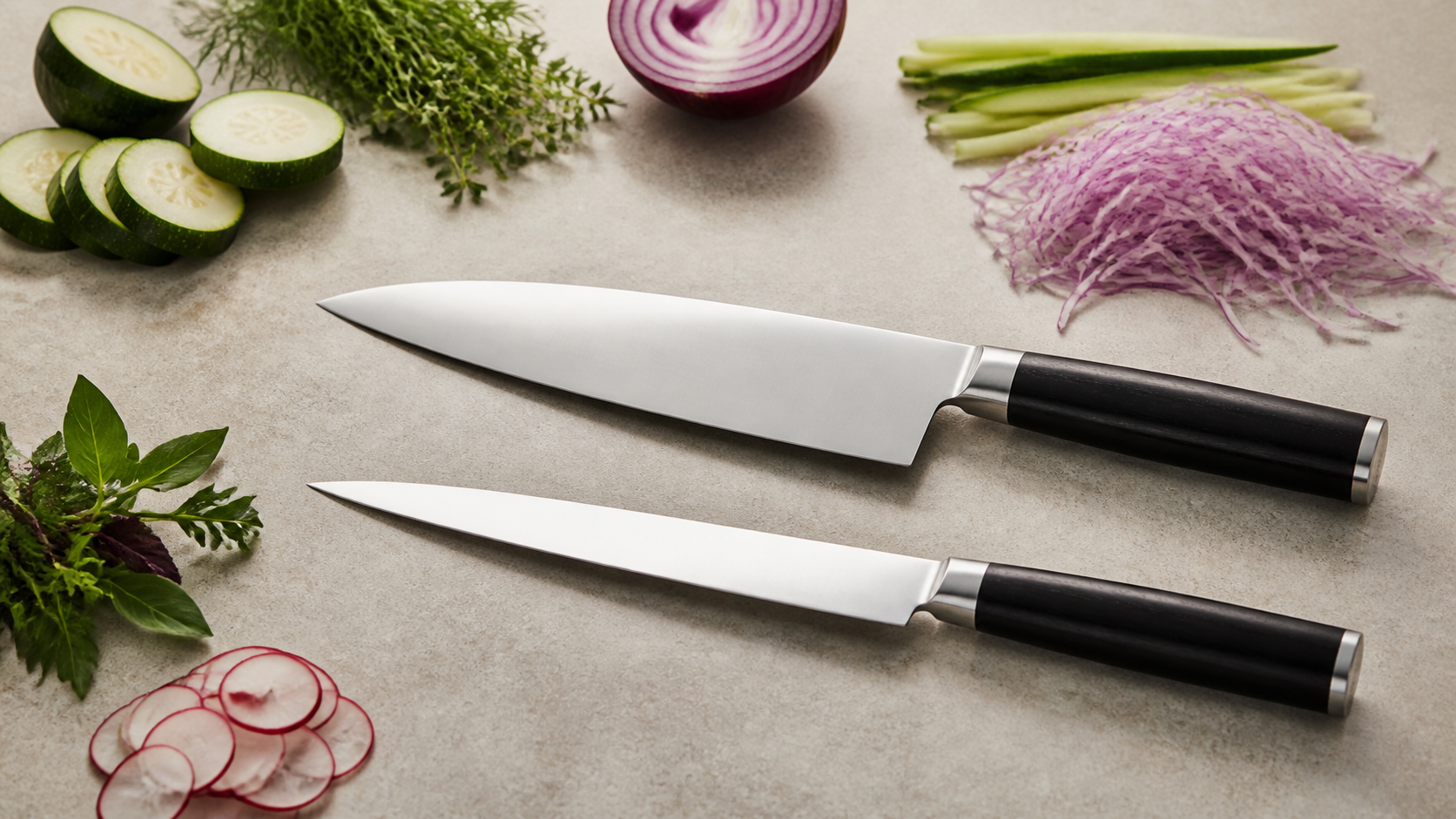
Finished Knife Performance Still Depends on Geometry
Even a well-characterized heat treatment does not determine finished knife performance by itself.
The edge is a structural component.
Performance is also influenced by:
- edge angle;
- thickness behind the edge;
- primary grind;
- blade thickness;
- surface condition;
- sharpening quality;
- cutting medium;
- lateral loading;
- user technique.
For example, two blades with similar steel and HRC can behave differently if one has a substantially thinner edge geometry.
A thinner geometry may reduce cutting resistance, but it also changes the mechanical loading experienced by the edge. The resulting balance between cutting efficiency and edge stability cannot be determined from HRC alone.
This is why material testing and finished-knife testing serve different purposes.

What Buyers Should Verify
For B2B purchasing and quality control, heat-treatment verification is stronger when several layers of evidence are connected.
1. Confirm the Material
Ask for:
- exact steel designation;
- applicable material standard or supplier grade;
- material certificate;
- heat or lot traceability;
- product form and delivery condition.
A commercial name alone may not be sufficient.
2. Confirm the Process Specification
The approved process should identify the relevant stages and revision.
Depending on the product and steel, this may include:
- heating and austenitizing controls;
- quenching method;
- tempering sequence;
- sub-zero treatment, if specified;
- process monitoring requirements.
The objective is not for the buyer to prescribe a universal recipe, but to confirm that the process is appropriate for the specified material and product.
3. Review Actual Batch Records
A written process specification describes what should happen.
Batch records provide evidence of what actually happened.
Relevant records may include:
- furnace cycle data;
- workpiece temperature records where required;
- quench records;
- tempering records;
- sub-zero treatment records;
- equipment identification;
- lot traceability.
4. Define Hardness Testing Properly
Instead of stating only an HRC range, a specification can also define:
- test method;
- test location;
- surface condition;
- sample quantity;
- number of measurements;
- acceptance range;
- reporting format.
This makes the result much easier to interpret during production and incoming inspection.
5. Add Other Tests When the Claim Requires Them
If the product claim depends on retained austenite, grain condition, decarburization, corrosion resistance, or edge retention, then an appropriate test should support that claim.
The test should match the property being discussed.
Common Claims That Need Caution
Buyers should treat the following statements as incomplete unless supported by defined evidence:
- “perfect heat treatment”;
- “maximum performance”;
- “fully optimized steel”;
- “uniform hardness”;
- “zero retained austenite”;
- “cryogenically enhanced”;
- “higher HRC means better edge retention”;
- “vacuum heat treated, so corrosion resistance is better”;
- “one heat-treatment cycle works for all stainless knife steels.”
These expressions often compress several different technical questions into one marketing phrase.
A more useful approach is to ask which property was measured, under which method, on which material, and under which conditions.
Conclusion
Heat treatment affects kitchen knife performance because it changes the internal condition of the steel, not simply because it produces a target hardness number.
Austenitizing influences the austenite, carbide, and grain condition. Quenching controls the transformation toward martensite while introducing thermal and transformation stresses. Tempering modifies the as-quenched structure and can change hardness, stress, carbide precipitation, and other properties. Some steels may also benefit from carefully controlled sub-zero treatment, but this is not a universal requirement.
For professional buyers, the most reliable evaluation model is therefore:
material identity → documented heat-treatment history → measured microstructure and hardness condition → finished-product performance testing
No single temperature, HRC value, heat-treatment label, or microstructural feature can establish the overall quality of every kitchen knife.
The stronger purchasing question is not “What heat treatment does this knife use?”
It is:
“What evidence shows that the specified steel reached the intended condition for this particular blade design and use case?”
References
- ISO 4885:2026, Ferrous materials — Heat treatments — Vocabulary
- ASTM A941-26a, Standard Terminology Relating to Steel, Stainless Steel, Related Alloys, and Ferroalloys
- NIST, Heat Treatment and Properties of Iron and Steel, NBS Monograph 88
- “Effect of the Austenitising Heat Treatment on AISI 420” — University of Wollongong research repository
- Alleima, Hardening Programs for Alleima Knife Steels
- Alleima 12C27 material datasheet
- Alleima 14C28N material datasheet
- Uddeholm, Special Heat Treatment Guidelines for Elmax
- BÖHLER N690 material datasheet
- “The Effect of Tempering Temperature on Microstructure and Corrosion Resistance of M390 Powder Metallurgical Martensitic Stainless Steel”
- “Cryogenic Treatment of Martensitic Steels: Microstructural Fundamentals and Implications for Process Optimization”
- ASTM E18-25, Standard Test Methods for Rockwell Hardness of Metallic Materials
- ASTM E384-22, Standard Test Method for Microindentation Hardness of Materials
- ASTM E975-22, Standard Practice for X-Ray Determination of Retained Austenite in Steel with Near Random Crystallographic Orientation
- ASTM E112-25, Standard Test Methods for Determining Average Grain Size
- ASTM E1077-14(2021), Standard Test Methods for Estimating the Depth of Decarburization of Steel Specimens
- ASTM E407-23, Standard Practice for Microetching Metals and Alloys
- ISO 8442-5:2004, Materials and articles in contact with foodstuffs — Cutlery and table holloware — Part 5: Specification for sharpness and edge retention test of cutlery