
Knife Knowledge · Handle Materials
Which Knife Handle Materials Fit Which Use Environments? Wood, POM, PP, TPE/TPR, and G10
Wood, POM, PP, TPE/TPR, and G10 are material families—not complete finished-handle specifications. Suitability depends on the exact grade, construction, service environment, and market documentation.
Quick answer
Define the real moisture, heat, chemical, grip, cleaning, and maintenance conditions first. Then verify the exact material grade and the complete handle assembly instead of relying on a shorthand material name.
Selecting a kitchen-knife handle material is not simply a choice between wood and plastic. For importers, private-label brands, product managers, and quality teams, the more useful question is whether a specific material grade and finished handle construction are suitable for the intended environment.
Names such as POM, PP, TPR, and G10 identify material families or systems. They do not, by themselves, define food-contact status, dishwasher suitability, chemical resistance, service temperature, grip performance, or product life.
A practical comparison therefore needs four layers of information:
- the exact material or grade;
- the finished handle construction;
- the actual cleaning and use environment;
- the documentation and testing required for the target market.
This approach is more useful than trying to rank handle materials from “best” to “worst.”
Start by Separating the Material Families
Several common knife-handle materials belong to technically different material groups.
Natural Materials: Wood
Wood is a natural, hygroscopic material. Its moisture content can change as surrounding temperature and relative humidity change.
Different wood species also have different structures and properties. Grain direction, drying condition, initial moisture content, surface treatment, and handle geometry can all affect how a finished wooden handle responds to changes in its environment.
For this reason, “wood handle” is not a complete material specification.
Thermoplastics: POM and PP
POM, or polyoxymethylene, and PP, or polypropylene, are both thermoplastic polymer families.
However, a polymer abbreviation does not identify the complete formulation.
POM may involve different polymer structures, including homopolymer and copolymer systems. PP may be supplied as homopolymer, random copolymer, impact copolymer, or modified grades containing fillers, reinforcement, colorants, stabilizers, or other additives.
Two materials carrying the same general polymer abbreviation can therefore have different physical properties and different regulatory documentation.
Elastomeric Systems: TPE and TPR
Thermoplastic elastomers, or TPEs, form another broad material group. In commercial discussions, TPR is also frequently used to describe thermoplastic rubber-like materials.
These terms should not be treated as the identity of one fixed formulation.
Different elastomer systems can vary substantially in hardness, surface feel, chemical compatibility, temperature response, aging behavior, and adhesion to the rigid substrate underneath an overmold.
A soft handle surface is therefore a design characteristic, not proof of a particular grip or durability level.
Fiber-Reinforced Composites: G10
G10 is commonly associated with a glass-fabric-reinforced epoxy laminate.
This makes it fundamentally different from POM or PP. It is typically a fiber-reinforced thermoset laminate rather than a conventional injection-molded thermoplastic.
The G10 designation can help identify a material family or industrial laminate grade, but it does not establish food-contact status, dishwasher resistance, chemical resistance, or finished-handle performance.
Define the Use Environment Before Comparing Materials
Handle materials should be evaluated against the real conditions in which the knife will be used.
A knife used in a controlled home kitchen and washed by hand faces a different environment from one exposed to frequent commercial washing, sanitizing chemicals, high humidity, oily hands, or repeated temperature cycles.
For sourcing purposes, buyers should define at least four types of exposure.
Moisture and Cleaning
Important questions include:
- Will the knife normally be hand washed?
- Can the handle remain wet for extended periods?
- Is temporary immersion possible?
- Is domestic dishwasher cleaning expected?
- Will the knife enter a commercial warewashing process?
These conditions should not be treated as equivalent.
Heat and Chemicals
Cleaning environments may involve detergents, alkaline cleaners, chlorine-containing products, quaternary ammonium compounds, peroxide-based products, or other chemicals.
Chemical compatibility depends on more than the chemical name. Concentration, temperature, contact time, mechanical stress, and the number of exposure cycles can all change the result.
The same applies to temperature data. Heat-deflection temperature, Vicat softening temperature, short-term peak temperature, regulatory use conditions, and long-term finished-product service temperature are different concepts.
One number should not be substituted for another.
Grip Conditions
A handle may be used with:
- dry hands;
- wet hands;
- oily or greasy hands;
- disposable gloves;
- cut-resistant gloves.
Grip is influenced by material formulation, surface texture, handle geometry, contamination, hand position, and glove type.
A soft material is not automatically a high-friction material, and a textured material is not automatically “non-slip” under every condition.
Appearance and Maintenance Expectations
Some products are expected to maintain a visually uniform surface. Others intentionally use natural materials whose appearance develops over time.
Buyers should decide in advance which changes are acceptable, including changes in color, gloss, texture, scratches, surface wear, or visible grain.
Without an agreed reference sample or acceptance limit, normal aging can easily be confused with a quality defect.
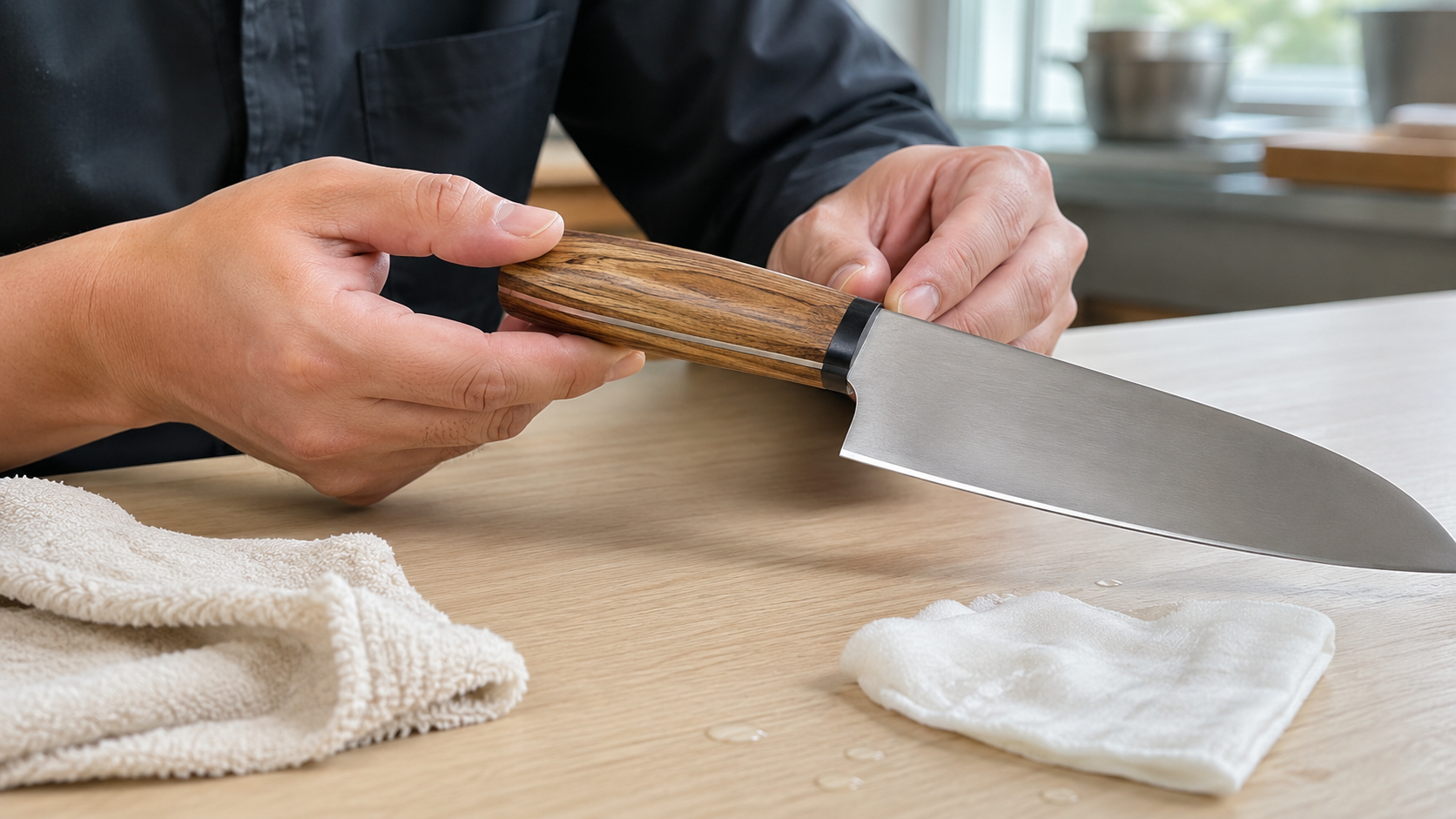
Wood Handles: Best Evaluated as a Moisture-Management System
Wood is particularly sensitive to environmental definition because it exchanges moisture with its surroundings.
Changes in moisture content can lead to dimensional changes. These changes are also anisotropic, meaning wood does not expand or shrink equally in every direction.
For a knife handle, the result depends not only on the wood species but also on grain orientation, the dimensions of the handle scales, the steel tang, fasteners, adhesive layers, and any surface treatment.
A finish, oil, wax, or coating may slow moisture exchange, but it should not be treated as proof that the wood has become completely impermeable to moisture.
This makes wooden handles a reasonable candidate where:
- the knife is primarily hand washed;
- prolonged soaking is avoided;
- the handle can be dried after cleaning;
- periodic inspection and maintenance are acceptable;
- natural appearance changes are consistent with the product concept.
Automatic dishwasher use or repeated high-temperature sanitizing should not be assumed to be suitable without product-specific validation.
For buyers, the specification should therefore identify the wood species, material condition, surface treatment, handle construction, and maintenance instructions rather than simply stating “wood handle.”
POM and PP: Polymer Names Are Only the Starting Point
POM and PP are widely used engineering and commodity polymer families, but their names alone provide limited purchasing information.
POM
POM can be supplied in different polymer structures and modified grades.
A buyer evaluating a POM handle should ask for the actual supplier grade and determine whether the material is a homopolymer, copolymer, filled grade, lubricated grade, antistatic grade, UV-stabilized grade, or another modified formulation where relevant.
These distinctions can affect mechanical, dimensional, appearance, and regulatory properties.
POM can be considered for rigid molded handles intended for routine cleaning, but its suitability for a specific dishwasher, sanitizer, or temperature cycle still depends on the selected grade and finished assembly.
PP
PP presents a similar issue.
A PP homopolymer and a PP impact copolymer should not automatically be treated as equivalent. Fillers, elastomer modification, pigments, stabilizers, and reinforcement can further change product behavior.
Even regulatory statements can differ from one commercial grade to another.
For buyers, “PP handle” should therefore be expanded into a usable specification that identifies the grade, relevant additives or reinforcement, color system, intended use, and applicable supplier documentation.
For both POM and PP, the finished handle should also be reviewed for molding quality, joints, seams, metal-to-plastic interfaces, and other features that could affect cleaning or durability.

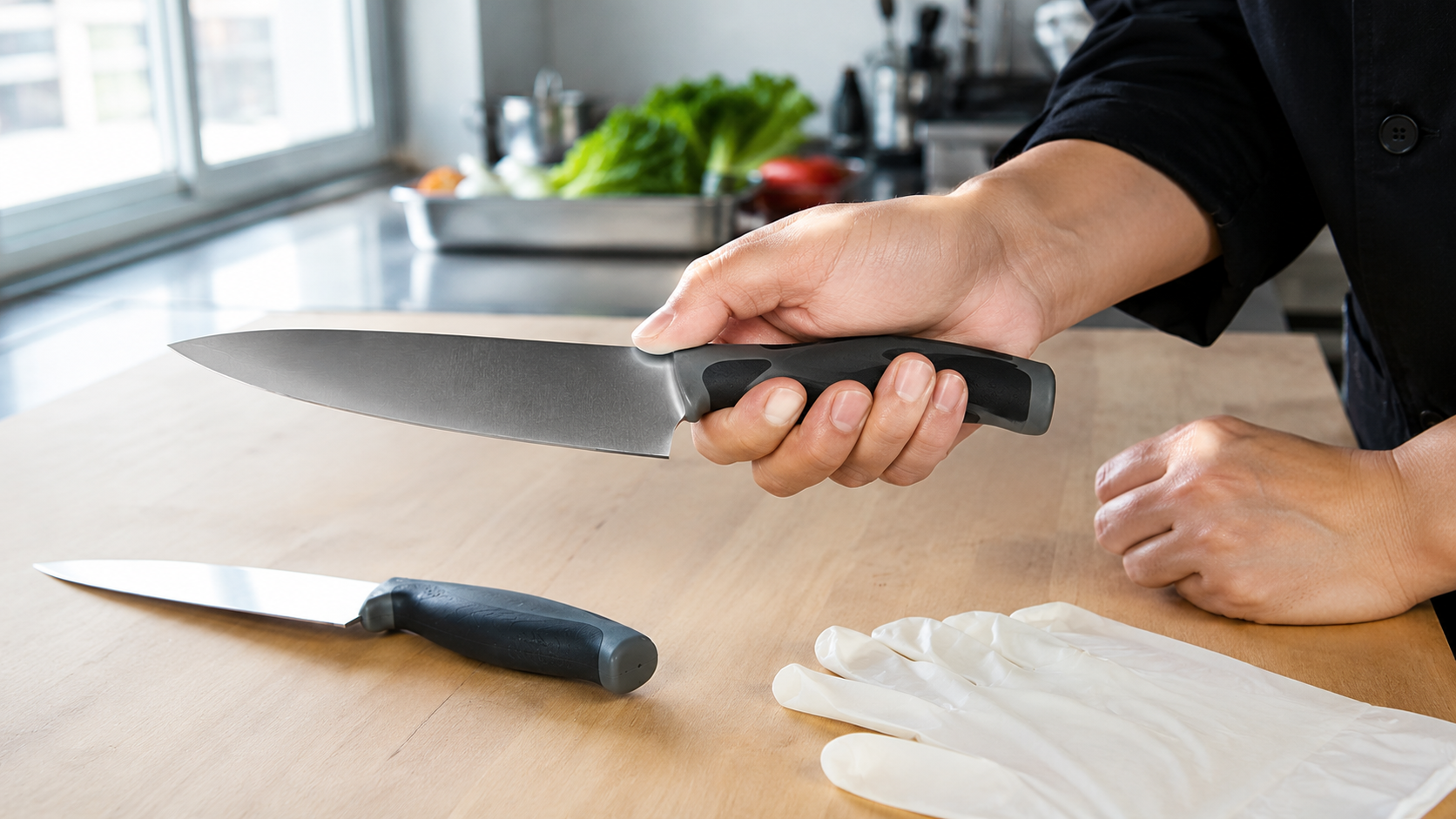
TPE and TPR: Grip Depends on More Than Softness
TPE or TPR materials are often used when designers want a softer surface or an overmolded grip zone.
That does not mean every TPE formulation performs similarly.
The perceived grip of a handle can change with:
- elastomer chemistry;
- Shore hardness;
- surface texture;
- handle geometry;
- moisture or oil contamination;
- glove material;
- wear and aging.
Some elastomer formulations are specifically developed for enhanced grip, chemical resistance, food-contact applications, or other functions. Those characteristics belong to the specific formulation, not to the entire TPE or TPR category.
Overmolded handles also introduce an additional question: the interface between the soft material and its rigid substrate.
Repeated washing, heat, chemicals, mechanical flexing, and aging can affect this interface differently from either material tested separately.
A meaningful qualification program may therefore need to examine surface tackiness, softening, cracking, wear, color change, edge lifting, and overmold separation after defined exposure cycles.
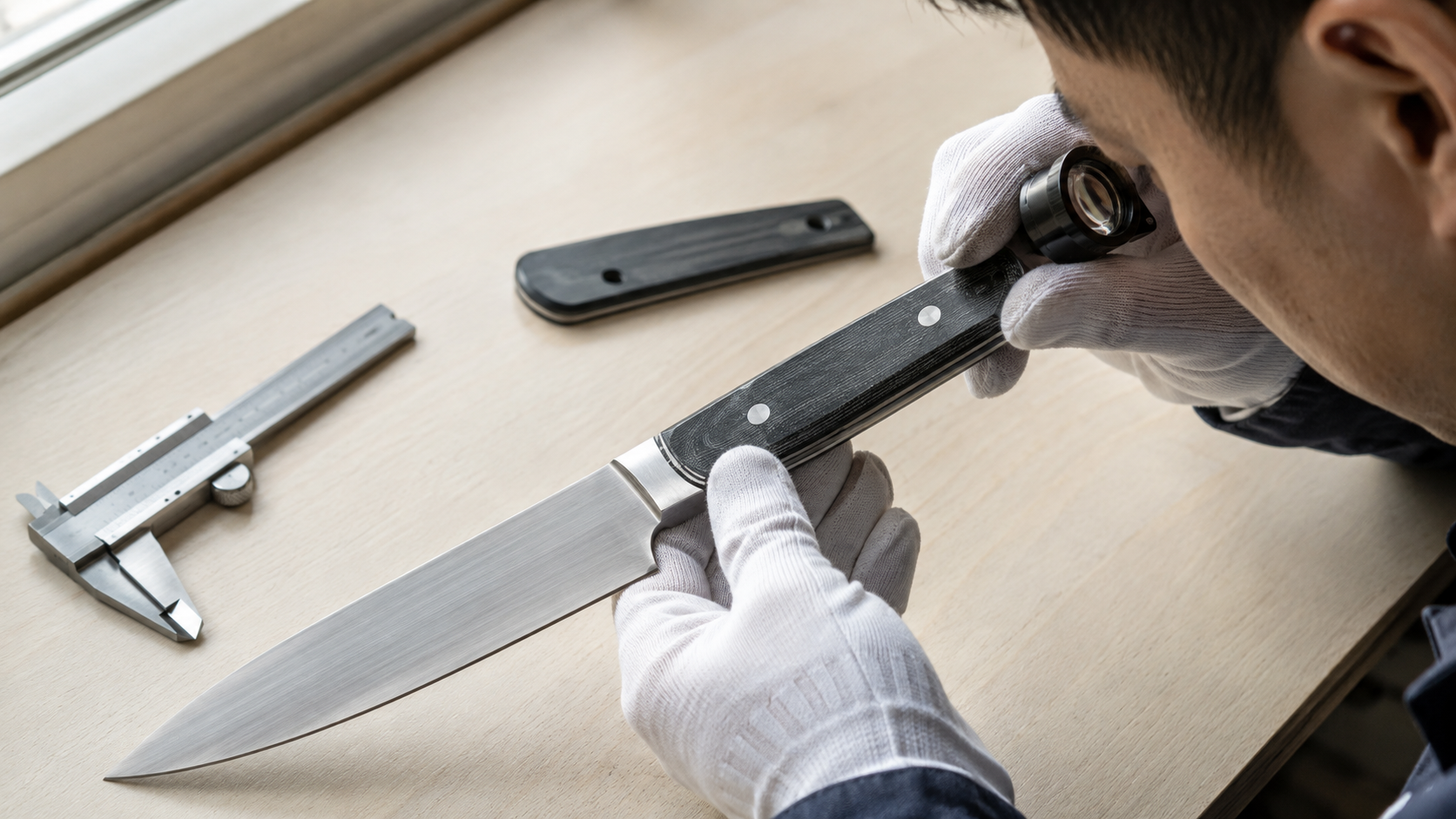
G10: Evaluate the Laminate and the Finished Handle Separately
G10 is usually specified as a glass-fabric and epoxy laminate system.
Its layered construction can provide a rigid material suitable for machining into handle scales, but the industrial laminate designation should not be used as a shortcut for kitchen-use claims.
Buyers should identify the specific laminate grade and supplier rather than simply accepting “G10” as a full specification.
The finished handle also introduces features that are not represented by a flat material test coupon, including:
- machined edges;
- drilled holes;
- fasteners;
- adhesive layers;
- surface texture;
- exposed laminate edges;
- interfaces with the steel tang.
Water absorption, thermal properties, or chemical-resistance data from a laminate supplier can be useful, but only within the conditions stated for that material.
They do not automatically demonstrate that a finished kitchen-knife handle is dishwasher-safe, food-contact suitable, or resistant to every cleaning chemical.
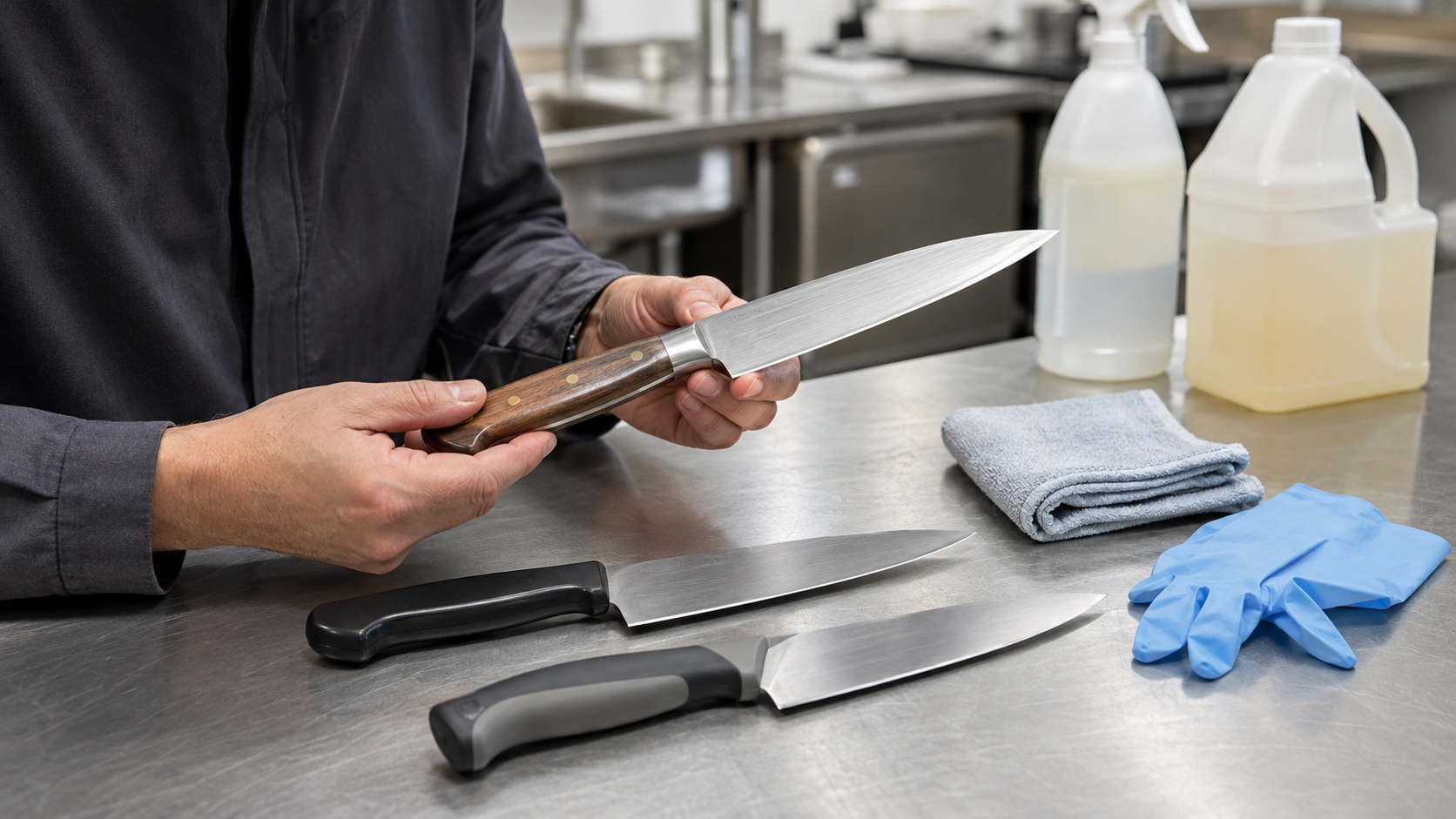
Food Contact, Cleanability, and Dishwasher Suitability Are Different Questions
These three concepts are often combined in commercial descriptions, but they should be evaluated separately.
Food Contact
For the U.S. market, FDA food-contact requirements are based on the specific substance, formulation, intended use, and applicable authorization.
A polymer family name such as PP or POM is therefore not sufficient evidence that every commercial grade is suitable for a particular food-contact application.
The phrase “FDA approved handle” should also be avoided unless it accurately reflects the applicable regulatory mechanism. In most sourcing discussions, it is more useful to identify the specific regulatory basis and intended-use conditions.
European Union requirements operate under a separate regulatory framework and should be described as such rather than being presented as a global standard.
Cleanability
A material can have suitable intrinsic properties while the finished handle remains difficult to clean because of its geometry.
Deep texture, open joints, cracks, gaps around fasteners, damaged coatings, overmold interfaces, and other surface discontinuities can affect cleanability.
This is why a material data sheet cannot replace an examination of the complete handle.
Dishwasher Suitability
“Dishwasher-safe” is also a finished-product claim.
Testing should define the actual conditions, including:
- domestic or commercial equipment;
- wash and rinse temperatures;
- detergent or sanitizer;
- cycle duration;
- number of cycles;
- drying conditions;
- acceptance criteria.
A temperature value from a resin data sheet does not establish dishwasher suitability by itself.
Likewise, a regulatory food-contact temperature condition should not be treated as a finished-product service-temperature rating.
A Practical Buyer Verification Checklist
Before approving a kitchen-knife handle material, buyers and QA teams can request an evidence package covering four areas.
Material Identification
Confirm:
- exact material supplier and grade;
- wood species and treatment where applicable;
- polymer, elastomer, or laminate system;
- fillers, reinforcement, stabilizers, colorants, and other relevant modifications;
- current technical and safety documentation.
Market Documentation
Where relevant, verify:
- the applicable U.S. food-contact basis;
- intended-use restrictions;
- European Union documentation for EU products;
- whether the documentation covers the actual grade, color, additives, and supply chain.
Finished-Handle Construction
Review:
- handle drawings and dimensions;
- joints and seams;
- fasteners;
- adhesives;
- exposed tang areas;
- overmold interfaces;
- machined laminate edges;
- surface textures.
Product-Level Validation
Where the intended use requires it, define tests for:
- wet and dry cycling;
- heat exposure;
- dishwasher or warewashing cycles;
- cleaning and sanitizing chemicals;
- wet, oily, or gloved grip conditions;
- UV or thermal aging;
- color and gloss change;
- cracking, deformation, tackiness, delamination, or loosening.
The test method and acceptance criteria should be established before samples are compared.
The Main Purchasing Principle: Match the Material to the Environment
No single knife-handle material is universally appropriate for every kitchen, cleaning process, price point, or product structure.
Wood may be appropriate where controlled washing, drying, natural appearance, and maintenance are accepted. POM and PP can be candidates for rigid molded handles, but their exact grades and finished structures still require verification. TPE and TPR systems can support soft-touch or grip-oriented designs, but grip, aging, and chemical behavior remain formulation-specific. G10 can provide a rigid machined laminate option, but its industrial material designation does not establish finished-knife suitability by itself.
For professional sourcing, the most defensible sequence is:
use environment → exact material grade → finished handle construction → market documentation → product-level validation.
That process provides a stronger basis for purchasing decisions than relying on a material abbreviation or a single property value.
References
- USDA Forest Products Laboratory. Wood Handbook, Chapter 4 — Moisture relations and physical properties of wood (2021).
- CDC/NIOSH. Easy Ergonomics: A Guide to Selecting Non-Powered Hand Tools (2004).
Scope note: These sources support the general principles discussed here; they do not prove the material, performance, compliance, or production history of any specific Tastiva product. Links last checked August 24, 2026.
Continue exploring practical knife specifications and buyer guidance.View all News →