
Knife Knowledge · Handle Care
Wooden Knife Handle Care: Cleaning, Drying, Storage, and Everyday Maintenance
Cleaning, drying, storage, and conditioning guidance for product-specific wooden knife handle constructions.
Quick answer
There is no universal wooden-handle care formula. Instructions should be tied to the actual wood or wood-based material, finish, construction, cleaning process, storage environment, and manufacturer guidance.
Wooden handles remain common on kitchen knives because they offer a wide range of visual, tactile, and construction options. From a maintenance standpoint, however, “wooden handle” is not a complete specification.
Different wood species can respond differently to moisture. Grain direction, handle dimensions, surface finishes, adhesives, fasteners, tang construction, and environmental exposure can also affect how a finished handle behaves over time. A maintenance instruction that is appropriate for one knife therefore should not automatically be applied to every wooden-handled knife.
For importers, distributors, brand managers, product teams, and quality personnel, the more useful question is not simply “How should wood be maintained?” It is:
What cleaning, drying, storage, and conditioning instructions are appropriate for this specific finished handle construction?
Why Moisture Matters to Wooden Handles
Wood is a hygroscopic material. In practical terms, this means it can exchange moisture with its surrounding environment.
The USDA Forest Products Laboratory explains that wood moisture conditions are influenced by factors including relative humidity, temperature, and the wood’s existing moisture content. Direct exposure to liquid water is another moisture pathway and can produce faster moisture changes than water-vapor sorption under ordinary atmospheric conditions.
This distinction is important for kitchen knives.
A brief hand-washing operation, prolonged immersion in a sink, repeated dishwasher cycles, and long-term storage in a humid environment are not equivalent exposure conditions. They differ in duration, temperature, water availability, drying opportunity, and other variables.
Wood also does not expand and contract uniformly in every direction. Moisture-related dimensional change is anisotropic, meaning that grain orientation matters. Species, dimensions, shape, drying history, and individual material variation can further influence the result.
For this reason, a buyer should be cautious about statements such as:
- “This wood never swells.”
- “A sealed wooden handle is waterproof.”
- “Any contact with water will cause cracking.”
- “This species is always more dimensionally stable.”
Those conclusions require more information than a wood name alone can provide.
Hand Washing and Soaking Are Different Conditions
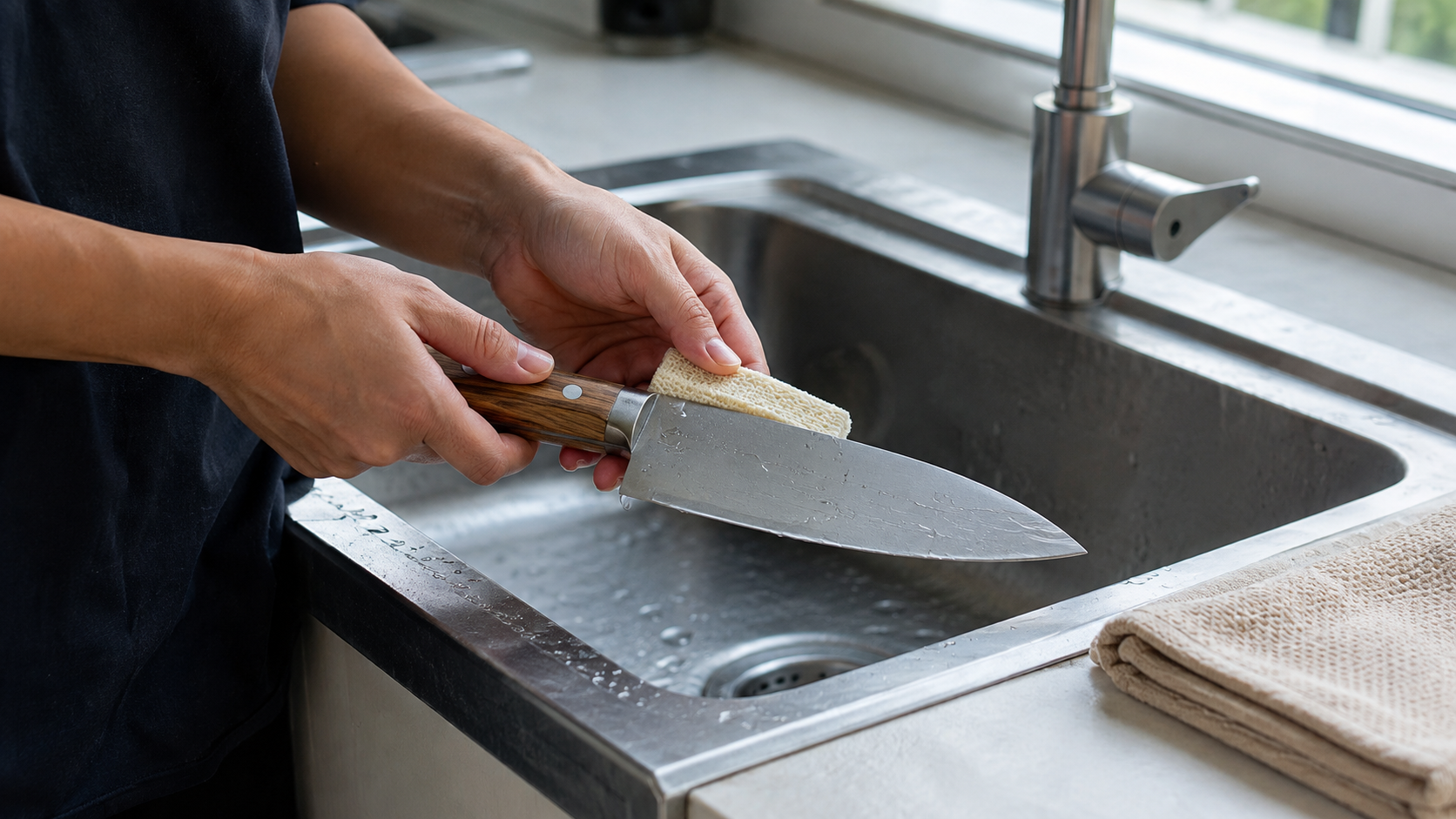
Many manufacturers of wooden-handled kitchen knives specify hand washing rather than prolonged water exposure.
For example, current care instructions published by WÜSTHOF, ZWILLING, and Opinel include hand-washing recommendations for specified knife ranges or wooden-handle products. Some also explicitly advise users not to leave the knife soaking in water.
These instructions should be understood within their stated product scope. They are useful examples of how established manufacturers manage wooden-handle care, but they are not universal technical standards for every wooden knife handle.
From a wood-science perspective, separating brief cleaning exposure from immersion is reasonable. Direct liquid-water exposure can change wood moisture more rapidly than ordinary atmospheric moisture exchange.
What the available evidence does not establish is a universal time limit.
There is no broadly applicable rule such as:
“A wooden knife handle can remain in water for up to three minutes without risk.”
The appropriate exposure limit would depend on factors including the wood, finish, construction, condition of the handle, temperature, and previous use.
For buyer-facing maintenance instructions, it is therefore safer to specify the intended cleaning method rather than inventing a universal maximum immersion time.
A typical product-level specification might distinguish among:
- quick hand washing;
- wiping with a damp cloth;
- rinsing under running water;
- prolonged soaking;
- commercial warewashing;
- household dishwasher use.
Those conditions should not be treated as interchangeable.
Dishwasher Suitability Must Be Verified at the Finished-Product Level
Wooden-handled knives are frequently described as “hand wash only,” but dishwasher discussions require careful wording.
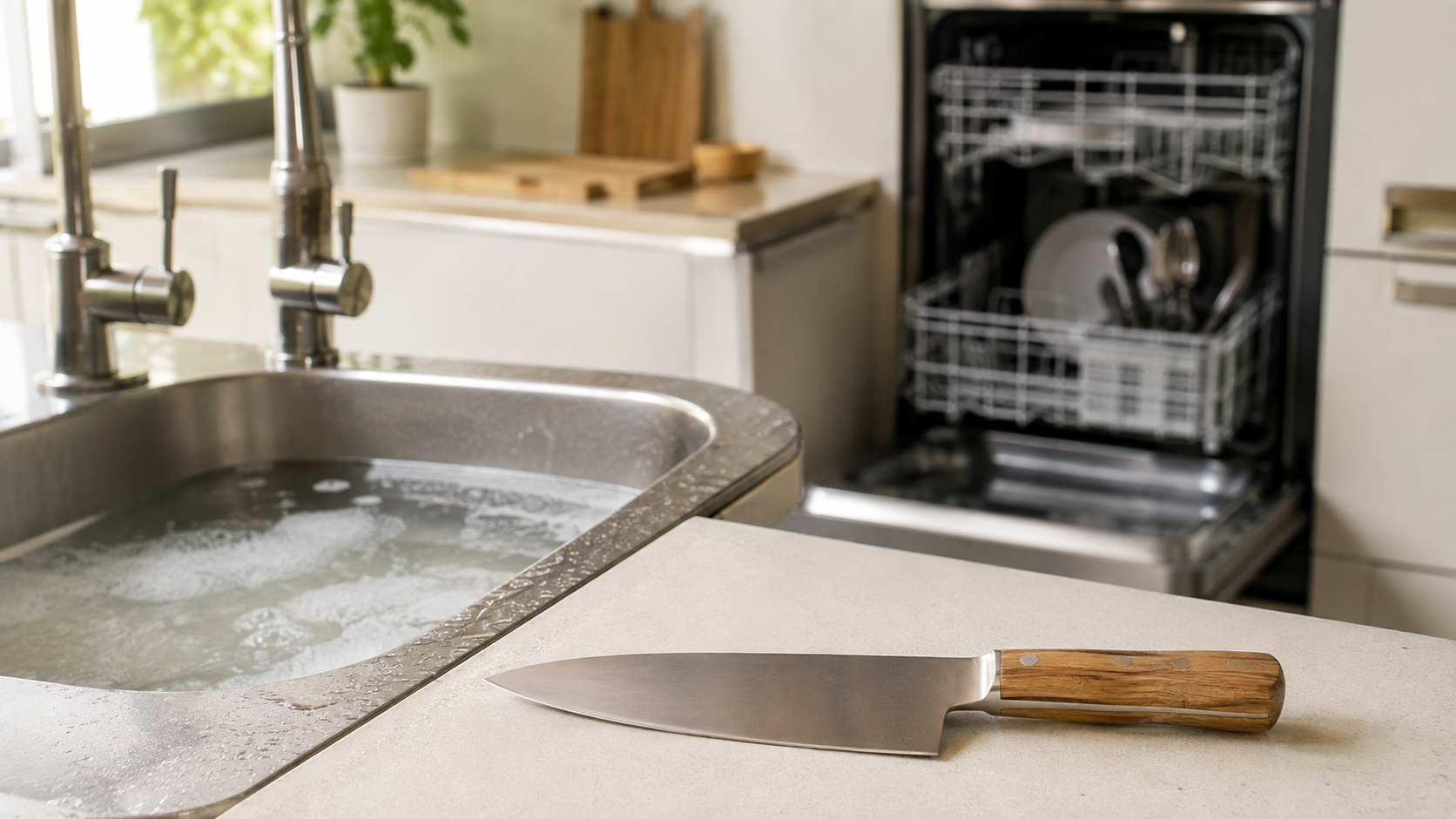
Several knife manufacturers explicitly exclude particular wooden-handled knives from dishwasher cleaning. That is relevant evidence for those products. It does not prove that every wooden handle will crack, loosen, warp, or otherwise fail after a particular dishwasher cycle.
A dishwasher introduces several variables at the same time, including:
- extended water exposure;
- elevated temperature;
- detergent chemistry;
- repeated wetting and drying;
- mechanical movement during the cycle.
The finished knife—not the wood species name by itself—is therefore the appropriate level at which dishwasher suitability should be assessed.
A buyer should not assume that a handle is dishwasher-safe merely because it has a coating, varnish, stabilized appearance, or dense wood species.
Likewise, a buyer should not state that every wooden-handled knife will be damaged by a dishwasher unless there is evidence supporting that claim for the relevant construction.
The practical procurement question is simpler:
What cleaning environment has the finished knife actually been specified or validated for?
A Surface Finish Can Slow Moisture Exchange, but It Does Not Make Wood Permanently Waterproof
Surface treatment is one reason generic wooden-handle maintenance advice can be misleading.
USDA Forest Products Laboratory material explains that protective finishes such as varnish, lacquer, and similar surface coatings can reduce the rate at which wood exchanges moisture with its surroundings. However, such treatments should not automatically be interpreted as completely preventing moisture movement.
That distinction matters commercially.
Two handles made from the same nominal wood species can require different care if one is unfinished, another is oil-treated, and another uses a film-forming finish.
The finish can also affect whether an additional oil or wax treatment is appropriate.
Before publishing maintenance instructions, a buyer or brand should therefore identify, where relevant:
- the wood or wood-based material;
- whether the wood has been modified or stabilized;
- the existing surface finish;
- the recommended cleaning method;
- permitted conditioning products;
- any curing or drying requirements;
- restrictions involving heat, detergents, or prolonged water exposure.
“Wood” alone is not enough information.
Drying Instructions Need Context
Drying is another area where consumer product care and commercial food-safety procedures can easily become confused.
Some knife manufacturers instruct users to dry their products promptly with a soft cloth after hand washing. For their specified products, this is a clear maintenance instruction intended to remove surface moisture and reduce prolonged water exposure.
Commercial foodservice sanitation rules can operate differently.
The U.S. FDA Food Code contains provisions requiring cleaned and sanitized equipment and utensils to air-dry or adequately drain before certain storage or reuse conditions. The Food Code also generally prohibits cloth drying after cleaning and sanitizing in the situations covered by those provisions.
However, an important regulatory distinction must be preserved:
The FDA Food Code is a model code.
It is designed for adoption by state, local, tribal, and territorial authorities. It should not be described as though every section automatically operates as a single nationwide federal rule for every kitchen knife in every setting.
As a result, an article should not combine a household knife manufacturer’s instruction to “wipe dry immediately” with a Food Code air-drying requirement and present the result as one universal rule.
For consumer or ordinary product care, follow the manufacturer’s instructions.
For commercial foodservice use, applicable sanitation requirements should also be checked for the relevant jurisdiction and operating environment.
Dry Before Enclosed Storage
Whatever cleaning method is specified, storing a handle while moisture remains trapped around the knife can create an unnecessary exposure condition.
The safest general principle is not to prescribe an exact drying time but to ensure that the knife has completed the drying process required for its intended use before enclosed storage.
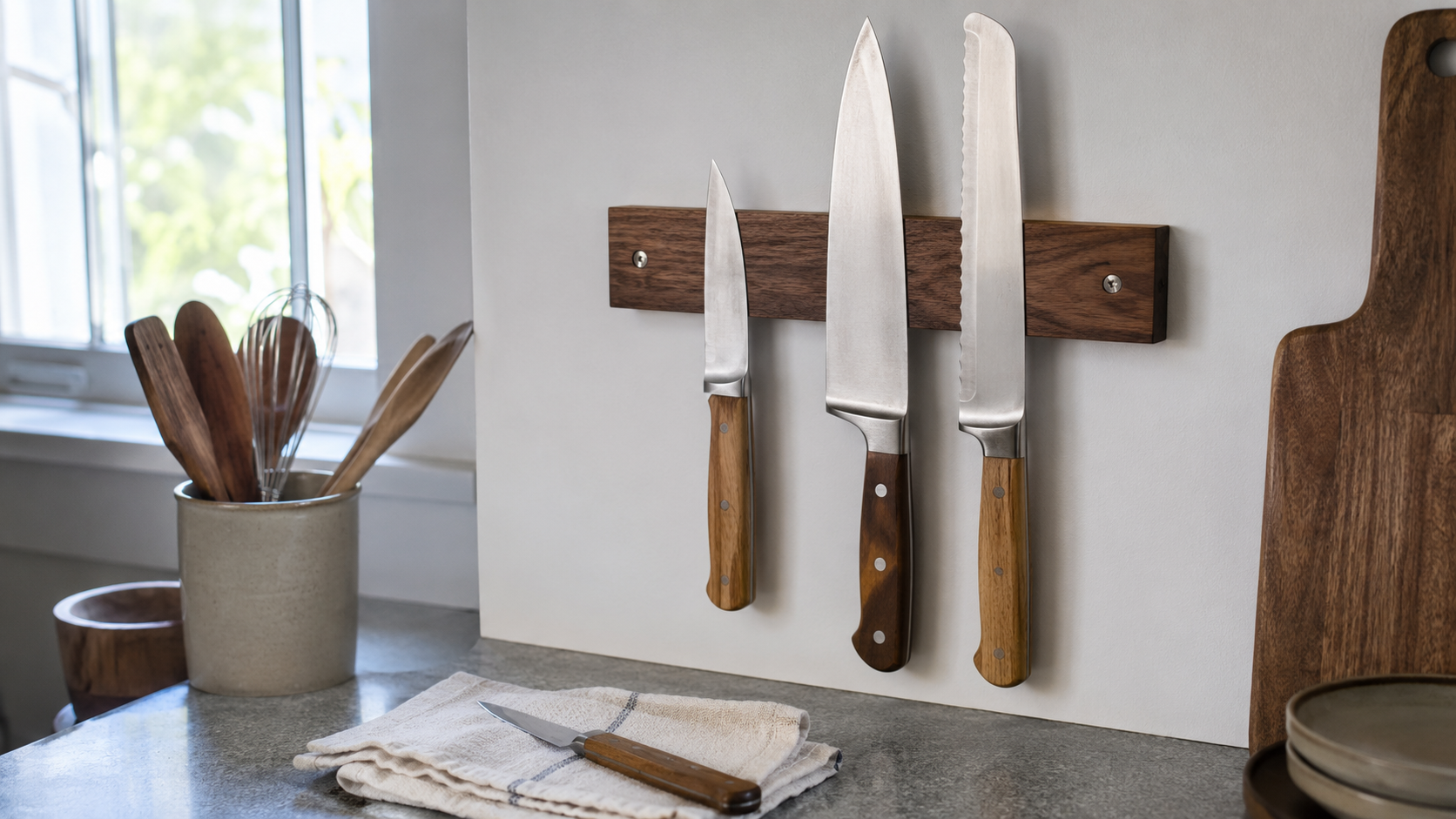
Storage systems can differ substantially:
- open magnetic racks;
- ventilated knife blocks;
- enclosed blocks;
- drawers;
- blade guards;
- sheaths;
- cases;
- retail or transport packaging.
The important question is whether the storage arrangement allows residual moisture to escape rather than trapping it around the blade, handle, joint, or other components.
For commercial foodservice environments, the FDA Food Code also contains requirements concerning the storage of cleaned equipment and utensils in clean, dry locations and in configurations that allow appropriate draining or air drying. Again, the exact regulatory effect depends on jurisdictional adoption.
Humidity Still Matters After the Knife Is Clean
A wooden handle continues to interact with its environment even when it is not being washed.
Changes in ambient relative humidity and temperature can alter the moisture balance of wood. Over time, sufficiently large environmental changes can contribute to dimensional movement.
This does not justify creating a universal storage specification such as:
“All wooden knife handles must be stored at 40–60% relative humidity.”
No single RH range has been established as a universal requirement for all wooden kitchen knife handles.
A finished handle may involve a particular species, finish, geometry, moisture history, adhesive system, and construction that differs significantly from another knife.
The better guidance is to avoid extreme or repeatedly changing environments unless a product has been specifically evaluated for them.
For procurement and product documentation, a defined environmental limit should come from product-specific information or validation—not from a generic rule about wood.
Be Careful With Heat Sources
Heat should be viewed as part of the broader moisture-management problem.
Because temperature affects the relationship between wood and environmental moisture, prolonged exposure to unusually hot or dry conditions may change the moisture state of a wooden handle.
That does not mean there is a scientifically established universal rule such as:
- keep every knife one meter from a radiator;
- never store a wooden knife within 30 centimeters of an oven;
- never exceed one fixed room temperature.
Public wood-science sources do not establish product-independent distance limits of this kind for kitchen knife handles.
The defensible recommendation is therefore qualitative:
Avoid prolonged abnormal heat exposure unless the finished product has been evaluated for that environment.
There Is No Universal Oiling Schedule
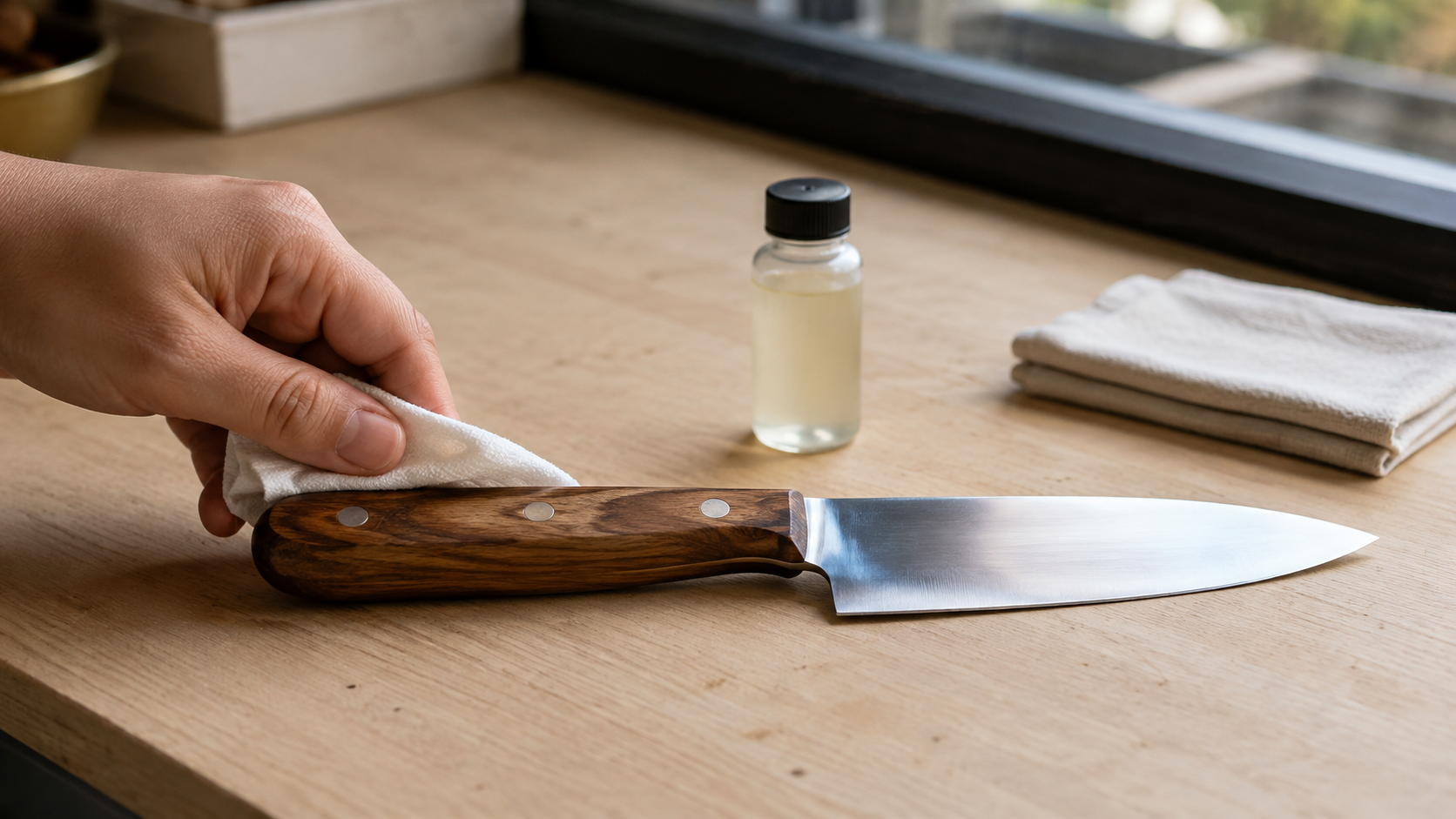
Wood-handle maintenance is often reduced to advice such as “oil once a month.”
That kind of fixed schedule is difficult to support as a general rule.
Manufacturer instructions vary. Depending on the product, wording may include terms such as:
- periodically;
- regularly;
- every so often;
- as needed.
WÜSTHOF, for example, specifies food-grade mineral oil for certain olive-wood handles. ZWILLING provides oil- or wax-based maintenance guidance for specified wooden handles. Opinel also markets a maintenance oil with defined uses for its own products.
These examples demonstrate an important point:
The correct conditioning product and frequency are part of a particular finish and maintenance system.
They do not establish that every wooden handle should receive the same oil on the same calendar.
An unnecessary or incompatible treatment may alter appearance, surface feel, or the intended finish. Before recommending a care product, buyers should verify:
- the exact product identity;
- its intended surface or material;
- the knife manufacturer’s instructions;
- application quantity and method;
- drying or curing requirements;
- compatibility with the existing finish;
- any relevant food-contact considerations.
Terms such as “food grade” should not substitute for those checks.
What Buyers Should Ask Before Approving Care Instructions
For B2B sourcing, wooden-handle maintenance should be treated as part of the product specification rather than as generic consumer advice.
Before approving packaging, manuals, web content, or after-sales instructions, the buyer should confirm:
- What is the actual handle material?
A commercial wood name alone may not fully describe the material condition.
- Has the wood been modified, stabilized, laminated, sealed, coated, oiled, or waxed?
- What is the finished handle construction?
Handle scales, hidden-tang structures, fasteners, adhesives, joints, and exposed grain can create different conditions.
- What cleaning method is officially recommended?
- Is soaking explicitly prohibited?
- Has dishwasher use been specified or evaluated?
- How should the knife be dried before storage?
- Are any care oils, waxes, or other conditioning products approved?
- Is there a manufacturer-defined conditioning frequency, or is care performed as needed?
- Are there storage limitations involving prolonged moisture, unusual heat, or other environmental exposure?
- If the knife is intended for commercial foodservice, what local sanitation requirements also apply?
These questions are more useful than relying on a generic rule such as “wood must always be oiled” or “wood should never touch water.”
Maintenance Is a Product-Specific System
Wood science provides a useful foundation for understanding wooden knife handles: wood exchanges moisture with its environment, liquid-water exposure differs from atmospheric humidity, dimensional response can vary by direction and material, and protective finishes can slow moisture exchange without necessarily eliminating it.
That foundation helps explain why hand washing, soaking, dishwasher exposure, drying, storage, humidity, and heat should all be considered.
It does not create one permanent care formula for every wooden handle.
For professional buyers, the most reliable approach is to connect maintenance instructions to the actual material, finish, construction, intended cleaning process, and use environment of the finished knife.
This avoids two common mistakes: treating wood as if it were completely unaffected by moisture, and treating every wooden handle as though it requires exactly the same care.
Reference Basis
- USDA Forest Products Laboratory, Wood Handbook: Wood as an Engineering Material, Chapter 4, “Moisture Relations and Physical Properties of Wood.”
- U.S. FDA, Food Code 2022, including provisions addressing air drying, storage, and the use of wood in specified food-contact applications.
- WÜSTHOF official knife care instructions and product-specific wooden-handle maintenance guidance.
- ZWILLING official knife use and care guidance.
- Opinel official FAQ, cleaning guidance, product care instructions, and maintenance-oil information.
References
- USDA Forest Products Laboratory. Wood Handbook, Chapter 4 — Moisture relations and physical properties of wood (2021).
- U.S. Food and Drug Administration. Safe Food Handling — clean and separate guidance.
Scope note: These sources support the general principles discussed here; they do not prove the material, performance, compliance, or production history of any specific Tastiva product. Links last checked August 24, 2026.
Continue exploring practical knife specifications and buyer guidance.View all News →