
Knife Knowledge · Cleaning & Food Safety
Knife Cleaning and Cross-Contamination: Raw vs Ready-to-Eat Food Handling
A practical guide to separating raw and ready-to-eat tasks, defining cleaning steps, and evaluating knife changeover controls.
Quick answer
Knife design alone cannot prevent cross-contamination. Control depends on task separation or a complete cleaning, rinsing, sanitizing, and drying process appropriate to the food task and applicable rules.
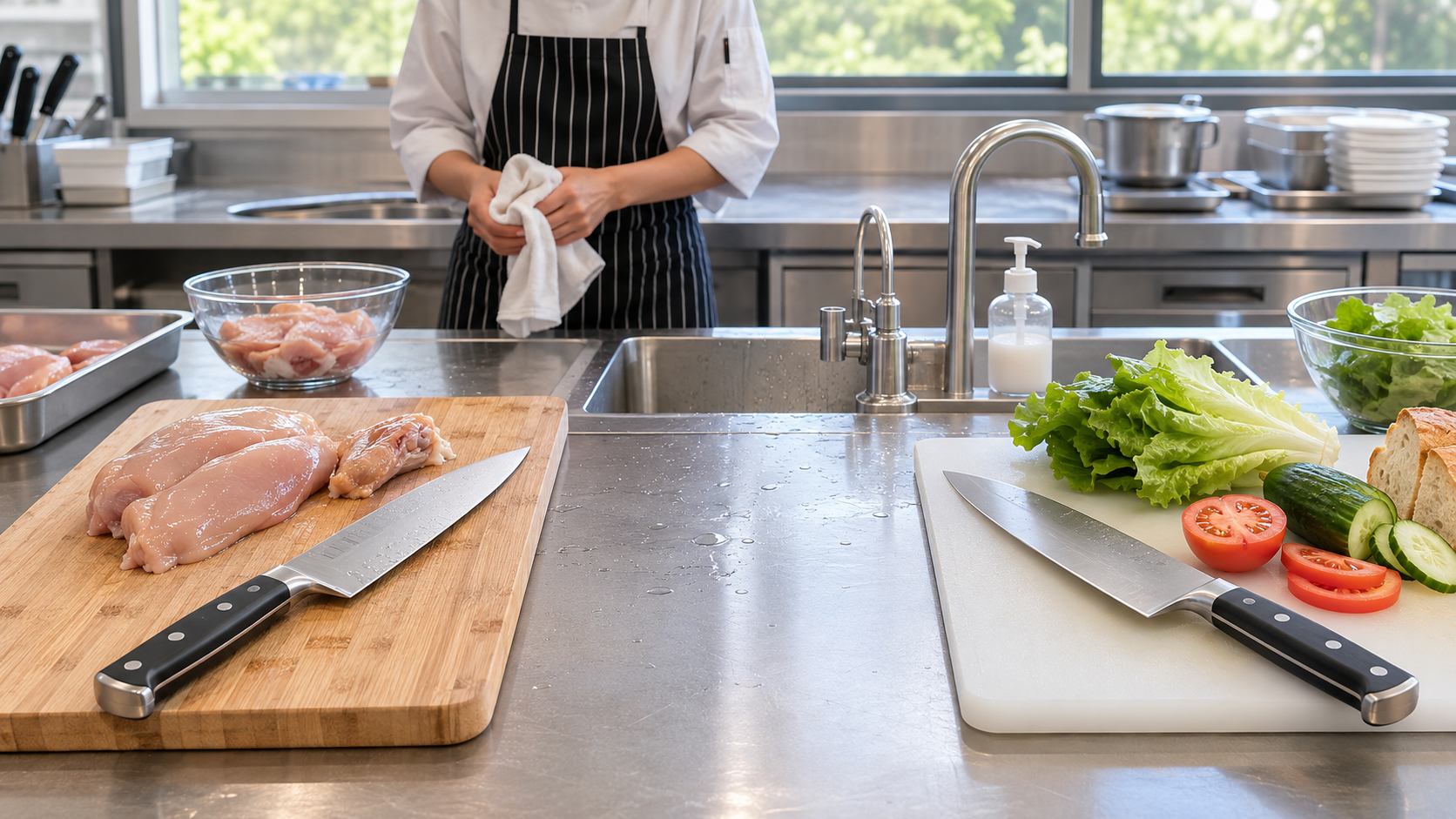
Cross-contamination control in a kitchen is not determined by the knife alone. It depends on how food, hands, utensils, cutting boards, work surfaces, cleaning procedures, and storage practices are managed together.
For kitchen-knife buyers, distributors, product managers, and QA teams, this distinction matters. A knife may be assigned only to certain food-preparation tasks, or the same knife may be reused for a different task after an appropriate cleaning process. These are different control strategies, and neither should be confused with a product claim that a particular knife can prevent cross-contamination.
In the United States, another distinction is equally important: consumer food-safety advice, the FDA Food Code, and legally enforceable state or local requirements are not the same thing. The FDA Food Code is a model for retail and foodservice regulation rather than a single federal restaurant law automatically applicable in every jurisdiction.
“Raw” and “Cooked” Are Not the Only Relevant Categories
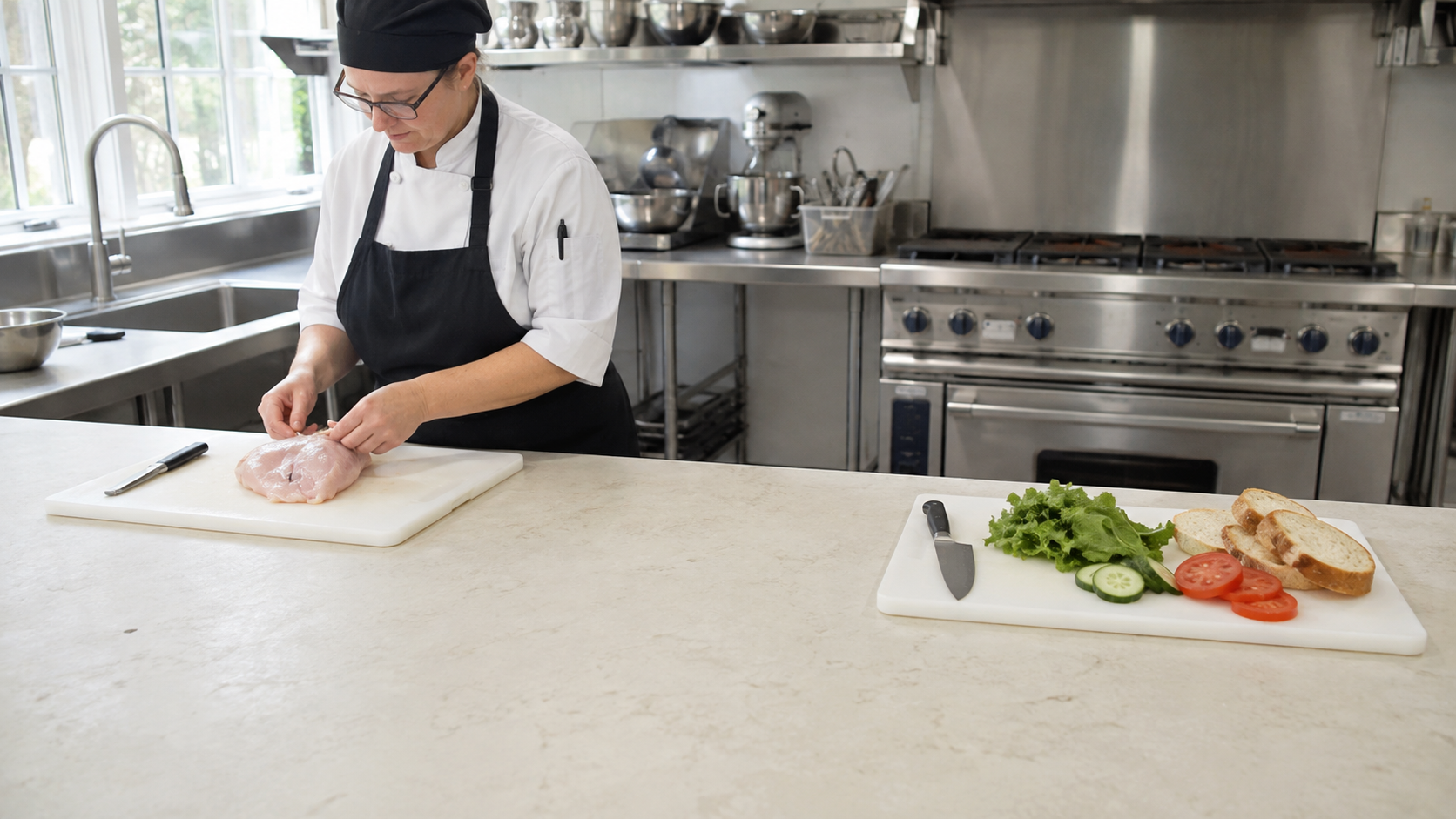
A simple distinction between a “raw-food knife” and a “cooked-food knife” can be useful in everyday conversation, but it is not precise enough for many foodservice decisions.
The FDA Food Code uses concepts such as raw animal food and ready-to-eat food, usually abbreviated as RTE food.
Ready-to-eat does not simply mean “cooked.” The Food Code definition focuses on whether the food is in a form that is edible without additional preparation for food safety. Depending on the product and preparation, washed fruits and vegetables can be ready-to-eat, and certain raw animal foods served for direct consumption can also fall within the RTE category.
This matters because a knife that has contacted raw meat, poultry, seafood, or another raw animal food may later be used on lettuce, bread, cooked meat, garnishes, or other foods that will receive no subsequent pathogen-control step.
FDA's Food Code therefore emphasizes separation between raw animal foods and ready-to-eat foods during preparation, storage, holding, and display. Its public-health explanation states that this separation is intended to reduce the possibility of pathogens from raw animal foods contaminating foods that are already in ready-to-eat form.
For buyers and kitchen operators, the more useful question is therefore not simply:
“Is this a raw-food knife or a cooked-food knife?”
It is:
“What foods will this knife contact, and what happens before it is used for the next task?”
Cleaning, Rinsing, Sanitizing, and Disinfecting Are Different Steps
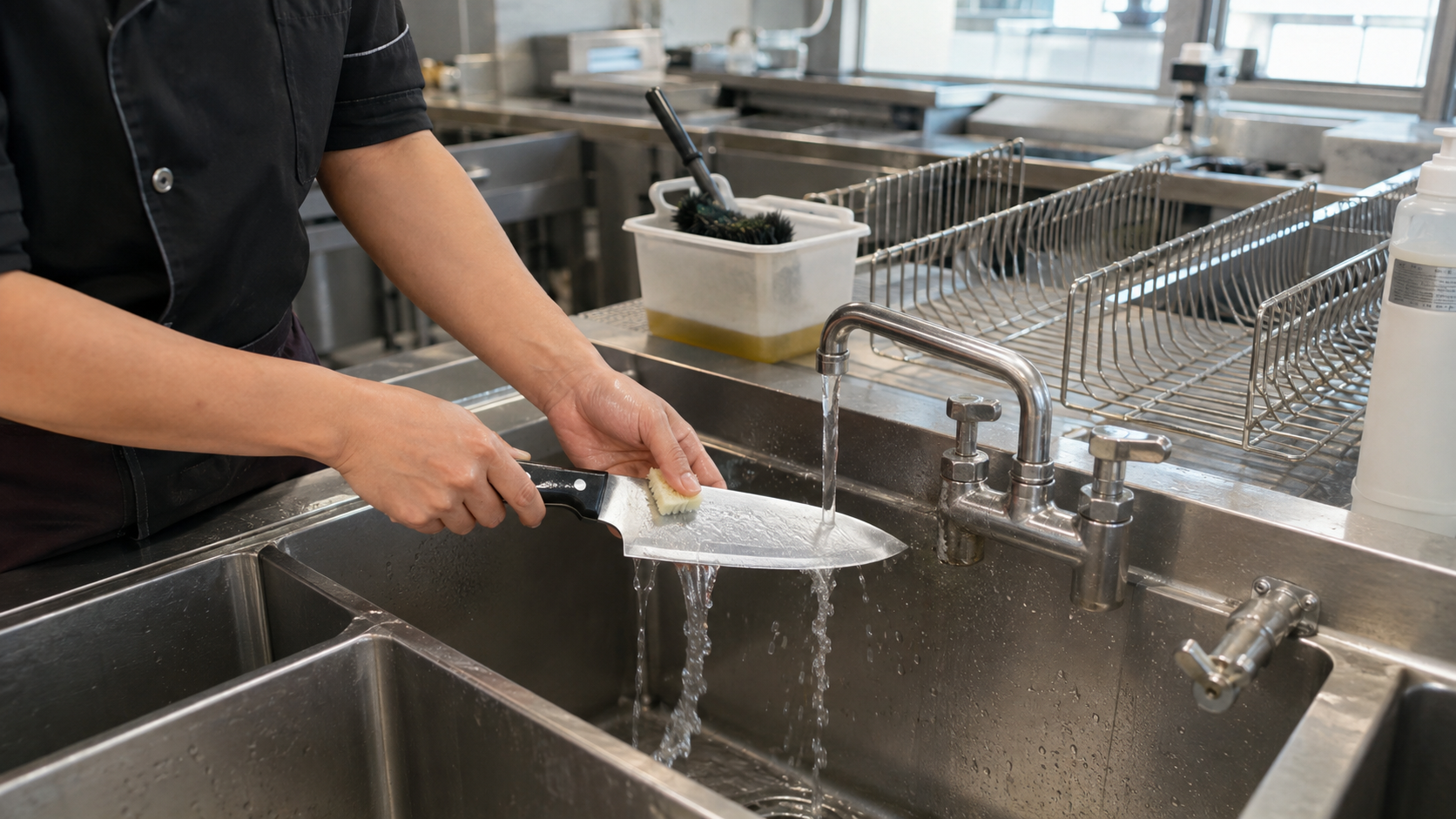
Food-safety discussions often use words such as wash, rinse, sanitize, and disinfect interchangeably. Under the Food Code framework, they should not be treated as synonyms.
Cleaning and Washing
Cleaning first addresses food residue and other soil on a food-contact surface.
The 2022 Food Code states that equipment food-contact surfaces and utensils should be clean to sight and touch. It also specifies that wet-cleaning procedures should effectively remove or loosen soil and that the cleaning method should be selected according to the type and purpose of the equipment or utensil and the type of soil involved.
This distinction is important because a surface that looks clean is not automatically equivalent to a surface that has completed a required sanitizing procedure.
Rinsing
Rinsing is another distinct part of the warewashing process.
The Food Code describes rinsing washed utensils and equipment so that abrasives are removed and cleaning chemicals are removed or diluted before the subsequent process.
A quick splash of water over a knife that has just contacted raw meat should therefore not be described as equivalent to a complete cleaning procedure.
Sanitizing
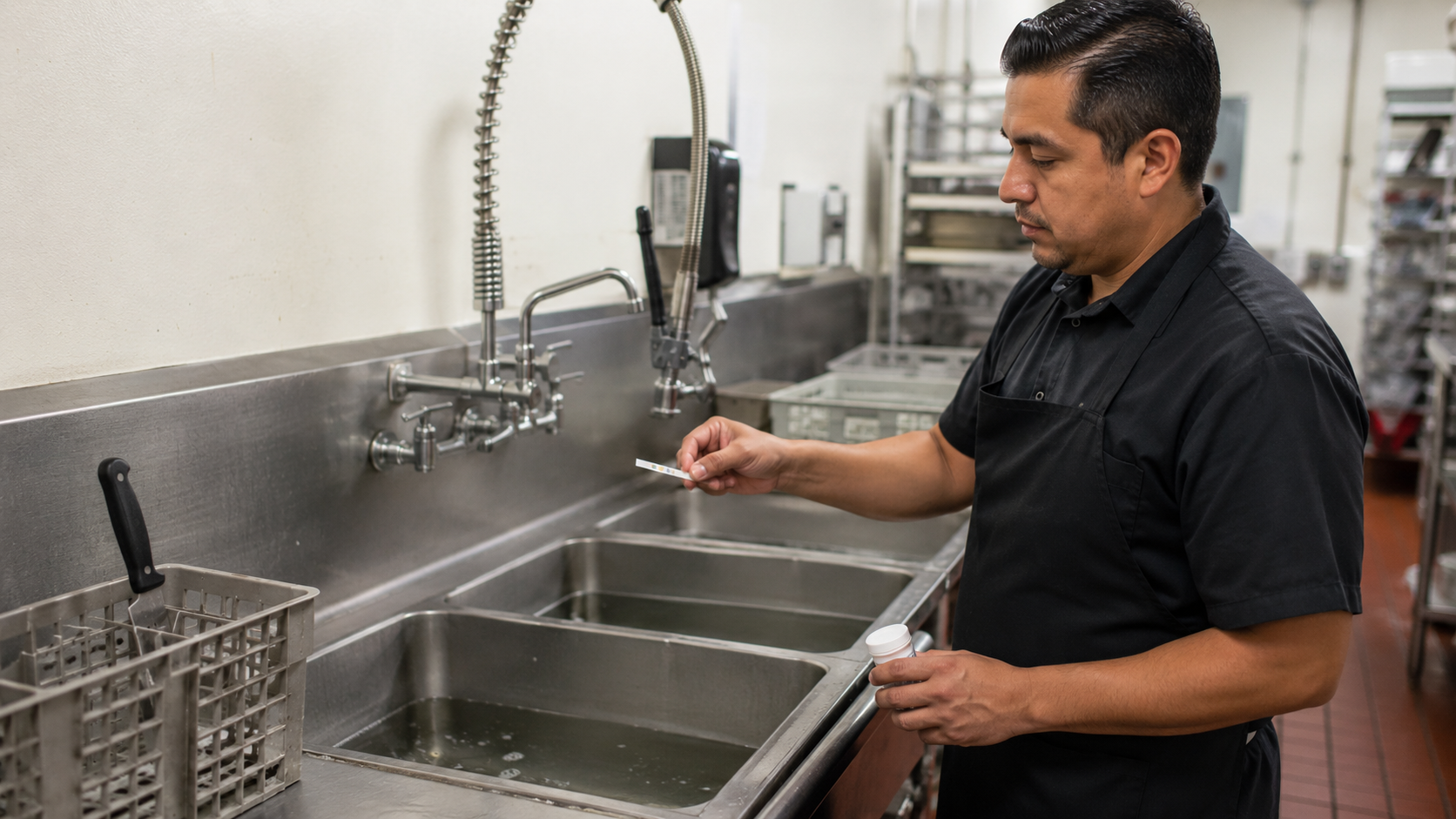
For food-contact surfaces in a retail or foodservice setting, sanitizing generally follows cleaning.
The Food Code requires utensils and food-contact surfaces to be sanitized before use after cleaning. It provides both hot-water and chemical methods under specified conditions.
The Food Code's definition of sanitization includes a 5-log reduction criterion under evaluated conditions. That definition should not be turned into a claim that every knife, every sanitizer, or every cleaning cycle has been individually demonstrated to remove 99.999% of microorganisms.
Actual effectiveness depends on the applicable process conditions.
Disinfecting
Disinfecting is not simply another word for routine sanitizing.
The FDA's December 2024 Supplement to the 2022 Food Code introduced a separate Part 4-10 addressing disinfection of equipment and utensils. The new provisions apply when pathogens of concern are not controlled by available sanitizers, including specified situations involving bodily-fluid contamination or a foodborne-disease outbreak or imminent health hazard.
For an ordinary discussion of moving a knife from raw-food preparation to RTE-food preparation, cleaning and sanitizing are therefore generally more appropriate terms than casually telling operators to “disinfect the knife.”
Two Different Strategies for Controlling Knife Changeovers
One of the most important distinctions for buyers is between dedicating separate knives to different tasks and reusing the same knife after an appropriate changeover process.
Strategy 1: Dedicated or Separate Knives
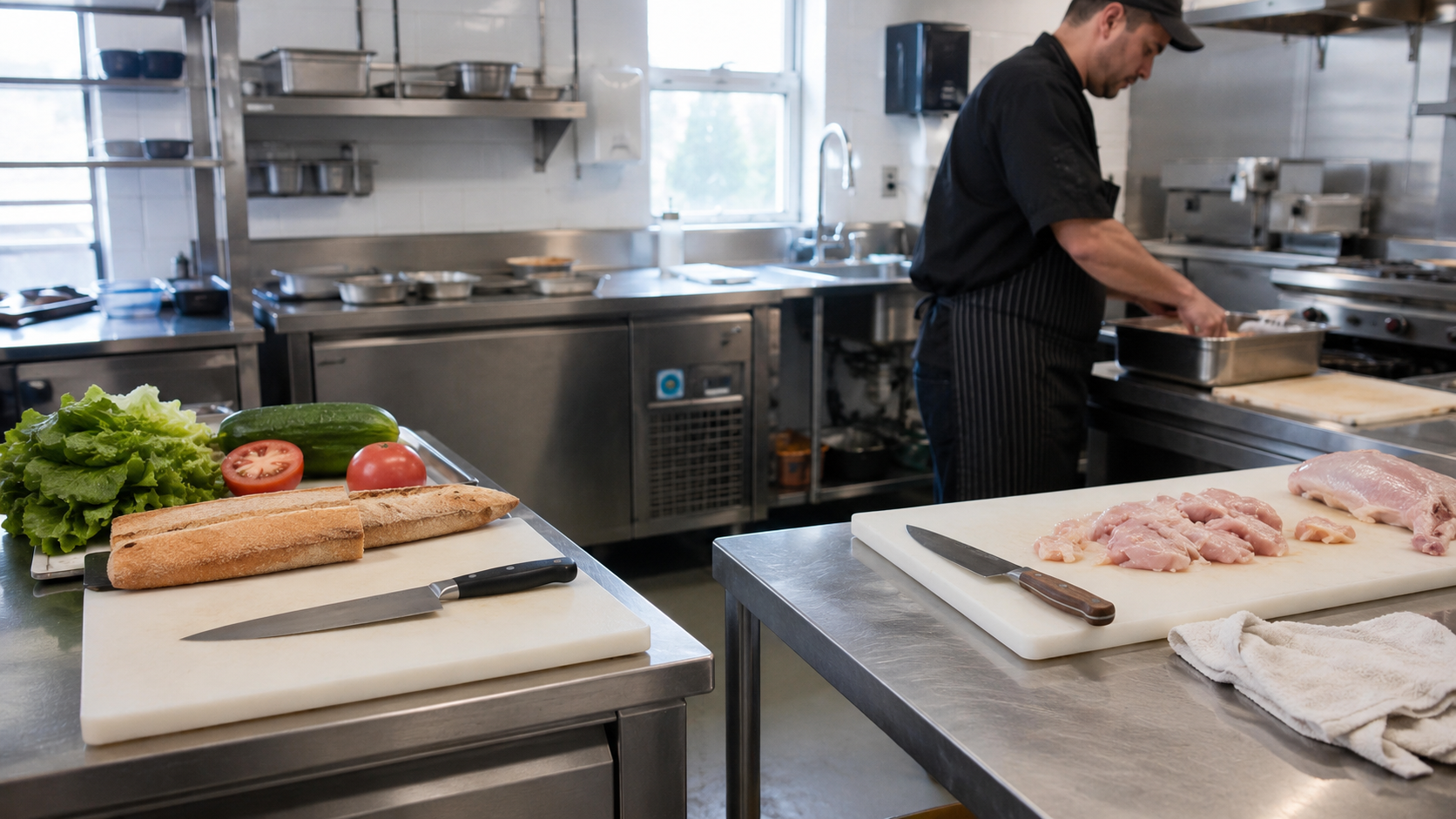
A kitchen may assign different knives, cutting boards, or preparation areas to raw animal foods and foods that will not undergo further cooking.
CDC currently recommends separate cutting boards or plates for raw meat, poultry, and seafood and for foods such as produce, bread, and other items that will not be cooked. USDA consumer guidance similarly emphasizes keeping raw meat and poultry separate from cooked foods or foods that will not be cooked later.
Dedicated tools can make workflow boundaries easier for staff to recognize. Color identification or different storage locations may further support the system.
However, a dedicated knife does not become maintenance-free or contamination-proof. It still requires appropriate cleaning, handling, drying, storage, and employee practices.
Strategy 2: Reusing the Same Knife After Cleaning
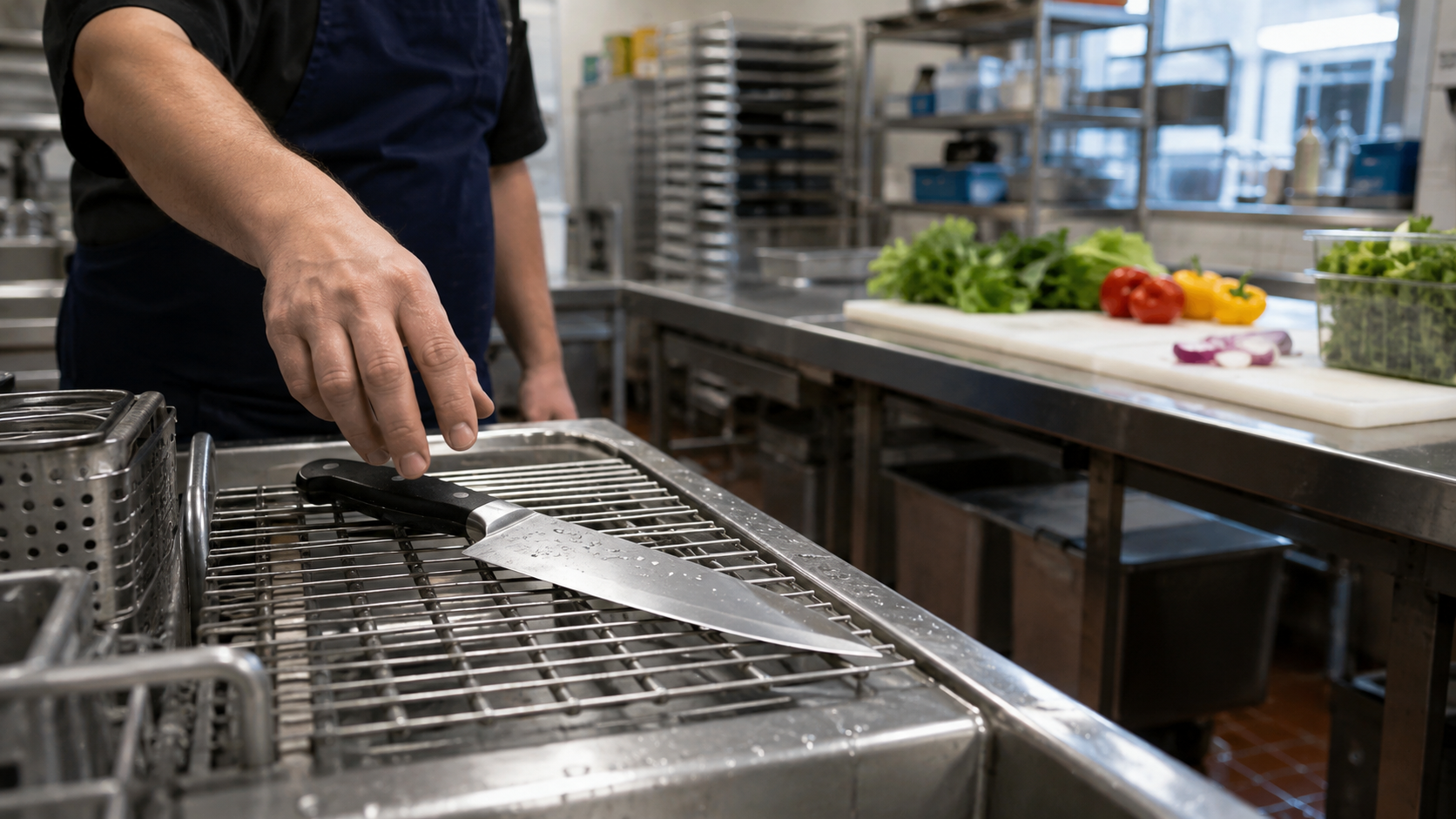
Using separate knives is not the only possible control approach.
For household settings, FDA consumer guidance recommends separating raw meat, poultry, seafood, and eggs from other foods and washing food-contact items after use. USDA guidance also states that a utensil used with raw food should not be used for cooked food unless it has first been washed.
Commercial foodservice requires a more specific framework.
Under FDA Food Code §4-602.11, food-contact surfaces and utensils are to be cleaned when changing from working with raw foods to working with ready-to-eat foods. The same section also identifies contamination during operation as another cleaning trigger.
The wider Food Code process then addresses effective washing, rinsing, sanitizing, and subsequent handling of the cleaned utensil.
The important point is that “the same knife can be reused” does not mean “the same knife can simply be wiped or briefly rinsed and moved to the next food.”
The required process depends on the operating environment and the rules applicable to that establishment.
Why the Four-Hour Rule Should Not Be Misread
Foodservice buyers sometimes encounter the Food Code's four-hour cleaning interval and interpret it as a universal rule for knives.
That is too broad.
The 2022 Food Code states that food-contact surfaces and utensils used with time/temperature control for safety food generally are to be cleaned throughout the day at least every four hours, subject to listed exceptions.
But the same section separately requires cleaning when changing from raw foods to ready-to-eat foods.
The four-hour provision therefore should not be presented as permission to use a raw-contact knife on ready-to-eat food for several hours before cleaning it.
For purchasing or QA documentation, it is better to distinguish between:
- routine cleaning frequency during continued use;
- cleaning triggered by a change in food type or task;
- cleaning triggered by contamination;
- and any additional requirements imposed by the establishment or local regulator.
Household Advice Is Not a Commercial Kitchen Code
FDA, USDA, and CDC provide deliberately practical consumer guidance.
For example, FDA recommends washing utensils and food-preparation surfaces with hot, soapy water after preparing food and keeping raw meat, poultry, seafood, and eggs separated from other foods. CDC similarly advises cleaning utensils and surfaces and separating raw animal foods from foods that will not receive further cooking.
These recommendations are useful for explaining the basic principles of Clean and Separate.
They should not, however, be copied directly into a commercial specification and presented as a complete restaurant sanitation procedure.
Foodservice operations may need to control additional variables such as:
- warewashing method;
- sanitizer identity;
- chemical concentration;
- water temperature;
- contact time;
- equipment loading;
- draining and drying;
- storage after cleaning;
- local regulatory requirements;
- and written operating procedures.
The Food Code, for example, requires chemical sanitizing solution concentration to be determined with an appropriate test kit or device.
That is a different level of process control from general household advice to wash a knife with hot, soapy water.
The FDA Food Code Is a Model, Not One Nationwide Restaurant Rule
This regulatory distinction is particularly important for importers and brands selling into the United States.
FDA describes the Food Code as a model representing its advice for a uniform system of retail and foodservice food-safety provisions. The 2022 Food Code remains the most recent complete edition listed by FDA as of August 2026, with a December 2024 Supplement providing subsequent changes.
Actual food establishments are regulated through the authorities applicable to their jurisdictions. A state, county, city, tribal, territorial, or other authority may adopt a particular Food Code edition, make amendments, or establish additional provisions.
As a result, an article for U.S. buyers should avoid claims such as:
“All U.S. restaurants are legally required to use separate raw-meat knives.”
A more accurate approach is:
“Foodservice operators should verify the code and procedures adopted by the applicable regulatory authority.”
This distinction also means that an FDA Food Code reference by itself does not establish that a particular kitchen knife is “FDA approved” or compliant with every U.S. foodservice requirement.
What Buyers and QA Teams Should Confirm

For a commercial knife program, cross-contamination control should begin with the intended operating process rather than with a marketing label on the knife.
Before specifying a knife for a particular foodservice program, buyers can ask:
- Will the knife contact raw animal foods, ready-to-eat foods, or both?
- Will separate knives be dedicated to different preparation tasks?
- If tools are reused, what changeover cleaning procedure is required?
- Is warewashing manual or mechanical?
- What cleaning agents and sanitizers are used?
- What temperatures and contact times are involved?
- Is the knife construction compatible with the intended cleaning process?
- Are handles, joints, coatings, adhesives, or markings affected by repeated exposure?
- How will cleaned knives be drained, dried, stored, and protected from recontamination?
- Which state or local food code applies to the operation?
- Does the customer have additional SOPs or internal hygiene requirements?
Some of these questions concern the food-safety process. Others concern product durability and compatibility.
They should not be merged.
For example, a knife being physically compatible with a dishwasher does not by itself prove that a specific warewashing cycle satisfies an establishment's sanitizing requirements. Conversely, a sanitation procedure that is acceptable under an operating code does not prove that every knife construction can tolerate repeated exposure to that procedure without material or structural effects.
Those product-specific questions require the manufacturer's instructions, material information, intended-use conditions, and, where necessary, appropriate testing.
Avoid Turning Hygiene Guidance Into Knife Performance Claims
Cross-contamination is a systems problem.
A knife is only one possible transfer surface among hands, gloves, cutting boards, containers, counters, utensils, food packaging, cleaning cloths, and storage equipment.
For that reason, statements such as the following need substantial caution:
- “prevents cross-contamination”;
- “naturally antibacterial”;
- “sanitation-grade knife”;
- “FDA-approved knife”;
- “compliant with all U.S. food codes”;
- “dishwasher-safe therefore fully sanitized”;
- or “separate knives eliminate contamination risk.”
General FDA, USDA, and CDC guidance does not establish those product claims.
A more defensible B2B approach is to describe the operating process, define the applicable terminology, and identify the product information that a buyer still needs to verify.
The Practical Takeaway
Separating knives by task and correctly cleaning a reusable knife between tasks are two different approaches to managing cross-contamination risk.
Dedicated tools can simplify workflow separation. Reusable tools can also move between tasks when the applicable cleaning process is properly completed. Neither approach works independently of food handling, employee practices, cutting boards, work surfaces, storage, and the rest of the kitchen's food-safety system.
For household users, FDA, USDA, and CDC provide practical Clean and Separate guidance. For U.S. retail and foodservice operations, the FDA Food Code provides a more detailed model framework covering cleaning, rinsing, sanitizing, and other controls, while the legally applicable requirements must still be confirmed for the specific jurisdiction.
For knife buyers, the key is not to ask whether a knife is inherently a “safe raw-food knife.” It is to define the task, the changeover procedure, the cleaning environment, the applicable regulation, and the product documentation needed to support that use.
Source Basis
This article is based primarily on the FDA Food Code 2022, January 18, 2023 version and its December 2024 supplement, FDA safe food-handling guidance, CDC food-safety guidance, and USDA FSIS cleaning and sanitizing guidance. Sources last checked August 24, 2026.
Regulatory note: The FDA Food Code is a model code. Requirements for a specific food establishment should be checked against the rules adopted by the applicable regulatory authority. Product-specific cleaning compatibility, chemical resistance, dishwasher suitability, or sanitation performance also requires product-specific documentation and, where appropriate, testing.