
Knife Knowledge · Materials & Construction
Damascus Patterns, Clad Steel, and Decorative Knife Finishes: What Buyers Can Actually Verify
Damascus can describe different material structures or surface treatments. Buyers should verify pattern source, core, cladding, layer-count conventions, and evidence rather than infer performance from appearance.
Quick answer
Damascus does not identify one universal material structure. Buyers should ask what creates the visible pattern, what the underlying blade construction is, and what evidence supports that description.
The word “Damascus” appears frequently in kitchen-knife specifications, catalogs, packaging, and supplier discussions. For professional buyers, however, the term creates an immediate verification problem: it does not always describe the same material structure.
A visible wave, ladder, raindrop, or layered pattern on a blade may be associated with several very different constructions. It may come from historical crucible-steel metallurgy, modern pattern-welded steel, patterned cladding around a separate cutting core, or a surface treatment such as selective etching or laser texturing.
For importers, distributors, private-label brands, product managers, and quality teams, the useful question is therefore not simply:
“Is this real Damascus?”
A better question is:
“What creates the visible pattern, what is the underlying blade construction, and what evidence supports that description?”
That distinction matters because visual complexity, layer count, and the word Damascus do not by themselves establish sharpness, hardness, strength, toughness, corrosion resistance, or durability.
Why “Damascus Steel” Does Not Describe One Universal Construction
Historical Crucible Steel
In the narrower historical metallurgy context, Damascus steel is often associated with wootz or crucible steel.
Research on surviving historical blades and experimental reproductions has linked their characteristic watered appearance to the internal structure of high-carbon crucible-steel ingots. Segregation during solidification, followed by appropriate thermal and mechanical processing, can produce bands containing carbide-rich regions that later become visible at the surface.
This is fundamentally different from the modern practice of stacking different steels and forge-welding them together.
That distinction is important in B2B communication. A modern layered kitchen knife should not automatically be described as being made by the same metallurgical route as historical wootz simply because both can display flowing patterns.
Modern Pattern-Welded Steel
Pattern-welded steel generally refers to a construction in which different ferrous materials are joined and subsequently manipulated to create a layered pattern.
Depending on the manufacturing route, this may involve combinations of:
- stacking;
- forge welding;
- drawing;
- folding;
- twisting;
- cutting;
- restacking;
- grinding or machining to expose internal layers.
The resulting pattern can extend into the material rather than existing only as a superficial graphic.
However, pattern welding describes a material and manufacturing architecture, not a performance grade.
Two pattern-welded blades can differ substantially in:
- steel grades;
- heat treatment;
- layer thickness;
- bonding quality;
- blade geometry;
- edge geometry;
- surface condition;
- intended task.
It is therefore inappropriate to treat “pattern-welded” as an automatic synonym for stronger, sharper, harder, or more durable.
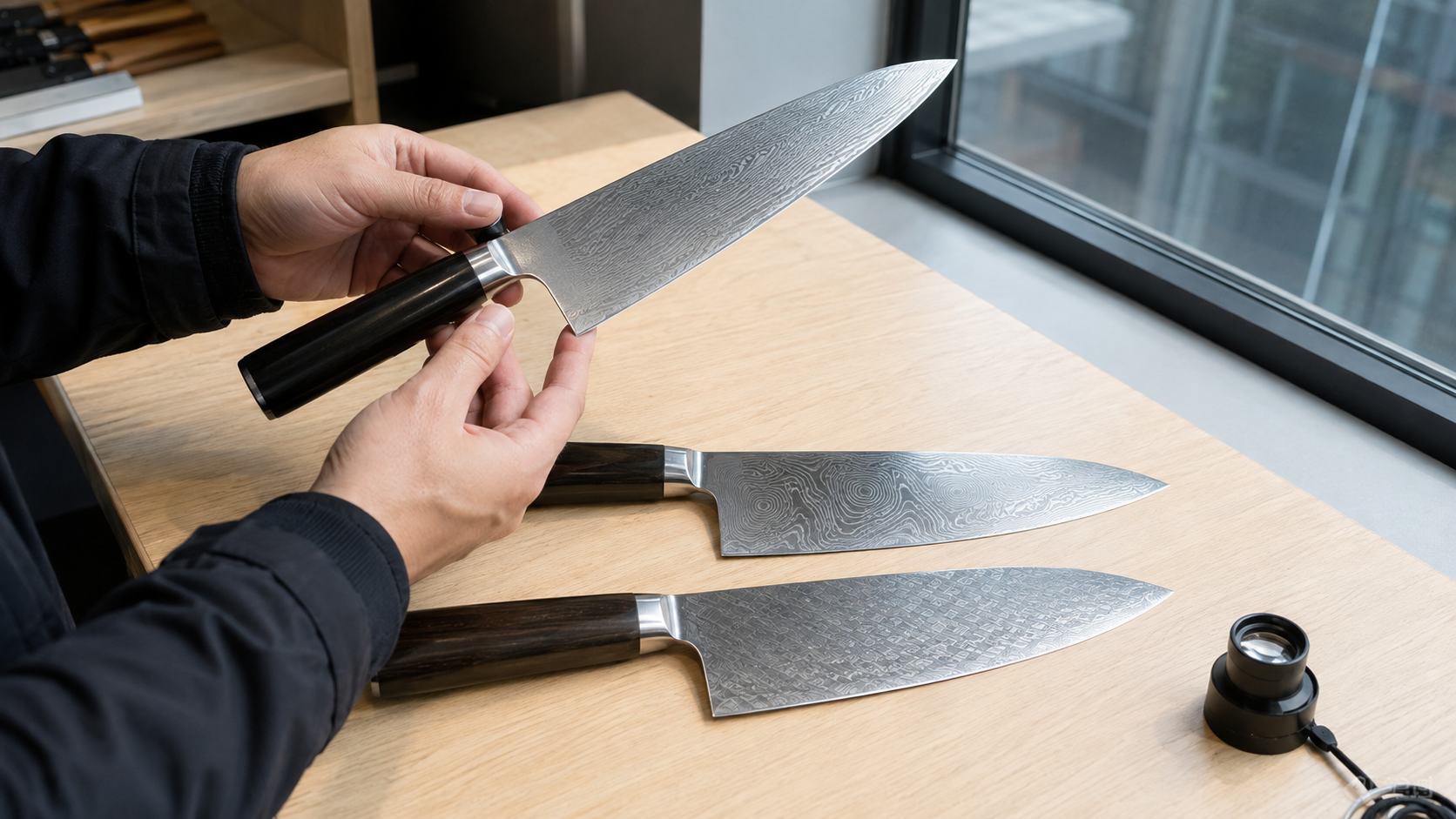
Damascus Cladding Is Not the Same as a Fully Pattern-Welded Blade
Many contemporary kitchen knives use a separate cutting core with outer layers applied to both sides.
In this type of construction, the cutting edge may be formed primarily by the center material, while the outer layers provide another function or visual appearance.
Those outer layers may themselves consist of multiple alternating steels and may be marketed as Damascus cladding.
A simplified construction could therefore look conceptually like:
patterned outer layers → cutting core → patterned outer layers
This is different from a coreless multi-layer material in which alternating materials extend throughout the relevant blade section and no single, separate center steel is designated as the cutting core.
Both constructions may appear in the market under Damascus-related terminology.
For a buyer, the word Damascus therefore does not answer several essential specification questions:
- Is there a separate core steel?
- Which material forms the actual cutting edge?
- Which steels make up the outer layers?
- Does the pattern extend through the material?
- How is the stated layer count calculated?
These points should be confirmed independently.
Laminated, Clad, and Patterned Are Different Descriptions
Terms such as laminated, clad, and pattern-welded are sometimes used loosely in knife marketing, but they describe different aspects of a product.
Laminated construction broadly indicates that multiple material layers have been joined.
Cladding normally refers to an outer material joined to a substrate or core.
Pattern-welded describes a route in which joined metallic layers are deliberately manipulated to produce a patterned structure.
A blade may therefore be:
- laminated but visually plain;
- clad with a patterned outer material;
- pattern-welded without a separate cutting core;
- or constructed from a core plus multi-layer patterned cladding.
Formal engineering standards for clad metals also exist, but their scope must be respected. For example, ASTM specifications for stainless chromium-nickel steel-clad plate apply to specific industrial products such as pressure-vessel plate. They are not general kitchen-knife product standards.
The engineering terminology can help explain the concept of metallurgical cladding, but it should not be presented as a mandatory U.S. kitchen-knife requirement.
Etching Can Reveal a Pattern—or Create One
One of the most common sources of confusion concerns acid etching.
Etching can perform at least two very different roles.
Revealing Existing Material Differences
When a blade contains different alloys or microstructural regions, those areas may respond differently to an etchant.
Selective attack can increase contrast between them and make an existing layered structure much easier to see.
Metallographic standards such as ASTM E407 use chemical etching for a similar general purpose: revealing phases and microstructural constituents in prepared metal specimens.
In this situation, the visible pattern is enhanced by surface treatment, but the underlying material differences already exist.
Creating a Surface Pattern
Etching can also be used selectively to remove or modify only designated surface areas.
Masks, resist materials, electrochemical processes, or other techniques can therefore create a visible design on a surface without requiring alternating steel layers inside the blade.
This leads to an important purchasing rule:
The phrase “acid etched” does not prove or disprove a layered construction.
A structurally layered blade may be etched to increase contrast, while a homogeneous blade can also receive a decorative etched pattern.
Additional evidence is needed to distinguish the two situations.
Laser Patterns Are Also Surface Evidence, Not Structural Proof
Laser processing provides another route for producing controlled marks and textures on stainless steel.
Research has demonstrated that laser treatment can change surface morphology and oxide conditions sufficiently to produce visible coloration and patterning.
This means a blade can carry an intricate Damascus-like visual design even if the underlying steel does not contain alternating metallic layers.
Laser processing is not necessarily the same as printing. It may physically or chemically modify the metal surface.
But from a buyer-verification perspective, the key point remains the same:
a visible laser-created pattern does not establish an internal layered structure.
It is also unsafe to assume that laser-created patterns can always be identified reliably by eye. Appearance depends on the equipment, processing parameters, subsequent polishing, surface finish, and material condition.
What Can the Blade Face Actually Tell You?
A normal blade-face photograph is useful for assessing appearance, but its evidentiary value is limited.
It can usually confirm that:
- a visible pattern exists;
- the pattern has a particular direction or visual scale;
- the surface has a particular level of contrast;
- some areas may have been polished or worn differently from others.
It generally cannot establish:
- the steel grades;
- whether layers continue through the blade;
- the presence of a separate core;
- the true layer count;
- the bonding method;
- heat-treatment condition;
- local hardness;
- interface quality;
- edge retention;
- toughness;
- strength;
- corrosion resistance.
A highly complex surface pattern is therefore still primarily surface evidence.
What About the Spine and Cutting Edge?
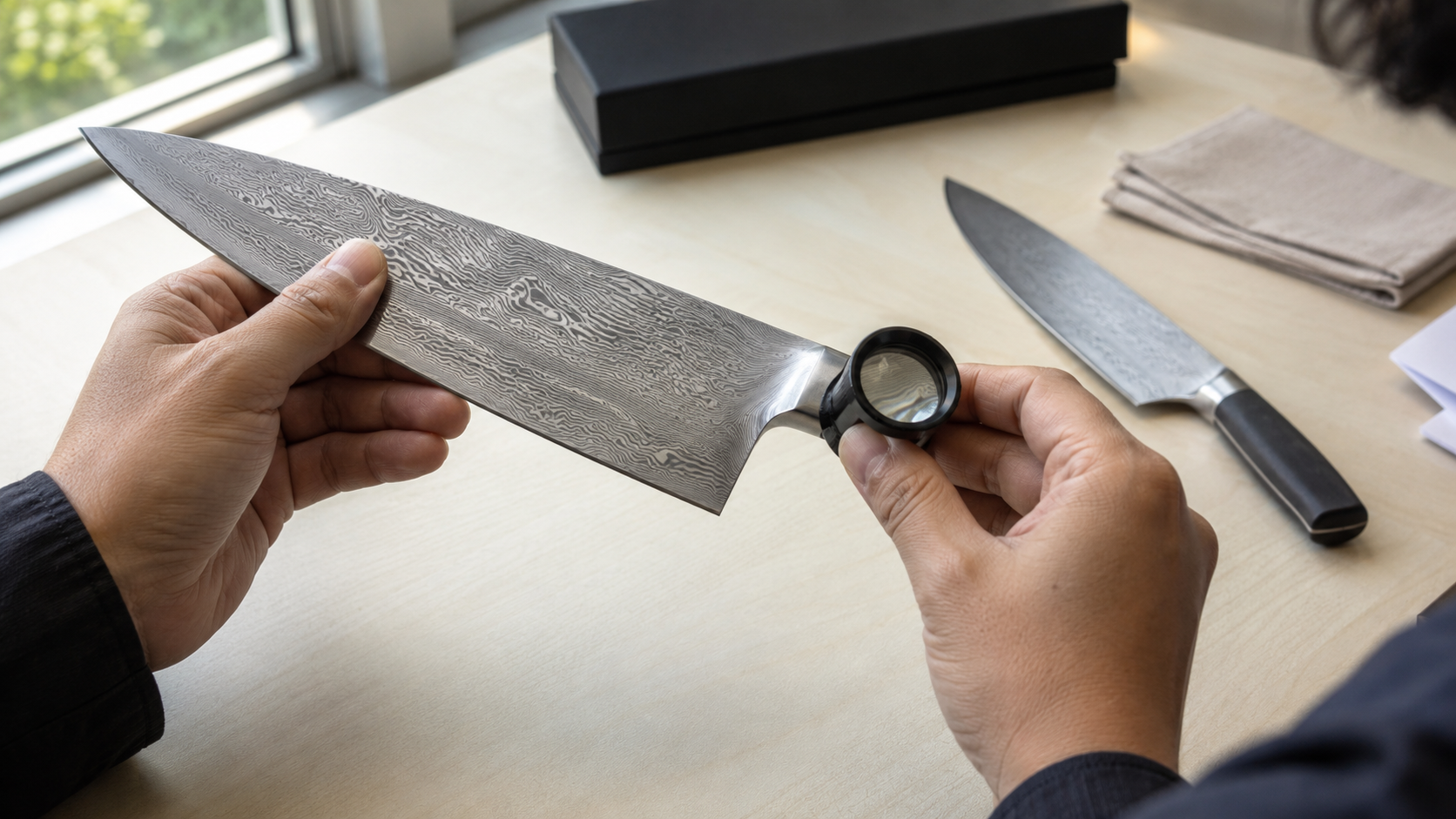
The spine, choil, and sharpened edge can provide more useful structural clues.
Spine Evidence
If different layers are exposed at the spine, visible material boundaries may support a layered-construction interpretation.
However, absence of visible lines does not prove that the blade is monosteel.
Spine polishing, rounding, coating, geometry, or the way the outer layers terminate may all affect visibility.
Likewise, visible spine lines cannot identify the exact alloys or verify the supplier’s stated layer count.
Edge and Choil Evidence
On a core-and-cladding blade, a separate center material may sometimes be visible near the sharpened edge or at the choil.
A central band can be consistent with a separate cutting core.
But it cannot prove that the core is a particular steel grade or has a particular hardness.
For example, a visible line cannot independently establish that a core is VG10, 10Cr15CoMoV, or another specified material. That requires traceable documentation, suitable material analysis, or both.
Why Cross-Sections Provide Stronger Evidence
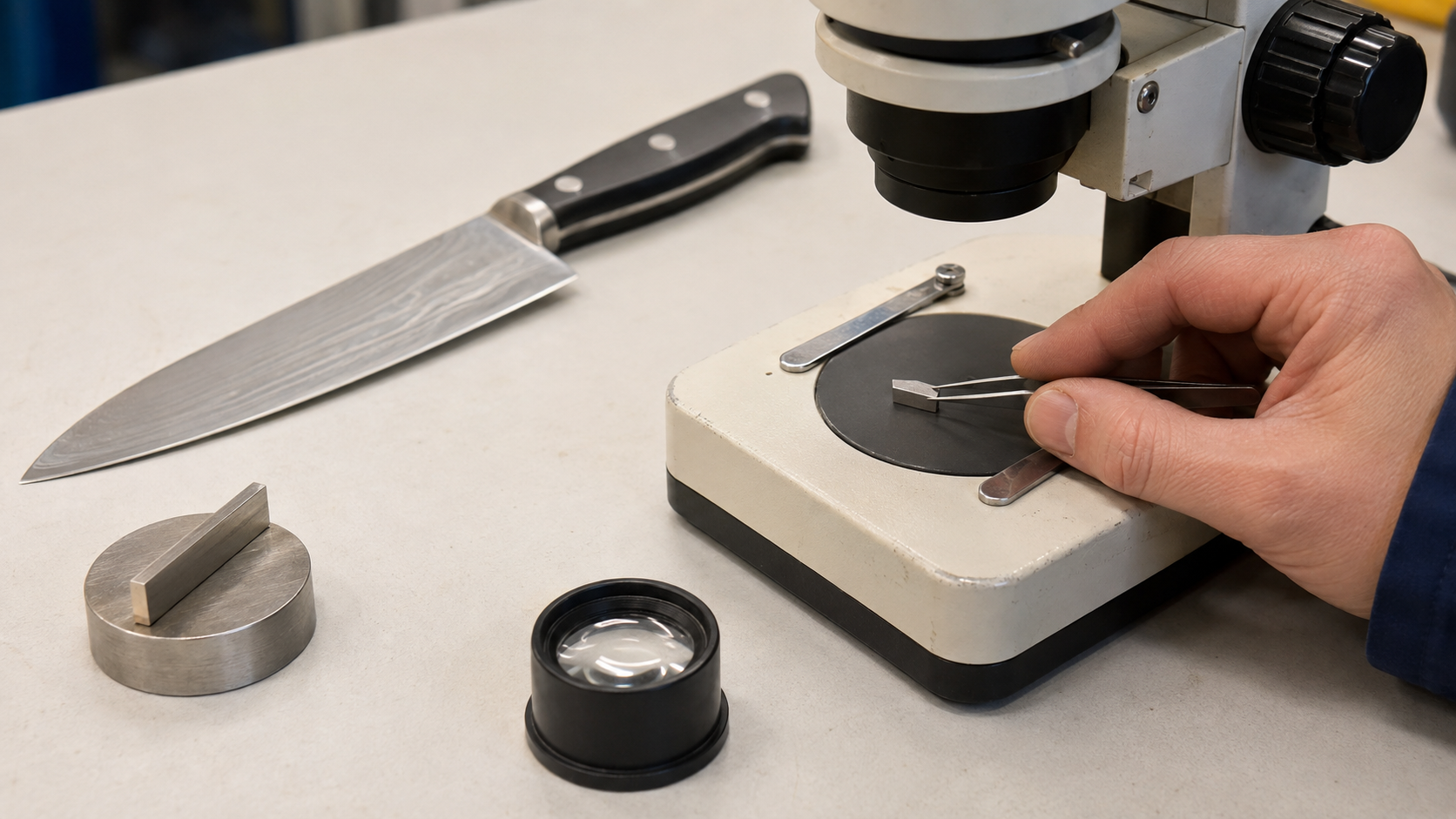
When the construction must be verified directly, a properly prepared cross-section is much more informative than surface photography.
A sectioned sample can reveal:
- the geometry of a central core;
- the position of outer layers;
- local layer thickness;
- material interfaces;
- some pores or discontinuities;
- whether visible structures extend into the sampled section.
ASTM E3 addresses metallographic specimen preparation and emphasizes the importance of appropriate sample selection and preparation.
ASTM E340 covers macroetching of metals and alloys and notes that macroetching can reveal characteristics such as segregation, banding, weld structures, porosity, and other discontinuities.
Even cross-sectional evidence has limits, however.
A section taken from one location proves what exists at that location. It does not automatically establish identical construction across:
- the full blade length;
- the opposite side of the blade;
- another knife;
- or an entire production lot.
Sampling design therefore matters.
Microscopy and Elemental Analysis Answer Different Questions

When visual evidence is insufficient, laboratories can combine several analytical methods.
Optical Metallography
Prepared and etched samples can be examined to identify:
- layer architecture;
- grain or phase differences;
- carbides;
- interface features;
- pores;
- local structural variations.
Optical microscopy is valuable for architecture, but appearance alone may not provide complete alloy identification.
SEM and EDS
Scanning electron microscopy can examine much smaller regions and interfaces at higher magnification.
Energy-dispersive X-ray spectroscopy, or EDS, can provide local elemental information and help determine whether adjacent regions differ chemically.
ASTM E1508 provides guidance for quantitative EDS analysis, but the method has limitations related to analysis volume, element concentration, light elements, surface preparation, and measurement conditions.
A single EDS point should therefore not be treated as a complete steel-grade certification.
Composition Testing
Methods such as optical emission spectroscopy can provide more complete bulk chemical information under appropriate conditions.
For laminated blades, however, test location becomes critical.
A measurement performed only on an outer layer may characterize the cladding rather than the cutting core.
The report must therefore specify what region was tested.
Microhardness Mapping
Vickers or Knoop microhardness measurements can be useful when individual layers are too small for conventional macro-hardness testing.
ASTM E384 recognizes microindentation hardness as suitable for small regions and hardness gradients.
It also cautions, in effect, against assuming that one local result represents an entire component.
For layered blades, hardness mapping may help compare a core, outer layer, and interface region.
It still does not directly measure sharpness, toughness, cutting life, or overall knife quality.
Why Layer Count Should Not Be Used as a Performance Ranking
Layer-count claims are among the most visible Damascus marketing numbers.
Examples in the commercial market include descriptions such as:
- 67 layers;
- 69 layers;
- 101 layers;
- 133 layers;
- and substantially higher numbers.
The problem is not necessarily that such numbers are incorrect. The problem is that counting conventions may differ.
A manufacturer may describe:
- a certain number of cladding layers on both sides combined;
- layers on each side;
- cladding layers plus one core;
- or the entire billet architecture.
For example, one product may describe 68 cladding layers around a cutting core, while another describes a 133-layer blade by adding 132 outer layers and one core.
Without knowing the counting rule, two layer-count numbers are not necessarily directly comparable.
More importantly, even an accurately verified layer count does not establish:
- sharper cutting;
- higher core hardness;
- stronger interfaces;
- greater toughness;
- better edge retention;
- better corrosion resistance;
- longer service life.
Scientific studies of pattern-welded steels can examine the effects of layer count under controlled conditions, but those findings apply to the specific alloys, processing route, heat treatment, specimen geometry, and test method used in the experiment.
They should not be converted into a general rule that “more layers are better.”
A More Reliable Buyer Verification Chain

Instead of judging a knife primarily by appearance, buyers can structure verification around a sequence of questions.
1. Define the Construction
Ask the supplier to state clearly:
- whether the blade has a separate core;
- the core material;
- the outer-layer materials;
- whether the outer material is multi-layer;
- whether the pattern exists through the material or only at the surface;
- the layer-count method;
- how visible contrast is produced.
2. Review the Material Documentation
Relevant documents may include:
- approved product specifications;
- construction drawings;
- material supplier documents;
- heat or lot information;
- inspection records;
- supplier declarations.
A document is only useful for product verification when it can be linked to the relevant material, order, production batch, or sample.
A generic material certificate alone does not prove that every finished knife in a shipment was made from that material.
3. Use Inspection Appropriate to the Claim
Different claims require different evidence.
If the question concerns external appearance, visual inspection may be sufficient.
If the question concerns core geometry, a choil examination or cross-section may be useful.
If the question concerns alloy composition, appropriate chemical analysis is required.
If the question concerns local hardness, hardness measurements must be taken at defined positions.
If the question concerns interface quality, metallographic or other suitable examination may be necessary.
The inspection method should follow the claim—not the other way around.
The Practical Rule: Describe the Evidence, Not the Pattern
For professional kitchen-knife sourcing, the most defensible approach is to avoid treating Damascus as a complete technical specification.
A visible pattern can be commercially important and aesthetically distinctive, but appearance alone cannot establish the underlying steel architecture or finished performance.
Buyers should separate four questions:
- What is the blade construction?
- What creates the visible pattern?
- What materials are actually present?
- What evidence supports each claim?
A layer count can describe construction when the counting method is defined. A core-steel designation can identify a material when documentation and traceability are adequate. A cross-section can show local architecture. Microscopy and chemical analysis can provide stronger sample-level evidence.
None of those items, individually, should be converted into an unsupported claim about sharpness, strength, durability, corrosion resistance, or overall knife quality.
For B2B buyers, that is the key distinction:
Damascus should be evaluated as a combination of terminology, construction, surface treatment, documentation, and test evidence—not as a visual performance grade.
References
- Verhoeven, J. D., Pendray, A. H., & Dauksch, W. E. The Key Role of Impurities in Ancient Damascus Steel Blades. JOM, 1998.
- Verhoeven, J. D. Damascus Steel Revisited. JOM, 2018.
- Maryon, H. Pattern-Welding and Damascening of Sword-Blades. Studies in Conservation, 1960.
- ASTM International. ASTM E3-26, Standard Guide for Preparation of Metallographic Specimens.
- ASTM International. ASTM E340-23, Standard Practice for Macroetching Metals and Alloys.
- ASTM International. ASTM E407-23, Standard Practice for Microetching Metals and Alloys.
- ASTM International. ASTM E1508-12a(2019), Standard Guide for Quantitative Analysis by Energy-Dispersive Spectroscopy.
- ASTM International. ASTM E384-22, Standard Test Method for Microindentation Hardness of Materials.
- ISO. ISO 10474:2013, Steel and Steel Products — Inspection Documents.
References
- ASTM International. ASTM E3-26 — Preparation of metallographic specimens.
- ASTM International. ASTM E407-23 — Microetching metals and alloys.
Scope note: These sources support the general principles discussed here; they do not prove the material, performance, compliance, or production history of any specific Tastiva product. Links last checked August 24, 2026.
Continue exploring practical knife specifications and buyer guidance.View all News →